Showing posts with label power outage. Show all posts

Thursday, May 1, 2014

DIY Solar Backup In Action During Storm / Tornado

This American guy I have been following on Youtube for years about his DIY Solar Battery Storage is using it these last days because of the general power outage caused by a tornado in Northern Alabama.

This is real and happening now like he says !

"Video showing how I power up the house during a severe storm that knocked out power in northern Alabama due to Tornado's etc"


Part 2: Now he can follow the news forecast on TV


Monday, December 9, 2013

SolarCity Introduces DemandLogic - Energy Storage for Businesses

SolarCity Introduces Energy Storage for Businesses


SolarCity DemandLogic™ integrates intelligent management software and Tesla battery technology to reduce businesses’ peak demand, provide backup power during outages and potentially save thousands on energy costs

SAN MATEO, Calif., Dec. 4, 2013—SolarCity® (Nasdaq: SCTY) has unveiled a smart energy storage system to address two major pain points for business: rising utility demand charges and increasing grid outages. SolarCity DemandLogic™ can allow businesses to reduce energy costs by using stored electricity to reduce peak demand, and can also provide backup power during grid outages. Developed with advanced battery technology from Tesla, SolarCity DemandLogic storage includes learning software that automates the discharge of stored energy to optimize utility charge savings for customers.

“Utilities have altered their rate structures such that demand charges are rising faster than overall energy rates, and businesses are bearing the bulk of those increases,” said Peter Rive, SolarCity’s chief technology officer and chief operations officer. “Time is money, but so are control and predictability. Our storage systems can give businesses the tools to address all three—delivering immediate savings, protection against escalating demand charges and optional, grid-independent backup power in case of outages.”


SolarCity storage systems are available to new solar power customers through 10-year service agreements including monthly payments, with no upfront cost required. SolarCity will customize the system size to make it possible for businesses to save money immediately by saving more on energy costs than they spend for the storage service. Unlike load shifting approaches to demand management, this product requires no change in operations for the business and is fully automated. SolarCity DemandLogic can also power IT functions, security systems, cash registers and other critical business systems during power outages. SolarCity analyzes each organization’s energy usage to design a storage system that can offset peak load and support high priority backup functions.

“We are thrilled to leverage Tesla’s technology leadership in energy storage systems, charging and power electronics to enable this exciting SolarCity launch,” said Tesla CTO and co-founder JB Straubel. “The economics and scale that Tesla has achieved in the automotive market now make stationary energy storage more cost effective and reliable than it has ever been in the past. We expect this market to grow very rapidly now that we have crossed this economic threshold.”


Video Link for more details

The utility grid is aging and outages are increasing. The U.S. experienced 679 major weather-related power outages between 2003 – 2012, including 7 of the 10 costliest storms in American history. At the same time, while overall electricity usage in the U.S. has increased only modestly since 2001—approximately 10 percent according to the U.S. Energy Information Administration—utility revenues have increased more than 50 percent in the same time period.*

Utilities have increased revenues faster than electricity usage in part by creating “demand charges” for businesses that have increased their share of the utilities’ cost burden. Some utilities are basing rates less on the overall amount of electricity consumed, and more on “peak demand”, i.e. the maximum amount of electricity used at a specific point in time. Solar power can significantly offset the overall amount of electricity used by organizations, but if an organization’s “peak” electricity demand is still high during the day—in the late afternoon, for example—the organization can be hit with high demand charges. SolarCity’s commercial storage system regulates the amount of electricity that organizations need from the grid during “peak” periods, reducing exposure to exorbitant demand charges.

SolarCity storage systems will initially be available in areas of California serviced by Pacific Gas & Electric and Southern California Edison, areas of Massachusetts serviced by NSTAR, and areas of Connecticut served by Connecticut Light & Power. For questions or additional information about the program, business owners should contact SolarCity directly at 888-SOL-CITY or 888-765-2489, visit www.solarcity.com/demandlogic or email demandlogic@solarcity.com to schedule a free consultation.


Make sure you check out this page dedicated to DemandLogic on SolarCity's website

Media Contact:
Molly Canales
SolarCity
650-963-5674
press@solarcity.com


Source: SolarCity

Monday, November 4, 2013

Solar City - Tesla Battery Backup Update

After my posts last year, here is little update on the SolarCity / Tesla Solar ESS, which is really only a Backup System usable in case of blackout, still in test in California

Capacity : 10kWh
Price: 15,800 USD

Composed of a 10kWh pack of Tesla - Panasonic - cells and a Schneider Electric - Xantrex - Charger / Inverter


Monday, August 12, 2013

Energy Storage: Rural Electrification’s Backup


"Energy storage represents a key element to ensure the proper functioning of any system and will contribute to the positive development of the entire industry."


The Alliance for Rural Electrification (ARE)’s objective is to stimulate economic development through the promotion of off-grid renewable energy technologies for rural electrification in developing countries and emerging markets. While often grid extension is not a feasible option, decentralized solutions are often the better alternative to alleviate energy poverty: they are cost-effective over the system’s lifetime, easy-to-deploy, install and maintain and their design can be tailored to demand needs. Plus, these regions offer abundant renewable energy resources.


Despite the solid arguments to support off-grid renewables as the best solution for remote areas, there is still one open question: What happens with the electricity service when the sun stops shining or the wind doesn't blow? No doubt this is a relevant issue which may prevent local energy decision makers from including renewable energy sources in their rural electrification plans. Fortunately, present markets offer technologies that enable storing energy for its use at a later time. Many of these solutions have reached maturity and therefore are being increasingly used to improve efficiency, reliability and price-competitiveness of electricity services as well as to achieve deeper penetration of renewable energy systems.

Energy storage technologies can be applied twofold: First for off-grid systems installed in rural areas, and second for decentralized grid backup in peri-urban areas that remain under-electrified.

To ease the path to these solutions, ARE has launched the six-month “Energy Storage Campaign.” This initiative aims to inform decision makers in Africa, Asia and Latin America about the added value that energy storage offers to rural areas.

It’s All Happening

The success of the campaign has been built upon the expertise of a group of rural electrification experts. These nine members of the Alliance based in three different continents and with a wide experience on the topic have formed the ARE Energy Storage Task Force with the objective of shaping this initiative and to find answers to ‘What really matters!’

As a result, the ARE Secretariat jointly with the Energy Storage Task Force has developed the position paper Using batteries to ensure clean, reliable and affordable universal electricity access. This guide paper includes information and recommendations for decision makers, applications of the different types of battery technologies, as well as successful case studies from India, Bangladesh, Jordan, Peru and Mozambique. The position paper has a focus on electromechanical energy storage, in particular on four different families of batteries, as they remain the main technology applied to off-grid.


Energy storage represents a key element to ensure the proper functioning of any system and will contribute to the positive development of the entire industry:
Batteries will improve the system’s performance and lead to economic savings over its lifetime and thereby lower operational costs if properly designed and maintained. In this regard, it is of utmost importance to use certified equipment and observe international standards while designing, installing and operating the system in order to ensure its longevity.
The stand-by battery market is expanding rapidly in developing and emerging markets, which represent important growth niches for the sector. The increasing demand of batteries can facilitate deeper penetration of intermittent renewables in these regions. For example, whereas Africa represented the smallest market for European stand-by battery systems (2V cells and mono blocks) in 2011 with 3.5 percent of total sales, it was the region in the world which enjoyed by far the highest growth rates with an increase of 25 percent compared to the year before.
Batteries play two major roles in terms of energy management. Short-term: The battery regulates the system by absorbing or supplying power to maintain a balance between instantaneous power production and consumption. Long-term: Allows storing electricity at a period of peak production, thus avoiding wastage of energy at times when it is not required and supplying energy when intermittent primary energy resources are unavailable.
The remote areas where off-grid renewable energies operate are vast and diverse. Thanks to the existence of different chemical battery families, each of them with its own specific features, storage systems can be designed to play a wide range of roles perfectly fitting local conditions.


Not without the Public Sector

Energy storage applied to rural electrification is attracting a lot of attention these days. However, these are still young markets which need more explanation and promotion. The support from public authorities, particularly regulators, as well as power sector technical bodies -such as rural electrification agencies and public utilities-would certainly help stimulate more investments in the market. To enhance developments, ARE has formulated the following recommendations for decision makers:
Developing and enforcing a well fitted regulatory framework is critical to ensure the market’s sustainable development and consumer’s trust.
A well tailored framework should be complemented via awareness creation campaigns and technical assistance to the operations sector (manufacturers, installers, operators, recyclers).
Establishing policy targets for batteries, as it is done for renewable energies, could help stimulate the sector’s development.
The achievement of these targets should be stimulated with the establishment of specific support schemes and assistance to the financing sector.

Learning from the Past to Improve the Future

The kick-off of the “Energy Storage Campaign” was held at Intersolar Europe in June 2013, where ARE celebrated a successful workshop as official side event of the conference. Further promotion activities will include several webinars in collaboration with international organisations such as the United Nations Foundation Energy Access Practitioner Network, the creation of new papers on other storage technologies, as well as other workshops in international events, among others.

Thanks to the experience gained with the “Small Wind Campaign”, the expertise of the Energy Storage Task Force and the support of the industry, ARE expects to facilitate business dialogue between private and public sector on the advantages of energy storage.

This is not the first time ARE has launched such a campaign. Last year the focus was small wind power, and now it is the turn of energy storage, a technology that undoubtedly will make a difference in the long way towards achieving universal access to reliable and sustainable electricity in remote areas.


Source: Renewable Energy World


Wednesday, May 30, 2012

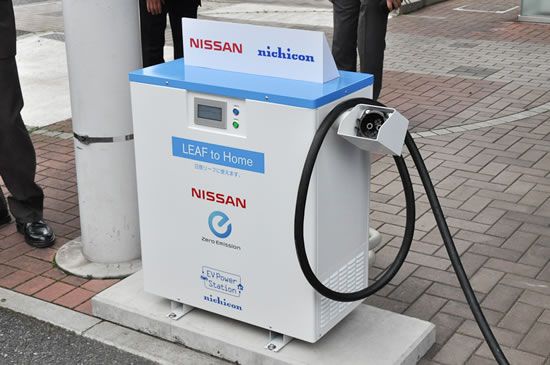
Nissan Launched "LEAF to Home" V2H EV Power Supply System


- Nissan to launch LEAF to Home power system at its dealerships in Japan in mid-June

- Nissan and Nichicon collaborate to achieve the world's first power supply system that provides electricity from the Nissan LEAF's high-capacity batteries to houses

Nissan announced "LEAF to Home" power supply system, which can supply electricity from batteries onboard in Nissan LEAF electric vehicles (EV) to homes when used with the "EV Power Station" unit developed by Nichicon Corporation. "LEAF to Home" is an industry first backup power supply system that can transmit the electricity stored in the large-capacity batteries of Nissan LEAFs to a residential home. Nissan will showcase this system at its Japanese dealership showrooms beginning in June to help promote efficient electricity management and demonstrate the features built into electric vehicles.


This equipement is using the CHAdeMO protocol / standard


Nissan Motor Co., Ltd. will launch the "LEAF to Home" power supply system at its dealerships in Japan in mid-June 2012. The V2H system (Vehicle to Home) can supply electricity from batteries onboard in Nissan LEAF electric vehicles (EV) to homes when used with the "EV Power Station" unit developed by Nichicon Corporation.


"LEAF to Home" is an industry-first backup power supply system that can transmit the electricity stored in the large-capacity batteries of Nissan LEAFs to a residential home. Nissan will showcase this system at its Japanese dealership showrooms beginning in June to help promote efficient electricity management and demonstrate the features built into electric vehicles.

Nichicon, an innovator in power supply systems, will provide the technology to move the electricity from vehicle to home through its "EV Power Station" units. This power transfer system enables electricity stored in high-capacity lithium-ion batteries onboard a Nissan LEAF to be sent to an ordinary home by connecting the car to the home's electricity distribution panel with a connector linked to the LEAF's quick charging port.

The EV Power Station system is similar in size to an external air-conditioning unit, can be installed outdoors, and conforms to the CHAdeMO protocol for EV quick chargers. CHAdeMO is an abbreviation of "Charge de Move" ("charge for moving") and is the trade name for a quick-charging method used to charge the batteries of electric vehicles. The Nichicon system's connector complies with the JEVS G 105 standard defined by the Japan Automotive Research Institute (JARI). This system can run on various operating modes and has a timer function which can be controlled with a liquid crystal display (LCD) touch panel. Electricity is stored or supplied automatically in accordance with a household's electricity capacity and consumption.

The EV Power Station can fully charge a LEAF in as little as four hours, which is approximately half the time required when a normal charger is used. All current Nissan LEAF owners in Japan will be able to use the system, depending on their home's installation requirements. With Japanese government subsidies taken into account, the EV Power Station is estimated to cost 330,000 yen ($4200), which amount includes 10% consumption tax and installation charge.


Detailed specifications of the system:


Official video:


This system helps to balance the electrical supply system, and can even lower a consumer's electricity bill. The LEAF to Home system will help encourage Nissan LEAF owners to charge their cars with electricity generated during the night, when demand is low, or sourced from solar panels. This assist in balancing energy needs by supplying electricity to the grid during daytime, when demand is highest. It can also be used as back-up power source in case of power outages and/or shortages.

The lithium-ion batteries can store up to 24kWh of electricity, which is sufficient to supply an average Japanese household for about two days. This system underscores an additional attribute of EVs: vehicles which can be used as a storage battery whether they are moving or stationary.

Source: http://www.nissan-global.com/EN/NEWS/2012/_STORY/120530-01-e.html?rss

The LEAF 24kWh battery pack could, through the LEAF to Home PCS / EV Power Station, supply all the necessary power used by a  regular house, that is 6 kW.
This supply could come on to fill the power gap between the house solar system and the power usage, or in the evening and at tnight when the sun doesn't shine anymore 


Using the Peak Offset Function, an average home in Japan could save money and releave the grid during power consumption peak at noon, by using the LEAF as a power supply during this period, charging at night at low power demand and low cost :

More info here: http://car.watch.impress.co.jp/docs/news/20120530_536403.html

Nissan did a first demo of this system back in August 2011:
http://www.nissan-global.com/EN/NEWS/2011/_STORY/110802-01-e.html

Here is a video of this event:


[System Overview]

Power Control System (PCS)
- Rating: 6kW
- Control system: Sinusoidal PWM System
- System power: 200V single-phase three-wire system
Operation display panel
- Display for switching electricity charge between supply
- Battery power, output voltage and output current display
Nissan LEAF connection specification
- Quick charge connector (CHAdeMo specification)
Nissan LEAF
- Corresponds to the electricity supply program


Tuesday, May 29, 2012

Nissan Leaf at the Isle of Islay Whisky Distillery

A nice video from the Isle of Islay in Scotland where a distellery manager purchased a LEAF and Nissan's V2G equipment to run his factory in case of power outage (I guess it is the same location as inFully Charged last video)


Nissan V2G equipement used here


Please Share this Post if you Liked it !

Please Share this Post if you Liked it ! Thanks !
Related Posts Plugin for WordPress, Blogger...