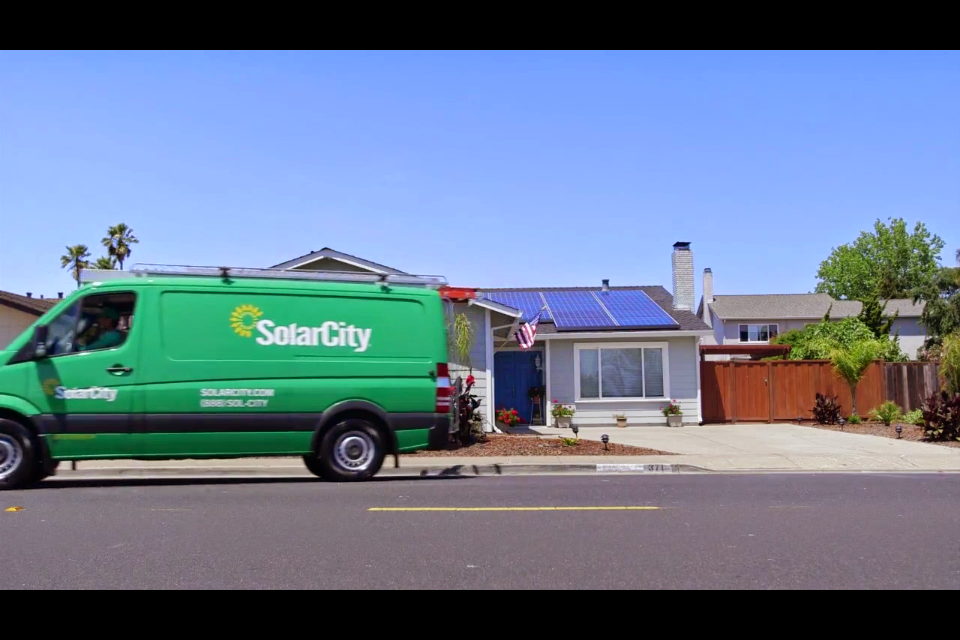
Showing posts with label solar city. Show all posts

Saturday, March 29, 2014

SolarCity Freezes Energy Storage Program as Utilities Resist Grid Connections

SolarCity Freezes Energy Storage Program as Utilities Resist Grid Connections
SAN FRANCISCO -- SolarCity Corp., the biggest developer of U.S. rooftop solar panels, halted efforts to install and connect systems that include batteries for power storage because California's utilities are reluctant to link them to the electric grid.

About 500 SolarCity customers in the region have agreed to use the systems, and the state's three biggest utilities have connected 12 of them since 2011, said Will Craven, a spokesman for San Mateo, California-based SolarCity.


SolarCity is testing the units with photovoltaic panels to generate power and batteries that retain that energy for use when the sun isn't shining. The combination makes customers less dependent on local utilities. It may be a threat to the business model that's underpinned the power industry for a century.
"We've stopped submitting applications because we've lost faith that these things are actually going to be carried out in any reasonable time," Craven said in a phone interview.
The utilities require a series of applications and fees that Craven said makes the process too onerous. SolarCity has installed a total of 65 of the systems in areas overseen by PG&E Corp., Edison International's Southern California Edison and Sempra Energy's San Diego Gas & Electric.
"The ones we have submitted haven't gone anywhere," he said.
Homeowners with rooftop panels buy less electricity from the grid, and those who use batteries to store power may need to purchase even less.


Utilities Reply
The utilities say they support the use of solar power and new technologies such as batteries that promote energy efficiency. They also note that storage is a relatively new capability and that it will take some time to properly assess how to add it to the grid at fair pricing.
David Eisenhauer, a PG&E spokesman, said it takes about eight to 10 weeks to handle applications and the utility has processed eight of the 20 it has received.
"Because battery installation is such a new technology," he said today in a phone interview. "We're still working to find more efficiencies in processing the applications."
San Diego Gas & Electric said there is "an ambiguity in the existing tariff language" regarding storage and it's working with regulators to determine the appropriate fees, Hanan Eisenman, a spokesman, said in an e-mail today.

Thursday, June 13, 2013

We Are SolarCity

A cool video showing how a SolarCity team installs 2 solar roofs in one day


A camera crew followed one of SolarCity's installation crews as they installed two complete PV Solar systems in ONE day. Great job to Chris and her team - simply amazing!


Monday, June 3, 2013

Lessons Learned From SolarCity’s First Home Energy Storage Installs

SolarCity has reservations for at least 65 energy storage systems in California, according to the latest SGIP summary. (SGIP is California's Self Generation Incentive Program, which provides a subsidy for fuel cells, biogas digesters, energy storage, etc.) In 2009, SGIP started offering credits of $2 per watt for energy storage systems that can store power from an eligible on-site generation system and discharge it at rated capacity for a four-hour period.

SolarCity promotes its system as a way for homeowners to have backup power in case of utility outages. According to the company, there are more than 100 pilot projects under contract. Most of the SolarCity projects in the SGIP spreadsheet are 5 kilowatts in size, using batteries from cousin company Tesla Motors.

Eric Carlson, Lead Architect of Energy Systems at SolarCity, spoke at last week's Energy Storage Association and shared some of the firm's experience in its first 100 energy storage installs.

Carlson said, "We think storage will be absolutely necessary to enable the deployment of solar across the grid at extremely high penetrations," adding, "When you combine solar and storage, you have a dispatchable asset at the load."

SolarCity has built two community deployments using a 9-kilowatt, 18-kilowatt-hour lithium-ion battery, but Carlson notes, "There is no magic formula for proportions -- it depends on usage at the site." Earlier installations used lead acid batteries.


SolarCity's Energy Systems Architect noted some lessons from the field:- The storage system typically gets installed inside a garage. It turns out that people are not happy in turning over precious garage space to a battery and a protective bollard. Carlson said, "Customers hated the space being used in their garage." The new Tesla-labeled 10 kilowatt-hour lithium-ion battery bolts on the wall and mitigates some of the space issues.
- A new acronym, NIMG, stands for "Not in my garage."
- "Interconnection costs and requirements need to reflect the true cost of of the interconnect. Requirements need to be consistent, codified and predictable across multiple regions." The process needs to be streamlined and over-the-counter.
- "We need harmonized tariffs for combining PV and storage."
- "We need outdoor-hardened devices that are low- or no-maintenance."
- Installing solar jointly with energy storage, either where storage was retrofitted or installed with solar, reduces costs and brings the net cost of storage down.


As Jeff St. John reported, "Battery backup could really help solve some of the larger-scale problems associated with connecting lots of intermittent solar power to the grid. Energy storage could help mitigate the distribution grid voltage sags and surges that can occur when clouds pass over neighborhoods with lots of rooftop solar, for example. It could also help shift stored solar power to cover peak loads that may occur slightly later in the afternoon than solar’s peak production times."

Calculations by Sam Jaffe, now of Navigant, found SolarCity offering the systems at a cost of $2,000 per kilowatt-hour, which would add up to $40,000 for a 5-kilowatt system. Adding the ITC benefits to the SGIP incentives cuts the cost of the system to $800 per kilowatt-hour, Jaffe estimated. With time-of-use benefits added to that, “The homeowner is paying about $6,000 for the benefit of having reserve power during short-term blackouts, which is roughly equivalent to what an advanced hard-wired generator would cost,” he said.

Tesla and SolarCity aren’t the first to try out batteries to backup solar power. Japan’s Panasonic and Hitachi are installing home-based, solar-backed energy storage in pilot projects. In the United States, battery startup Xtreme Power is eyeing smaller-scale solar-backed applications to match their big, substation-sized grid batteries, and utility AEP is working with S&C Electric Co. on “community energy storage” systems that back up grids at the neighborhood level. General Electric just inked a partnership to integrate its nickel-salt Durathon batteries with Arista Power’s power-balancing system to back up solar and wind power.

One interesting note on the Tesla-SolarCity effort is that the two are offering the systems for lease in California, according to SolarCity’s website. That could open the door to SolarCity managing the batteries en masse, to maximize the value of the energy they’re storing.

There is always a policy piece with energy storage. SolarCity's Carlson emphasized, "We need to harvest multiple income streams with energy storage. We need policy to align customer benefits with grid operation and wholesale market value."


SolarCity's SGIP reservations

SolarCity PV Storage Reservations


Source : GreenTech Media

Monday, May 13, 2013

SolarCity Sees Energy Storage ‘Viable’ Within 10 Years, CEO Says

SolarCity Corp. (SCTY), the solar power provider led by billionaire Elon Musk, will complete about 100 energy storage systems for customers this year and plans to expand as costs decline, according to its chief executive officer.


“It’ll be a viable product in the next ten years,” SolarCity CEO Lyndon Rive said today in an interview in San Francisco. “We don’t know yet how big the next phase is going to be, but this is a long term investment, full stop,” he said. “We will solve the storage issue.”

The San Mateo, California-based company is installing 8 kilowatt-hour battery packs provided by Tesla Motors Inc. (TSLA) and combining them with energy management systems that allow for remote monitoring. Storage will be crucial to balance the U.S. electric grid as solar expands from 1 percent of total generation capacity today, according to Rive.

“The criticism that solar gets is that it’s intermittent, that you can’t depend on it, but at 1 percent it still doesn’t matter,” Rive said. “Once you get to 20 percent, it starts to matter,” he said.

Rooftop solar systems that SolarCity provides don’t have the same risk of dropping off in large amounts from the grid, though that is an issue with larger utility-scale systems, according to Rive.

“The fear of intermittency actually comes from large central solar,” he said. “We can forecast very accurately what power you’re going to produce based on the weather conditions that we see,” he said.

SolarCity has 395 energy storage “pilots” under contract, according to a filing March 27.

Musk is Tesla’s CEO as well as SolarCity’s chairman and it’s largest shareholder. Rive is his cousin.


Source: Bloomberg

Please Share this Post if you Liked it !

Please Share this Post if you Liked it ! Thanks !
Related Posts Plugin for WordPress, Blogger...