Showing posts with label smart grid. Show all posts

Tuesday, August 6, 2013

Ten Bucks a Litre - Dick Smith Documentary cherry picks the facts

A recently aired Australian documentary by local eccentric millionaire Dick Smith about alternatives to fossil fuels has stirred quite a hornets nest of feedback, both positive and negative.


While on the whole the Doco was fairly interesting and we here at EV News noted Dick's enthusiasm for electric cars, some facts seem to have been seriously cherry picked.

The EV segment starts @47 mins with Dick enthusing about an EV powered only by renewables and which has Vehicle to Grid Technology (V2G) that can held smooth the intermittency of renewable energy.


The cherry picking starts @50 mins when to close the segment Dick holds up a flask containing 1 litre of fuel stating that it weighs 700 grams and will take an average car approx 10 km. The bad news for EV's, we are told, is that the equivalent battery would weigh 25x as much! End of argument apparently and the story moves onto bio-fuels.

What Dick failed to mention was that the equivalent of that 1 litre of fuel (10 kWh) stored in an EV battery can propel an electric car 10x as far (100 km)... surely a worthy trade-off in energy efficiency Dick?

Of course, battery power may not be a solution for his Helicopter any time soon but Dick was so impressed with EVs he is now the proud owner of a solar powered Nissan Leaf.


Source: Electric Vehicle News

Friday, October 19, 2012

【日産】 LEAF to HOME インタビュー The SIMPLE and LOCAL ESS


日産リーフのバッテリーから一般家庭2日分の電力を供給
・PCSによる双方向のエネルギーマネジメントを実現
・太陽光発電の有効活用、停電時のバックアップとして利用可能

"Nissan LEAF's battery can provide two days' worth of electricity to a typical household*
*Japanese typical household case"


During the day, the LEAF to Home system can charge the car from free solar electricity:
If enough power is generated, the solar arrays can supply the houses needs, charge the LEAF, and why not push power back  into the neighborhood grid
It can also supply power back to the house if necessary, during luch break peak for example


Smart grid investments are loosing momentum because they could be huge

They require massive changes to the existing grid network


Keep it Simple !

"LEAF to Home" is a SIMPLE & LOCAL solution that can take care of two mains problems : 
- Store solar & wind energy 
- Level the consumption peaks using off-peak (late night) or green energy


The CHAdeMO plug is the standard for Nissan / Nichicon PCS, carrying 400V DC directly from and to the battery pack  

Charging from solar power through the LEAF to Home PCS and storing free and clean energy for later use

If necessary, after powering the house during the evening, the LEAF battery can be refilled during the lowest rate electricty period at night, also through the PCS (leveling energy production here too) - Excess supply in green circle

500 LEAF and PCS have been lended to South Ouest Japanese Regions of Osaka, Kyoto, Kitakyushu & Fukuoka and Nissan is monitoring the systems but also people's behaviour changes

Source: NissanNewsRoom

My notes:
This is exactly what I am working on with my LiFePO4 BESPSS (Battery Energy Storage & Power Supply System), storing excess solar energy during the day and using it during the evening

Tuesday, October 2, 2012

IBM and ESB make important progress on EV smart charging

For years (literally) I have been griping and whining that vendors and utilities are spending too much time on electric vehicle hardware and not enough on smart charging. Smart charging, after all, is what can unlock the benefits of EVs for consumers and utilities alike. Smart charging is essential if we want to use EVs to take advantage of late night wind energy, for example. And if we want to avoid excessive peaks and other potential EV problems.

My power engineering friends tell me that I'm some combination of impatient and naive. That the industry first had to settle on the easy stuff like plugs and basic standards. THEN they could get to work on smart charging.


Here's one example of progress: IBM is working with ESB ecars to set up a smart charging infrastructure in Ireland that will manage about 1,000 public charging points. Much of the effort is around payment options and infrastructure monitoring, but some of it touches on the utility-side software needed to properly manage EVs when they start to show up in volume. If successful, it could become a template for future, larger EV infrastructures.

According to the announcement (which you can read on page 2), the IBM EV platform will connect ESB Networks with the energy retailers and the charge-points, allowing all three to communicate energy usage and financial data directly, providing the analytics and intelligence needed to better forecast and balance the load on the power grid.


"Infrastructure readiness and consumer acceptance are and will continue to be imperatives to the success of electric vehicles, however the industry must now focus on the management aspect. It will be how we support EV market growth from an interoperable and scalable level," noted Allan Schurr, Vice President, Strategy and Development of IBM's Global Energy and Utilities Industry.

"For utilities, this project tackles both front and back office operations by addressing business services such as billing, yet at the same time, also provides continued access to real-time data needed to monitor and forecast the impact on the grid," Schurr added.
electric vehicles, electric vehicle charging, EV charging, IBM EV charging
Jesse Berst


Press Release:


IBM teams with ESB to develop 
an Electric Vehicle

Smart Charging IT System in Ireland

Adds Flexibility to Smart Grid Operations during Mass-Scale EV Charging across Ireland


ARMONK, N.Y. and DUBLIN, Oct. 1, 2012 /PRNewswire/ -- IBM (NYSE: IBM) today announced that it has teamed with ESB to implement a fully integrated smarter charging IT system that will help manage electric vehicle public charge-points, which are being rolled out across Ireland by ESB Networks.

Together the companies will add a layer of intelligence and convenience to the recharging process, allowing EV drivers to access, charge and pay, using an identification card. Additionally, this project will provide utilities with access to energy usage data that can help improve smart grid operations, reduce power strain during peak charging times, and ensure reliable energy distribution to customers.

With approximately 1,000 public charging-points currently available, ESB Networks is on track to deliver one of the largest integrated and operational electric vehicle infrastructures in Europe. ESB Networks will use IBM's Intelligent Electric Vehicle Enablement Platform to provide the services needed to operate and manage the charge-points installed throughout Ireland.

This project is bolstered by Ireland's energy policy to increase sustainable energy use in the transportation sector by 2020. Today, the goal is to produce 40 percent of the country's current electricity consumption from renewable energy and have electric vehicles represent every tenth car on Irish roads. Already on the renewable fast track, this integrated EV charging network will allow Ireland to also contribute to the European Union legislation to reduce greenhouse gas pollution levels by approximately nine million tones before 2020.

Minister for Jobs, Enterprise and Innovation, Richard Bruton TD said: "Green energy and cloud computing are key sectors being targeted by the Government as part of our Action Plan for Jobs. This innovative partnership between an Irish energy company and a global IT leader puts Ireland at the forefront of global developments in the electric vehicle sector by using cutting edge cloud technologies, and represents a clear demonstration of what is possible in this area. Ireland will now be the first country globally to put in place this system on a national basis, and I am determined to ensure that through continued implementation of our plan we will see further examples of leadership in these areas."

The platform will connect ESB Networks with the energy retailers and the charge-points, allowing all three to communicate energy usage and financial data directly. This will provide the analytics and intelligence needed to better forecast and balance the load on the power grid as well as help ESB Networks to monitor the health and status of the charge-points to ensure service reliability.

Additionally, the project will create a scalable payment transaction platform for utilities and consumers by combining financial, settlement, and management services. As the IBM Intelligent EV Enablement Platform is a cloud delivered service, it provides operators such as ESB Networks the flexibility and scalability to add charge-points, incorporate new functionality, and support more electric vehicles as the market grows.

ESB Networks will have the capabilities to securely maintain customer and charge point data such as energy consumption, charging location, and settlement data. This information can then be used to calculate and reconcile the energy market. With this level of financial insight, industry participants can manage regular and interruptible tariffs and calculate the appropriate billing costs.

ESB Chief Executive, Pat O'Doherty said, "ESB Networks is rolling out a smart recharging network nationwide and committed to offering a service that will benefit the consumer, electricity retailer as well as the electricity grid. This project has the potential to significantly improve efficiencies in EV charging, streamline management services and contribute to the overall reduction of CO2 emissions," he said.

The new system accommodates the needs of all EV owners. The IBM EV platform will enable EV drivers to select convenient payment options and access all charge-points using one ID card – a process that will aggregate usage costs and simplify billing. This smart charging capability allows consumers to charge anywhere at anytime, regardless of their electricity provider and without the need to carry multiple access cards. Additionally, drivers will also have the option to use a mobile device or browser to locate the nearest charge post, check its availability, and make a reservation if the post is available. '

"Infrastructure readiness and consumer acceptance are and will continue to be imperatives to the success of electric vehicles, however the industry must now focus on the management aspect. It will be how we support EV market growth from an interoperable and scalable level," said Allan Schurr, Vice President, Strategy and Development of IBM's Global Energy and Utilities Industry. "For utilities, this project tackles both front and back office operations by addressing business services such as billing, yet at the same time, also provides continued access to real-time data needed to monitor and forecast the impact on the grid."

This initiative along with the recently announced Smarter Charging demonstration with American Honda Motor Co,. Inc. and Pacific Gas and Electric Company (PG&E), as well as the EKZ Smartphone Application pilot, demonstrates IBM's ongoing focus to improve driver services, increase renewable generation, and intelligently manage electric vehicles.

About ESBESB Networks is responsible for the roll out of electric vehicle infrastructure in Ireland and the operation of supporting IT/communications systems. A comprehensive network of charge-points is being developed, with open systems and platforms, so they are accessible to all electricity supply companies, and all types of electric cars. The primary activities of ESB and its subsidiaries are the ownership and of the electricity distribution and transmission networks and operation of the distribution system in Ireland and Northern Ireland and the generation and supply of electricity in Ireland and internationally.

For more information visit www.esb.ie/ecars, www.facebook.com/ESBecars

IBM and Smart GridIBM is involved in more than 150 smart grid engagements around the world, in both mature and emerging markets. More about IBM's vision to bring a new level of intelligence to how the world works—how every person, business, organization, government, natural system, and man-made system interacts, can be found here: http://www.ibm.com/ smarterplanet

For more information about Smarter Energy at IBM, please visit: www.ibm.com/press/ smarterenergy. Follow us on Twitter and LinkedIn.


Source : Smart Grid News & IBM

Friday, September 21, 2012

How can electric cars be charged with electricity from wind power and give power back to the grid ?

Smart grids

How can electric cars be charged with electricity from wind power and give power back to the grid? It's all about "smart grids", i.e. smart grid that can handle large fluctuations in the grid that comes with renewable energy such as wind turbines. In the case of charging the electric vehicles, it is interesting to see how electricity is transmitted from the network to the vehicle, and there are different strategies and work is under way to define standards in the field. In Test Site Sweden we are working with the automotive and power industries to test and validate the charging interfaces.

Interactive Smart Grid Technology Demonstrators

The continued work with Smart Charging systems at ANL led to the development of interactive displays that demonstrated the benefits of smart charging and smart grid as well as the vehicle to grid interfaces present in such systems. Two generations of the interactive smart grid display was developed, the first one is shown below and was demonstrated at the Technology Transfer Meeting May 11th in Gothenburg and at the Electric Vehicle Symposium short after.

Generation 1 of the interactive Smart Grid Display (Argonne National Laboratory)

The second generation of the display was developed by ANL for the Bright Green Expo.


Generation 2 of the interactive Smart Grid Display (Argonne National Laboratory)


Demonstration of a Smart Charge application for mobile phones

The demonstration was developed by TSS and Consat Engineering AB to show how managing charging could be performed using a mobile phone. The demonstration is available as a flash – movie and shows how the driver can reserve a park and charge spot and also manage the charge process. A screen shot from the demonstration is shown.


Smart Grid Technology explained

As our attention turns to new cars that run partially or completely on electricity, how can we redesign our electric grid to not only handle the new load, but make electricity cheap and efficient for everyone? Argonne engineer Ted Bohn explains a model of a "smart grid" that gives consumers the power to choose their own prices and sources of electricity.


Charging Stations


In order to test and validate the charging of EVs we have developed the ChargeAlyzor which is a combination of a charging station and a oscilloscope. By this you can very accurately measure and monitor the voltage and current feed into the vehicle.


The ChargeAlyzor (Test Site Sweden)


Source: TestSiteSweden

Friday, September 7, 2012

Customer Led Network Revolution (CLNR) | Fully Charged

Robert Llewellyn from Fully Charged visits Durham University to find out about the Customer Led Network Revolution (CLNR)


Very very interesting video from Robert this week, I loved it !  :-)

In his "high tech" lab, this professor at Durham University is testing generation, loads, power transportation, etc to try and recreate real life electricity use at home, generation from solar panels, wind turbines, etc


Tuesday, September 4, 2012

Smarter Grid Linking Solar Panels May Bypass Utilities

....
"The overall trend is that more and more households are choosing energy self-sufficiency."
....
"In the next fifteen years, the importance of the current grid — smartened or not — will wane and a parallel “new intelligent network” may supplant it."


Smarter Grid Linking Solar Panels May Bypass Utilities


I doubt that electricity is fundamentally a wide-area networking service. At first glance, this statement appears absurd. Like telephony or the Internet, electricity enters our homes through outside wires. Is it not therefore a networking service?


The spread of distributed generation, however, calls into question the nature of the electricity business. Rooftop solar panels, with accelerating price drops, no-payment installation options for households, and guaranteed prices lower on average than those of the incumbent utilities by solar companies, brings increasing “grid independence.”

The emergence of micro-grids and community grids also indicate a movement away from centralized, remote generation. California shows how this movement might spread throughout the U.S.; the Public Utilities Commission’s Net Energy Metering ruling on May 24 effectively doubles rooftop solar generation in the state’s utilities system.

More generally, over 1.5 billion people in India, the African continent and elsewhere are literally grid “independent;” they never had grid electricity. Today, they are getting solar-based electric lighting from standalone systems for the first time. The quaint story of a Florida community resisting grid electricity in favor of a certain lifestyle (New York Times, May 27, 2012) may be a harbinger of things to come.

The overall trend is that more and more households are choosing energy self-sufficiency.

The Smarter Grid

If electricity is not a wide-area network service, then the recent push for a smart grid, focused on improving the legacy infrastructure, is misdirected. The greater opportunity — the smartergrid — may be an entirely different network. ­

In the next fifteen years, the importance of the current grid — smartened or not — will wane and a parallel “new intelligent network” may supplant it. This new intelligent network will manage thousands of distributed generation and consumption points, including rooftop solar installations and networked electric appliances. The network management would resemble that of today’s IT networks and would be easy to set up. We would simply treat solar panels, inverters, and appliances as analogous to computers and other electronic devices on the Ethernet.

While the current smart grid projects primarily address the operational concerns of electric utilities, tomorrow’s smarter grid will serve the end customers, and may not even be managed by electric utilities. Of course, wherever the current grid is in place, which is most of the world, we should make it better and implement the smart grid solutions. But we should realize that parallel intelligent networks would likely be born.

The smart grid discussion is naturally about technology, but it ought to also be about business issues — how firms can adapt to non-traditional competition, industry structure changes, and disruptive innovation. With growing solar rooftop deployments, the traditional electric utilities face threats to their growth, though not to their immediate survival. Smart grid discussion therefore belongs at the corporate strategy level and in boardrooms.

The Legacy Network

Why is today’s electricity delivered to customers through transmission and distribution wires over long distances? For two reasons: a) the economics of scale and b) because we extract electricity from concentrated power sources, including coal, gas, nuclear plants, and dams.

Coal-based power plants or dams are so large and concentrated that only utilities can deliver electricity to customers inexpensively and afford transmission expenses and losses. The externalities of coal burning — the hazards of greenhouse gases – were unknown until recently, and are un-priced today.

Just as Yahoo! and Amazon are portals to repositories of content, electric utilities help us tap into concentrated energy sources such as fossil fuels. Whereas content is getting more concentrated in cloud computing platforms on the Internet, the distributed and “edge” paradigm appears to be the trend in electricity.

With distributed generation, the economics of the electricity business change because of new network topology, economies of scale due to retail installations on rooftops, and the use of diffuse energy sources, particularly sunlight. “Broadcasting” electricity through complicated, loss-prone, wide-area networks becomes unnecessary. While the economics did not favor rooftop solar generation until recently, grid parity is at hand in the renewables industry.

Competition and Parallels with Telecom

Even with thousands of net-zero energy homes powered by rooftop solar, most customers would still use the existing grid as insurance and pay a fixed price for access to it — a maintenance fee of sorts, known in telecom as an “access charge.”

When competition arrived in the telecom industry, new carriers had to pay an access charge to existing telephone companies for the use of their infrastructure. Competitors eventually won the right to use existing infrastructure to offer their services. In time, cellular operators accelerated the breakdown of the traditional landline infrastructure into component elements; competitors only paid for the landline components they used.

A similar fragmentation of the electricity infrastructure appears inevitable — there will be a price to access the grid elements. Power producers today sell electricity to the grid operators through power purchase agreements (PPA). In the future, they may sell directly to end customers. Such non-traditional service providers, like micro-grid operators or community power plants, will compel the disintegration or “unbundling” of the existing utility, whose infrastructure will be sold as separate components.

Households and businesses with rooftop solar are going further – they are becoming their own increasingly self-sufficient micro-utilities.

Substitution is Seldom Sudden

When cellular telephony became mainstream landline connections were not entirely cut off. Though usage has dropped, we still keep the connections. Similarly, even with widespread photovoltaic deployment, we will maintain connections with the classic grid. We need centralized generation from concentrated sources for large factories and railroads, and wired delivery at the consumption points. Substitution will not be complete and the utility architecture will stay in place. The smart grid deployment plan of San Diego Gas & Electric — a fine document — describes it as follows: “SDG&E stores the electricity the customer generates beyond their current demand, and returns that electricity to the customer when they need it.”

Widespread solar for homes faces the additional challenge of inertia: why replace something that works? Are the benefits of grid parity pricing, lower capital costs of deployment, and subsidies sufficient to outweigh the hassles of deployment? Nevertheless, starting with early adopter families, deployment will spread — for reasons including altruism, environmental consciousness, installation convenience for new homes, and rising affordability.

Those skeptical of energy self-sufficiency argue that, without good and affordable storage, renewables like solar and wind will remain peripheral and unreliable. The sun does not always shine nor does the wind blow predictably; renewables will never be mainstream.

But these are not credible arguments. When needed, diesel or gas-based generators and batteries can back-up renewables, as they do in countries with unreliable power. While expensive and polluting, diesel power may be needed only for a few hours per day.

Self Sufficiency and Strategy for Electric Utilities

In describing the transformation to the use of renewable energy sources, the word “self-sufficiency” is appropriate, not “grid independence,” which is commonly used in the industry. Why? Because the latter assumes the existence of the grid as the baseline. The starting point should rather be no power at all; for those without grid electricity, or those experiencing frequent blackouts, self-sufficiency is the only option.

While “self-sufficiency” indicates progressive deployment, “grid independence” suggests a drastic break, which is unlikely. Households may first offset their grid load by perhaps 25 percent, increasing renewable use over time.

In the face of transformative change, electric utilities face a lackluster future. They will lose usage and customers to renewable solutions, and they already have. But they might have a significant opportunity in a related area — the management of the information network linking millions of distributed generation points. The smarts of such a network — monitoring, tracking, billing, customer service, customization, reliability, peak administration, and storage optimization — may be the core competence of future utilities. Such an information network might be an independent overlay on today’s grid.

It might lead to an alternate or smarter grid managing millions of customers and their rooftop generation and usage. The convergence of mobile telephony and solar generation, or the ability to track generation on the Internet via connected solar inverters, are evidence of new intelligent network applications. In any case, the utility of the future is more of an informationcompany and less a generation, transmission, and distribution company.

In contrast, the smart grid being developed today views the electric utility as a customer and emphasizes operational improvements that, while necessary, are an extension of the current business model — a paradigm in decline.


Mahesh Bhave


BIO: Mahesh Bhave, Founder, CEO

Mahesh Bhave is a Visiting Professor of Strategy at Indian Institute of Management, Kozhikode, India since Fall 2010. He has worked in product management, strategy, and business development positions at Hughes, Sprint, and Citizens in the US. He is the founder of a rich media communications start-up in San Diego, CA. He is an engineer from IIT, New Delhi and Ph.D. from Syracuse University. He is also LEED AP.

Friday, August 24, 2012

3 Tri-City utilities to start pilot project on storing electricity


Three Tri-City-area utilities plan to start a pilot project in September to show how utilities might be able to store electricity when it's cheap and then release it back to the grid when it's in demand.


The project will help guide research that could make day-to-day storage of electricity by utilities practical, saving customers money and making better use of wind and solar power sources.

Benton PUD is an original participant in the Pacific Northwest Smart Grid Demonstration Project led by Battelle and paid for in part by the Department of Energy.

Franklin PUD and the city of Richland also have been added to the demonstration project through their involvement with the Tri-City Development Council's Mid-Columbia Energy Initiative.

"Demand shifter" devices have been installed by all three utilities.

Each utility has a large metal cabinet, about 6 feet tall and 6 feet wide, filled with batteries to store electricity at times it is not needed.

Battelle, which operates DOE's Pacific Northwest National Laboratory in Richland, will transmit information showing when the price of electricity increases and decreases to a computerized system controlling the demand shifters for the three utilities.

The demand shifters then can store electricity at off-peak hours when electricity is most abundant and least expensive for the utilities. It then can release the electricity back to the grid when demand is high, such as evenings when people are home and using more electricity.

The pilot project is being done on a small scale over two years, with each utility able to store 10 kilowatts for four hours. The average house uses about 1,400 kilowatt hours a month, according to Benton PUD.

"The project should provide some really good background," said Karen Miller, spokeswoman for the Benton PUD. "We're going to learn a lot in the next two years about how energy storage can be incorporated into the utility system."

Battelle researchers plan to quantify the costs and benefits of the demand shifter. For the study, a product called Grid.Balancer, manufactured by Demand Energy in Liberty Lake, is being used.


Anytime utilities can use energy more efficiently, it saves money for the customer, Miller said.

It also could help utilities make better use of renewable resources.

"This has the potential to help offset the intermittency of wind and solar, making them a more reliable source of energy," said Jim Sanders, general manager of Benton PUD, in a statement.

Wind only blows a third of the time.

But, should research prove successful, eventually large-scale demand shifter projects could allow electricity produced when the wind is blowing to be saved for some of the times when it is not.

In addition to the Tri-City-area project, 10 other utilities in Washington, Oregon, Montana, Idaho and Wyoming are participating in the Battelle project with different smart grid programs tailored to its customers.

Smart grids enhance power delivery through two-way communication between suppliers and consumers.

DOE provided $89 million in Recovery Act money for the project, with that money matched by BPA, utilities and five technology companies that make up the demonstration project team.


Source: Tri-City Herald

Tuesday, July 3, 2012

Osaka's New LEAF - 250 LEAF Available Free in Japan


Some 250 Nissan LEAFs will be available free for public and private use in Osaka - with a population of 8.8 million, supplying power to homes during the day and charging from the grid at night.


Osaka's economic activity is second only to Tokyo and it slowed last year due to changed work schedules and emergency conservation measures taken across Japan in the wake of the March disasters that disrupted national power supply.


With renewed fears of brownouts this summer, the LEAF can also be used as a backup power source, and the Osaka city and prefectural offices are taking 50 units.


"This year's demand for energy in Japan, and particularly in the western region of Kansai, is a very difficult situation," said Seiji Nakamura, general manager at the Osaka prefectural government office.

"The central government has created simulations for national energy demand, and as a result in Kansai we've been told we need to reduce consumption by at least a 15% to cope with the situation. In this, the Osaka prefectural and city governments are asking for citizens' cooperation and working together to achieve this cut target."


Nissan Chief Operating Officer Toshiyuki Shiga met Tuesday with Osaka governmental officials about the "LEAF-to-Home" power plan.

Shiga said that after last year's energy pinch that conservation has become a national issue.

"This year across the country, we are suffering a quite serious power shortage, especially this Kansai area," said COO Shiga.

"So, Nissan has developed the 'LEAF to Home' - we can store electricity in the nighttime, and then from the car, we use it in the daytime, especially during peak demand time."


The involvement of Mayor Toru Hashimoto, the leader of the One Osaka political party, is seen as a potential catalyst for further LEAF utilization.


Osaka is a first step for Nissan, which intends to offer "LEAF-to-Home" in other locations in Japan if further demand emerges.


Published on Jul 3, 2012 by NissanNewsroom

Wednesday, May 30, 2012

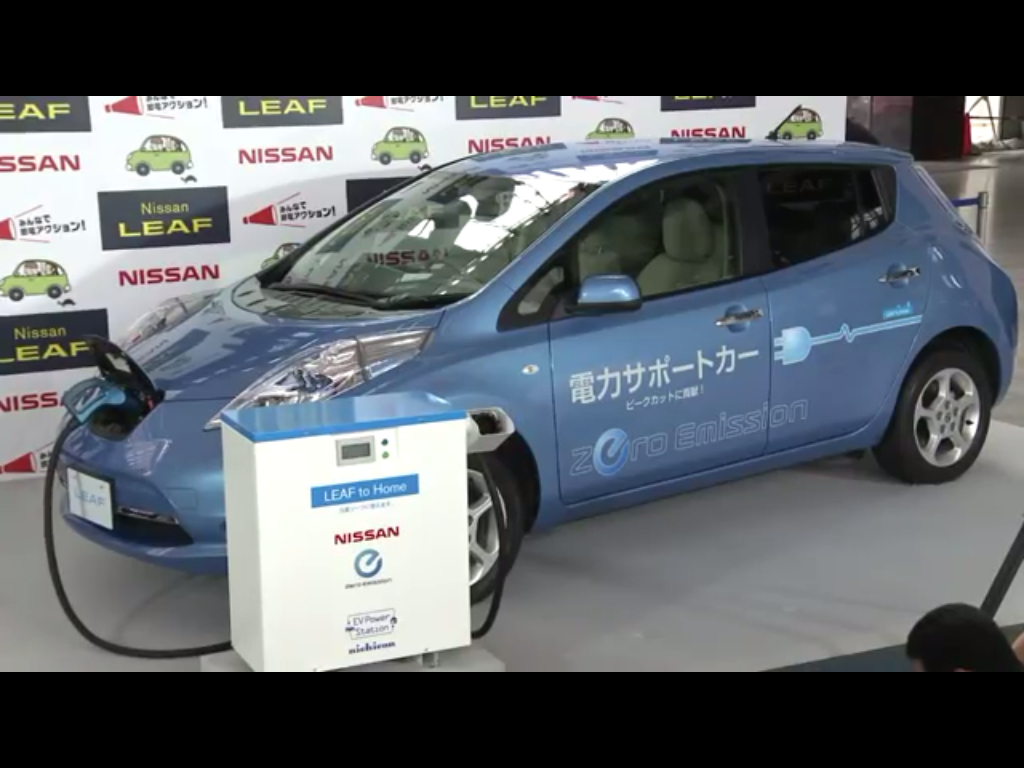
Nissan Launched "LEAF to Home" V2H EV Power Supply System


- Nissan to launch LEAF to Home power system at its dealerships in Japan in mid-June

- Nissan and Nichicon collaborate to achieve the world's first power supply system that provides electricity from the Nissan LEAF's high-capacity batteries to houses

Nissan announced "LEAF to Home" power supply system, which can supply electricity from batteries onboard in Nissan LEAF electric vehicles (EV) to homes when used with the "EV Power Station" unit developed by Nichicon Corporation. "LEAF to Home" is an industry first backup power supply system that can transmit the electricity stored in the large-capacity batteries of Nissan LEAFs to a residential home. Nissan will showcase this system at its Japanese dealership showrooms beginning in June to help promote efficient electricity management and demonstrate the features built into electric vehicles.


This equipement is using the CHAdeMO protocol / standard


Nissan Motor Co., Ltd. will launch the "LEAF to Home" power supply system at its dealerships in Japan in mid-June 2012. The V2H system (Vehicle to Home) can supply electricity from batteries onboard in Nissan LEAF electric vehicles (EV) to homes when used with the "EV Power Station" unit developed by Nichicon Corporation.


"LEAF to Home" is an industry-first backup power supply system that can transmit the electricity stored in the large-capacity batteries of Nissan LEAFs to a residential home. Nissan will showcase this system at its Japanese dealership showrooms beginning in June to help promote efficient electricity management and demonstrate the features built into electric vehicles.

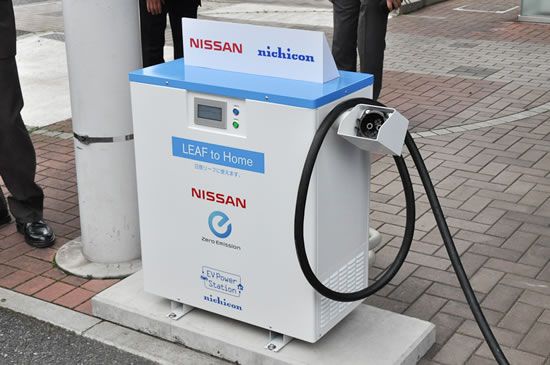
Nichicon, an innovator in power supply systems, will provide the technology to move the electricity from vehicle to home through its "EV Power Station" units. This power transfer system enables electricity stored in high-capacity lithium-ion batteries onboard a Nissan LEAF to be sent to an ordinary home by connecting the car to the home's electricity distribution panel with a connector linked to the LEAF's quick charging port.

The EV Power Station system is similar in size to an external air-conditioning unit, can be installed outdoors, and conforms to the CHAdeMO protocol for EV quick chargers. CHAdeMO is an abbreviation of "Charge de Move" ("charge for moving") and is the trade name for a quick-charging method used to charge the batteries of electric vehicles. The Nichicon system's connector complies with the JEVS G 105 standard defined by the Japan Automotive Research Institute (JARI). This system can run on various operating modes and has a timer function which can be controlled with a liquid crystal display (LCD) touch panel. Electricity is stored or supplied automatically in accordance with a household's electricity capacity and consumption.

The EV Power Station can fully charge a LEAF in as little as four hours, which is approximately half the time required when a normal charger is used. All current Nissan LEAF owners in Japan will be able to use the system, depending on their home's installation requirements. With Japanese government subsidies taken into account, the EV Power Station is estimated to cost 330,000 yen ($4200), which amount includes 10% consumption tax and installation charge.


Detailed specifications of the system:


Official video:


This system helps to balance the electrical supply system, and can even lower a consumer's electricity bill. The LEAF to Home system will help encourage Nissan LEAF owners to charge their cars with electricity generated during the night, when demand is low, or sourced from solar panels. This assist in balancing energy needs by supplying electricity to the grid during daytime, when demand is highest. It can also be used as back-up power source in case of power outages and/or shortages.

The lithium-ion batteries can store up to 24kWh of electricity, which is sufficient to supply an average Japanese household for about two days. This system underscores an additional attribute of EVs: vehicles which can be used as a storage battery whether they are moving or stationary.

Source: http://www.nissan-global.com/EN/NEWS/2012/_STORY/120530-01-e.html?rss

The LEAF 24kWh battery pack could, through the LEAF to Home PCS / EV Power Station, supply all the necessary power used by a  regular house, that is 6 kW.
This supply could come on to fill the power gap between the house solar system and the power usage, or in the evening and at tnight when the sun doesn't shine anymore 


Using the Peak Offset Function, an average home in Japan could save money and releave the grid during power consumption peak at noon, by using the LEAF as a power supply during this period, charging at night at low power demand and low cost :

More info here: http://car.watch.impress.co.jp/docs/news/20120530_536403.html

Nissan did a first demo of this system back in August 2011:
http://www.nissan-global.com/EN/NEWS/2011/_STORY/110802-01-e.html

Here is a video of this event:


[System Overview]

Power Control System (PCS)
- Rating: 6kW
- Control system: Sinusoidal PWM System
- System power: 200V single-phase three-wire system
Operation display panel
- Display for switching electricity charge between supply
- Battery power, output voltage and output current display
Nissan LEAF connection specification
- Quick charge connector (CHAdeMo specification)
Nissan LEAF
- Corresponds to the electricity supply program


Wednesday, March 14, 2012

Nissan e-NV200 - Great Electric Mini Van

Think Big 
This mini van is going to be a big hit I think, like the LEAF. Based on the same powertrain and battery pack,  it's a perfect fit for large families or people who need a lot of storage capacity, taxis, contractors, etc


Smartgrid ready !
In the 2nd video below, you will see that the NV200, like the LEAF, could be used as a source of energy, to power the house when power demand is high, in the evening, and then will charge at night when power demand is low


The e-NV200 on display at Geneva Auto Show

Please Share this Post if you Liked it !

Please Share this Post if you Liked it ! Thanks !
Related Posts Plugin for WordPress, Blogger...