It's been a few months now since reports of losses in battery capacity in Nissan LEAF electric cars began to filter out of Arizona.

Owners have complained to Nissan's Consumer Affairs group and written hundreds of posts on owner forums. In July, Nissan Americas took seven different Leafs in for a complete assessment by the technical unit at its Arizona Testing Center.
Now Nissan is starting to reveal the conclusions it's drawn from examining those seven Leafs and their battery packs.

Mark Perry, Nissan North America’s product planning and advanced technology director,discussed the company's findings exclusively with Green Car Reports.
19,000 miles or more
The common thread among the seven Leafs from Arizona, Perry said, was that all of them had covered much higher mileage than the 12,500 miles Nissan used to estimate the rate of battery capacity loss over time.
All of them had covered at least 50 percent more than that--or roughly 19,000 miles a year--and a few were "significantly higher" than that.
[UPDATE: After this article was published, Nissan used the actual mileage of the seven cars in the test to provide additional data. "The average mileage for the cars investigated was 19,600 miles, and the average in-service time was 14.7 months," wrote the company's Katherine Zachary. "Average annual mileage [of those cars] is about 16,000 per year, more than double the average Phoenix customer mileage of 7,500 miles per year."]
As a sprawling suburban city, Phoenix also requires a higher proportion of travel at freeway speeds, with relatively less time spent in low-speed urban stop-and-go traffic.
Based on those factors, Perry said, "The cars and the battery packs are behaving as we expected" given the use they've logged to date.

2011 Nissan LEAF prototype
Starting in 2009, Nissan executives have consistently said the Leaf battery pack would retain 70 to 80 percent of its charge capacity after five years--and average roughly 70 percent capacity after 10 years.
In other words, capacity loss is not linear, but quicker during the first few years than in subsequent years, assuming equivalent mileage in every year.
Assuming averages
Those projections, based on battery testing during development of the Leaf, assume the car covers 12,500 miles a year, in climates largely similar to those of Los Angeles (50 to 90 degrees F, with an average temperature of 68 or 70 degrees).
Phoenix has also just had one of its hottest summers ever, he noted.
Looking at 450 Nissan Leafs now in Arizona, Perry said, using data each car transmits to a Nissan control center, it appears that Leafs in Arizona are "on a glide path" to average battery capacity of 76 percent after five years rather than 80 percent.
The seven cars the company inspected in depth are likely to have less capacity than that after the same time.
Perry said he couldn't comment on what the company's data showed regarding frequency of charging and frequency of quick-charging for the Leafs it inspected.
Reaching out to owners
Starting on Thursday, Perry said, Nissan began reaching out to the owners of the seven cars it tested, to arrange face-to-face meetings with each of them.
The company's goal, he said, is to discuss how to satisfy those owners. "We want to make sure they're satisfied with their vehicles," Perry stressed.
He declined to suggest any remedies or compensations the company might offer, stressing that Nissan wanted to satisfy each owner individually.
Nissan has also heard from "a handful" of other Leaf owners on battery-capacity issues, he said, both those who have lost one or more bars and those who are concerned that this may happen in the future.
The company isn't now planning face-to-face talks with that larger group of owners, he said.

Leaf specialists
Instead, they should continue to discuss these issues with the Leaf electric-car specialists at the Nissan Consumer Affairs Center.
The toll-free number to reach that center is 800 877-NO-GAS-EV, or 800-664-2738.
Perry declined to go beyond "a handful" in specifying how many Leaf owners had contacted the company about the issue, although after continued questioning, he indicated it was far fewer than 100.
Perry also declined to comment on independent tests conducted by electric-car advocate and Leaf owner Tony Williams, which took place in Phoenixrecently and appeared to show range loss comparable to the indicated capacity loss in 12 Leafs tested.
"I understand what he was trying to do," Perry told Green Car Reports, "but it's hard to comment because we weren't there."
Pessimistic meter
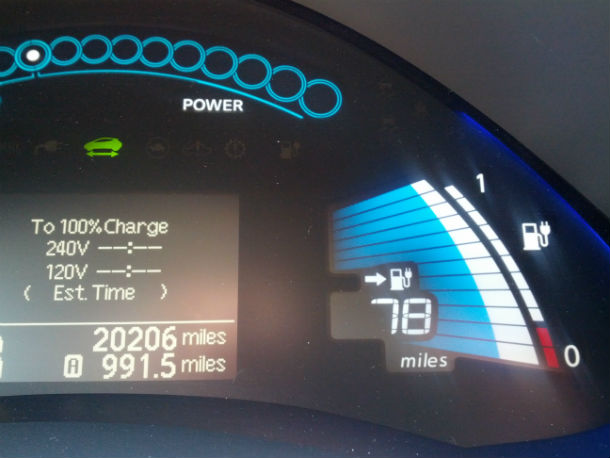
A further issue, Perry said, the battery capacity meter in the Leaf dashboard errs on the conservative side.
Thus, he said, a loss of three of the 12 capacity bars doesn't translate to exactly a 25-percent loss of capacity. In fact, not all the bars represent equal fractions of capacity.
This had previously been discussed by Andy Palmer, Nissan's executive vice president, who alluded to capacity-loss reports as stemming from a faulty battery level display.
Perry wouldn't specify what proportion of pack loss those three bars did represent, saying it could vary with each car's use.
The company would have to dig into its data on each individual pack to get those individual figures for each Leaf, he said.
Communicating with owners
While the Leaf batteries are behaving as the company expected, Perry admitted the challenge may be that the battery capacity losses may not have been what the owners of those electric cars expected.
Our analogy for battery capacity might be something like tire wear: The more miles you put on your tires, the more they wear.
Nissan Americas requires each buyer of a new Nissan Leaf electric car to sign a disclosure form in which the new owner acknowledges that battery capacity will decline over time.
The form also suggests ways the owner can maximize battery life.
Goodwill at risk
And that may be the real issue here.
"This ceased to be a technical issue a while ago, and has long been a goodwill issue," said electric-car advocate Chelsea Sexton, "based in what the drivers perceive as a lack of adequate communication."
And, she continued, if Nissan takes a position that 'there's still nothing wrong with your cars," that message is "unlikely to go over any better than it did the last time they said it."
On the other hand, electric-car advocate Mark Larsen takes a more nuanced view, decrying the angry tone adopted by some of the Leaf owners.

Your mileage may vary?
After analyzing the 12-car independent test data published by the owners, Larsen suggests that, in essence, "your mileage may vary."
His conclusion is that the Arizona heat affects "what data the capacity gauges are gleaning from the pack, but not the capacities themselves, according to miles driven."
This all indicates that there's likely to be much more to come on this story. Stay tuned.
Source: GreenCarReports
My notes:
It seems that Mark Larsen comes to the same conclusion as Jack Rickard: It looks like it is an instrumentation problem, degraded by the heat probably, because, out of all the LEAF tested by Tony Williams in Arizona last month, the pack voltages when the turtle shows up are very different from LEAF to LEAF, some showing a much higher voltage than others .... So the capacity is there, but it can not be used, blocked by the faulty energy meter on board ...

Owners have complained to Nissan's Consumer Affairs group and written hundreds of posts on owner forums. In July, Nissan Americas took seven different Leafs in for a complete assessment by the technical unit at its Arizona Testing Center.
Now Nissan is starting to reveal the conclusions it's drawn from examining those seven Leafs and their battery packs.

Mark Perry, Nissan North America’s product planning and advanced technology director,discussed the company's findings exclusively with Green Car Reports.
19,000 miles or more
The common thread among the seven Leafs from Arizona, Perry said, was that all of them had covered much higher mileage than the 12,500 miles Nissan used to estimate the rate of battery capacity loss over time.
All of them had covered at least 50 percent more than that--or roughly 19,000 miles a year--and a few were "significantly higher" than that.
[UPDATE: After this article was published, Nissan used the actual mileage of the seven cars in the test to provide additional data. "The average mileage for the cars investigated was 19,600 miles, and the average in-service time was 14.7 months," wrote the company's Katherine Zachary. "Average annual mileage [of those cars] is about 16,000 per year, more than double the average Phoenix customer mileage of 7,500 miles per year."]
As a sprawling suburban city, Phoenix also requires a higher proportion of travel at freeway speeds, with relatively less time spent in low-speed urban stop-and-go traffic.
Based on those factors, Perry said, "The cars and the battery packs are behaving as we expected" given the use they've logged to date.

2011 Nissan LEAF prototype
Starting in 2009, Nissan executives have consistently said the Leaf battery pack would retain 70 to 80 percent of its charge capacity after five years--and average roughly 70 percent capacity after 10 years.
In other words, capacity loss is not linear, but quicker during the first few years than in subsequent years, assuming equivalent mileage in every year.
Assuming averages
Those projections, based on battery testing during development of the Leaf, assume the car covers 12,500 miles a year, in climates largely similar to those of Los Angeles (50 to 90 degrees F, with an average temperature of 68 or 70 degrees).
Phoenix has also just had one of its hottest summers ever, he noted.
Looking at 450 Nissan Leafs now in Arizona, Perry said, using data each car transmits to a Nissan control center, it appears that Leafs in Arizona are "on a glide path" to average battery capacity of 76 percent after five years rather than 80 percent.
The seven cars the company inspected in depth are likely to have less capacity than that after the same time.
Perry said he couldn't comment on what the company's data showed regarding frequency of charging and frequency of quick-charging for the Leafs it inspected.
Reaching out to owners
Starting on Thursday, Perry said, Nissan began reaching out to the owners of the seven cars it tested, to arrange face-to-face meetings with each of them.
The company's goal, he said, is to discuss how to satisfy those owners. "We want to make sure they're satisfied with their vehicles," Perry stressed.
He declined to suggest any remedies or compensations the company might offer, stressing that Nissan wanted to satisfy each owner individually.
Nissan has also heard from "a handful" of other Leaf owners on battery-capacity issues, he said, both those who have lost one or more bars and those who are concerned that this may happen in the future.
The company isn't now planning face-to-face talks with that larger group of owners, he said.

Leaf specialists
Instead, they should continue to discuss these issues with the Leaf electric-car specialists at the Nissan Consumer Affairs Center.
The toll-free number to reach that center is 800 877-NO-GAS-EV, or 800-664-2738.
Perry declined to go beyond "a handful" in specifying how many Leaf owners had contacted the company about the issue, although after continued questioning, he indicated it was far fewer than 100.
Perry also declined to comment on independent tests conducted by electric-car advocate and Leaf owner Tony Williams, which took place in Phoenixrecently and appeared to show range loss comparable to the indicated capacity loss in 12 Leafs tested.
"I understand what he was trying to do," Perry told Green Car Reports, "but it's hard to comment because we weren't there."

Pessimistic meter
A further issue, Perry said, the battery capacity meter in the Leaf dashboard errs on the conservative side.
Thus, he said, a loss of three of the 12 capacity bars doesn't translate to exactly a 25-percent loss of capacity. In fact, not all the bars represent equal fractions of capacity.
This had previously been discussed by Andy Palmer, Nissan's executive vice president, who alluded to capacity-loss reports as stemming from a faulty battery level display.
Perry wouldn't specify what proportion of pack loss those three bars did represent, saying it could vary with each car's use.
The company would have to dig into its data on each individual pack to get those individual figures for each Leaf, he said.
Communicating with owners
While the Leaf batteries are behaving as the company expected, Perry admitted the challenge may be that the battery capacity losses may not have been what the owners of those electric cars expected.
Our analogy for battery capacity might be something like tire wear: The more miles you put on your tires, the more they wear.
Nissan Americas requires each buyer of a new Nissan Leaf electric car to sign a disclosure form in which the new owner acknowledges that battery capacity will decline over time.
The form also suggests ways the owner can maximize battery life.
Goodwill at risk
And that may be the real issue here.
"This ceased to be a technical issue a while ago, and has long been a goodwill issue," said electric-car advocate Chelsea Sexton, "based in what the drivers perceive as a lack of adequate communication."
And, she continued, if Nissan takes a position that 'there's still nothing wrong with your cars," that message is "unlikely to go over any better than it did the last time they said it."
On the other hand, electric-car advocate Mark Larsen takes a more nuanced view, decrying the angry tone adopted by some of the Leaf owners.
Your mileage may vary?
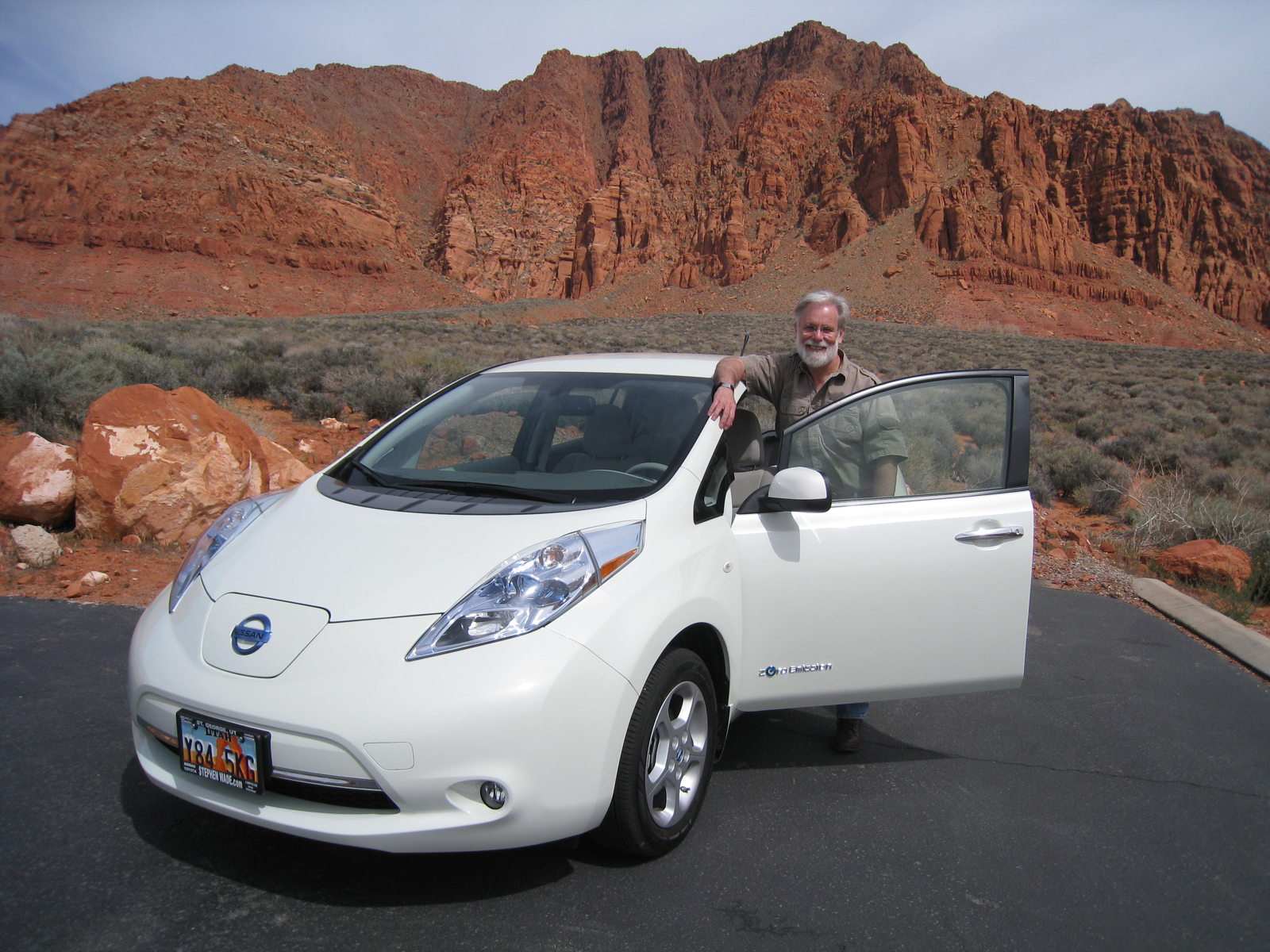
After analyzing the 12-car independent test data published by the owners, Larsen suggests that, in essence, "your mileage may vary."
His conclusion is that the Arizona heat affects "what data the capacity gauges are gleaning from the pack, but not the capacities themselves, according to miles driven."
This all indicates that there's likely to be much more to come on this story. Stay tuned.
Source: GreenCarReports
My notes:
It seems that Mark Larsen comes to the same conclusion as Jack Rickard: It looks like it is an instrumentation problem, degraded by the heat probably, because, out of all the LEAF tested by Tony Williams in Arizona last month, the pack voltages when the turtle shows up are very different from LEAF to LEAF, some showing a much higher voltage than others .... So the capacity is there, but it can not be used, blocked by the faulty energy meter on board ...


