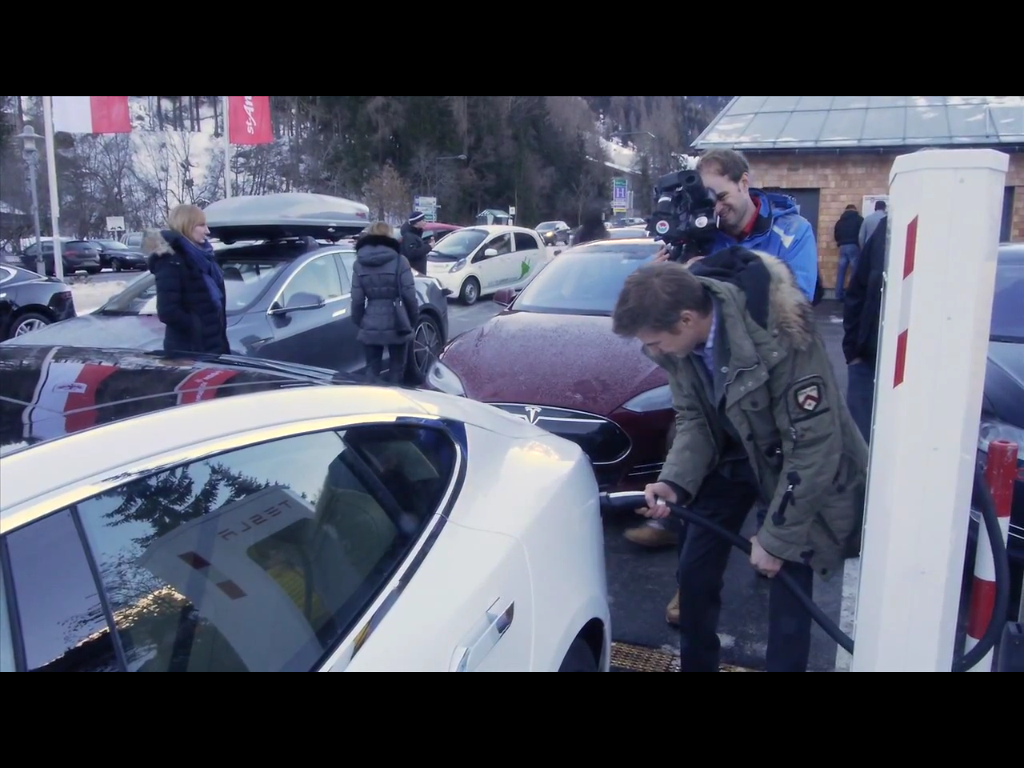
The 530-mile trip using Tesla's superchargers started at Lake Tahoe, near the California-Nevada border.
One week ago at this time, I was speeding down California’s Interstate in a
Tesla Model S, on a 530-mile one-day trip from Lake Tahoe to
Los Angeles. I told the tale of using Tesla’s
supercharger network, and reviewed the vehicle, in yesterday’s New York Times. But that was intended for a general audience. I figured the
EV crowd on PluginCars.com would want more of the geeky details about Tesla’s superchargers.
It seems obvious that
charging an EV, even at a rapid 90-kW rate, is a different experience than pumping gas into a petrol car. We have become accustomed to rolling up to rest stop on the highway in our gas car, and in a matter of about 10 minutes, pumping gasoline until the nozzle clicks and the tank is full. That’s not what you want to do with a big-battery EV like the 85-kWh Model S.
As I stated in the NYT piece, the rate of charging is about twice as fast when the battery pack is nearly empty as when it gets full. Check out this data, pulled by Tesla engineers right from the Model S I was driving. For two of my three stops, the state-of-charge (SOC) was less than 10 percent, when I arrived to a supercharger.
 Timeline of the Model S's state of charger for the 11.5-hour trip.
This might be perceived as a weakness—as if the car was running on fumes (I mean final electrons) as I pulled up for a charge. But it’s actually just one example of how Tesla is using the intrinsic technical and logistical dimensions of EV fast charging to leap ahead of competing models for quick charging.
You can see that during those two stops, at Harris Ranch and Tejon, the batteries were only restored to about 65 percent and 55 percent SOC respectively. Those recharging sessions were completed in 38 minutes and 25 minutes, and added 153 miles and 117 miles. I could have added more without a problem, except for two things: I didn’t need more juice than that to get to the next supercharger, and the reduced pace of recharging to get to full would have slowed down the trip.
I spent more time at the first stop in Folsom, and charged to about 95 percent SOC—or 250 miles of range—because the leg from Folsom to Harris Ranch, near Coalinga, was a bit more than 200 miles. This graph shows the remaining range at all points along the way.
 Timeline of the Model S's remaining range for the 11.5-hour trip.
That Folsom-to-Coalinga stretch is not a true indication of what Tesla has in mind, because the company’s strategy is to place superchargers only about 150 miles apart. Last week, we were trying to test the limits of the network—on the company’s inaugural run—but very few, if any, Model S owners will want to drive from Lake Tahoe to L.A.
The supercharger network was created to enable the most likely trips—like Tahoe to San Francisco; SF to LA; or LA to Vegas. So, the only reason we topped up in Folsom, and kept our speed to around 70 miles per hour, was because we were breaking the boundaries of how the system was designed to work.
J.B. Straubel—Tesla’s chief technology officer and the driving force behind the supercharger strategy—told me, “When you start to look at how many you need to enable all the frequent destinations, it’s in the tens if you’re in one state, to the hundreds nationwide. You don’t need 10,000 of them.”

 Top: The locations for Tesla superchargers opening to Model S drivers by the end of October, 2012.
Bottom: A nationwide network of superchargers, based on this map from Tesla, can serve the entire country with around 100 locations.
Good Economics
Now, consider relatively low hardware costs for the superchargers, because they are primarily comprised of a dozen of exactly the same on-board 10-kW chargers found in the vehicle—made from the same components and manufactured on the same production line. Straubel told me that each supercharger costs “less than half” of what competing quick chargers (like CHAdeMo) are running. And they are faster.
 The refrigerator-looking object is the actual Tesla supercharger. Inside, a dozen of the 10-kW chargers used in the vehicle are stacked up, and supported by computers and liquid cooling. One 120-kW supercharger can serve two vehicles at a time. The pedestal by the car merely supports the charging cord.
It makes good technical and economic sense to Straubel for the same company making the cars to make the off board fast chargers.
“For the cost of one hydrogen fueling station, we can put in a sizable part of a network,” Straubel said. “It’s pretty cool. We’re linking east and west coast, north and south. You can go from Tijuana to New York for free and back. In an EV, in about the same time you can do it in a gasoline car.”
Cheap electricity means that Tesla can make the chargers available at no extra cost to its customers. The network is primarily designed to sell more cars—the first business model for public charging that makes sense to me.
 The Tesla supercharger location in Tejon, Calif., is the first that uses solar power. Others will follow. Solar energy will ensure that Tesla vehicles using the network will run on renewable energy, and it will reduce ongoing operation costs.
High-price demand charges from the utility company are mitigated by using solar and stationary batteries, as is planned for many of the Tesla charging locations. While the most built-out Tesla charging locations with full solar and enough connectors to serve eight vehicles at the same time could cost a quarter-million dollars, the stations I visited are more likely to be a third of that cost.
Leading Edge
Tesla is being criticized for the fact that the superchargers are only available to their vehicles. But the company doesn’t want to wait for the entire industry to make up its mind about standards, or to catch on to its approach. Can you blame them? First of all, you need big battery EVs, like the 85 kWh Model S, for the idea to work as intended. And the battery systems in those vehicles must have the capacity to take 90-kW charging.
Once a few thousand Model S drivers start using the system for all-electric road trips, perhaps other automakers will start knocking on Tesla’s door, to see how their EVs can be equipped to use the network. Toyota and Daimler, as existing Tesla partners, are possible candidates.
What I like most about the Tesla supercharger network is how the company looked at long-distance electric vehicle driving and charging with the mindset of experienced EV guys—not like internal combustion carmakers thinking about electric cars for the first time. This EV-centric approach—electricity runs in Tesla's blood—has allowed them to devise a cost-effective solution to a problem that hasn’t crossed the mind of other carmakers. And even if it did, they wouldn’t dare to try to solve it.
Source:
PluginCars