Showing posts with label power supply system. Show all posts

Tuesday, January 29, 2013

ESS + Wattson Anywhere = Real Time Follow up of Generated Power at Home

Now with Wattson Anywhere I can keep track of my ESS Generation Anytime & Anywhere on Any device ! For me, this is really cool ...


My LiFePO4 BESPSS = Battery Energy Storage & Power Supply System stores 4kWh of energy and pushes it back into my home grid adjusting its output automatically, thanks to Wattson color codes, to keep the usage (purchased from my utility company EDF) as low as possible

Later on, this will be much improved when my solar panels are connected to my home grid: I will then store free solar energy during the day, and feed it back to my home appliances as soon as the sun is down or when the overall home power usage is high

To seethis Real Time Graph, go to my Public Wattson Anywhere Page


Back in october, when I still had these Mottcells cells (see picture above) on my BESPSS, the generation was pretty close to the usage (see graph below)

Zoom on the two generation periods of this day: Notice how the generation follows closely the usage

The same day, but the Energy graph, showing the amount of "green" energy generated


These are two iPad screenshots taken yesterday, while having breakfast, with my (Lead AGM) BESPSS switched ON


Every 5 minutes, I get an updated graph


The following screenshots show two full days with 2 BESPSS production periods in december and in january; Note that the Wattson Anywhere portal beta release has changed in between

Thursday, July 19, 2012

LiFePO4 ESS update - Arduino & Relays - Test #2

The sketch / program I wrote to interface Wattson with Arduino seems to work OK
It needs a little tuning here and there but I am happy with this 2nd test :-)


On the netbook screen (right window) you can see the Serial port information sent by the Arduino board:
Green / Blue / Red voltages read every 500ms
Depending on these values the program puts the output pins to High or Low, which energizes or not the high voltage relays, which in turn switch ON or OFF the Grid Tie Inverters
And it is trying to keep Wattson in the Blue or Green modes, meaning Low usage, or Negative usage (but not too much waste)
If seems to work OK, but I will have to spend some more time tuning it 

Tuesday, July 17, 2012

July 1st, reduced usage day - LiFePO4 ESS update

This is what happens when I spend grey sundays adjusting the power output of my Grid Tie Inverters to match grid usage

Energy graph
Blue bars = Usage Energy
Green line = ESS Generated Energy

Power graph
Blue line = Usage Power
Green line = ESS Generated Power


Power graph

Energy graph

24hours Energy graph


24hours Power graph


Same thing on sunday 8th


Monday, June 11, 2012

LiFePO4 Energy Storage System - New 24V configuration - 3 Remote Controlled Grid Tie Inverters

As I announced at the end of my last video, I spent this sunday changing my System to its new 24V configuration and also changed the cells layout as you can see

The New interesting feature of my Energy Storage System is these 3 Remote Controlled Grid Tie Inverters ...

Long test of the New system


Following are all the transition pictures:

Disassembling the 48V battery pack

Testing new layout

That one would use less space on the floor and still give me full access to individual cells to monitor voltage once in a while

What took a long time was polishing (with sandpaper) the cupper bars linking the cells together: they have to be exempt of oxydation to conduct current well

Each time a group of 4 cells was finished (4 cells in parallel) I would connect it to the string (8 groups in series)


Second level ...

A 100A breaker is placed at mid-pack (on the right)

Battery pack fully assembled, Tyco Kilovac contactor bolted to the positive terminal, DC-DC 24V to 12V converter and dual relay programmable voltmeter connected

Now time to install the 3 Grid Tie Inverters I had in stock from previous tests (bottom to top: SUN 250G, SUN25G, SUN 300G)

And the positive terminals of the GTIs are connected to the switched 24V from the Kilovac contactor
The lower voltage limit (cut-off) on the voltmeter has been changed from 48V to 24V
I brought Wattson to see the effect of this New Energy Storage System on my home power consumption


Overall view of the finished system, remote controlled outlets / sockets included (left)


I can now control my Power Supply to the grid with the remote while I am upstairs or doing something else


Short test after mounting everything


In the morning light

The remote control and the 3 controlled outlets / sockets

Top view

Next setp tonight: I will be adding a small relay/contactor for the charger side; My new 24V charger (10A) is on its way from China and will arrive soon hopefully ...

Thursday, June 7, 2012

Wattson : Good News for the future !

Wattson Energy Meter line of products should evolve and some addons could plug into Wattson (probably into the USB port) and control the triggering of devices at home to use the power generated by solar panels or wind turbine ... very promissing, I can't wait to try one of these :-) and plug it into my LiFePO4 Energy Strorage System and electric water heater

Wednesday, May 30, 2012

Nissan Launched "LEAF to Home" V2H EV Power Supply System


- Nissan to launch LEAF to Home power system at its dealerships in Japan in mid-June

- Nissan and Nichicon collaborate to achieve the world's first power supply system that provides electricity from the Nissan LEAF's high-capacity batteries to houses

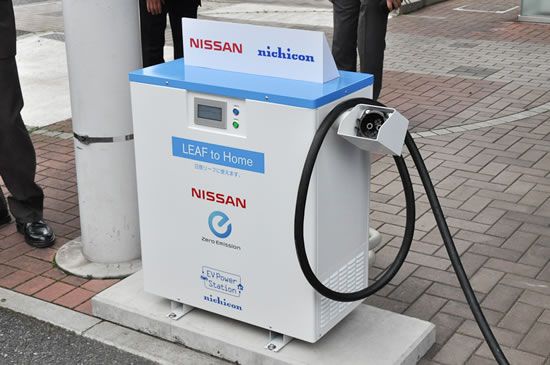
Nissan announced "LEAF to Home" power supply system, which can supply electricity from batteries onboard in Nissan LEAF electric vehicles (EV) to homes when used with the "EV Power Station" unit developed by Nichicon Corporation. "LEAF to Home" is an industry first backup power supply system that can transmit the electricity stored in the large-capacity batteries of Nissan LEAFs to a residential home. Nissan will showcase this system at its Japanese dealership showrooms beginning in June to help promote efficient electricity management and demonstrate the features built into electric vehicles.


This equipement is using the CHAdeMO protocol / standard


Nissan Motor Co., Ltd. will launch the "LEAF to Home" power supply system at its dealerships in Japan in mid-June 2012. The V2H system (Vehicle to Home) can supply electricity from batteries onboard in Nissan LEAF electric vehicles (EV) to homes when used with the "EV Power Station" unit developed by Nichicon Corporation.


"LEAF to Home" is an industry-first backup power supply system that can transmit the electricity stored in the large-capacity batteries of Nissan LEAFs to a residential home. Nissan will showcase this system at its Japanese dealership showrooms beginning in June to help promote efficient electricity management and demonstrate the features built into electric vehicles.

Nichicon, an innovator in power supply systems, will provide the technology to move the electricity from vehicle to home through its "EV Power Station" units. This power transfer system enables electricity stored in high-capacity lithium-ion batteries onboard a Nissan LEAF to be sent to an ordinary home by connecting the car to the home's electricity distribution panel with a connector linked to the LEAF's quick charging port.

The EV Power Station system is similar in size to an external air-conditioning unit, can be installed outdoors, and conforms to the CHAdeMO protocol for EV quick chargers. CHAdeMO is an abbreviation of "Charge de Move" ("charge for moving") and is the trade name for a quick-charging method used to charge the batteries of electric vehicles. The Nichicon system's connector complies with the JEVS G 105 standard defined by the Japan Automotive Research Institute (JARI). This system can run on various operating modes and has a timer function which can be controlled with a liquid crystal display (LCD) touch panel. Electricity is stored or supplied automatically in accordance with a household's electricity capacity and consumption.

The EV Power Station can fully charge a LEAF in as little as four hours, which is approximately half the time required when a normal charger is used. All current Nissan LEAF owners in Japan will be able to use the system, depending on their home's installation requirements. With Japanese government subsidies taken into account, the EV Power Station is estimated to cost 330,000 yen ($4200), which amount includes 10% consumption tax and installation charge.


Detailed specifications of the system:


Official video:


This system helps to balance the electrical supply system, and can even lower a consumer's electricity bill. The LEAF to Home system will help encourage Nissan LEAF owners to charge their cars with electricity generated during the night, when demand is low, or sourced from solar panels. This assist in balancing energy needs by supplying electricity to the grid during daytime, when demand is highest. It can also be used as back-up power source in case of power outages and/or shortages.

The lithium-ion batteries can store up to 24kWh of electricity, which is sufficient to supply an average Japanese household for about two days. This system underscores an additional attribute of EVs: vehicles which can be used as a storage battery whether they are moving or stationary.

Source: http://www.nissan-global.com/EN/NEWS/2012/_STORY/120530-01-e.html?rss

The LEAF 24kWh battery pack could, through the LEAF to Home PCS / EV Power Station, supply all the necessary power used by a  regular house, that is 6 kW.
This supply could come on to fill the power gap between the house solar system and the power usage, or in the evening and at tnight when the sun doesn't shine anymore 


Using the Peak Offset Function, an average home in Japan could save money and releave the grid during power consumption peak at noon, by using the LEAF as a power supply during this period, charging at night at low power demand and low cost :

More info here: http://car.watch.impress.co.jp/docs/news/20120530_536403.html

Nissan did a first demo of this system back in August 2011:
http://www.nissan-global.com/EN/NEWS/2011/_STORY/110802-01-e.html

Here is a video of this event:


[System Overview]

Power Control System (PCS)
- Rating: 6kW
- Control system: Sinusoidal PWM System
- System power: 200V single-phase three-wire system
Operation display panel
- Display for switching electricity charge between supply
- Battery power, output voltage and output current display
Nissan LEAF connection specification
- Quick charge connector (CHAdeMo specification)
Nissan LEAF
- Corresponds to the electricity supply program


Please Share this Post if you Liked it !

Please Share this Post if you Liked it ! Thanks !
Related Posts Plugin for WordPress, Blogger...