Showing posts with label self sufficiency. Show all posts

Tuesday, January 19, 2016

Finally got 2 100W Flexible SunPower Solar Panels, after 2.5 years of wait


Finally, 2.5 years after its discovery on EVtv in October 2013, I just purchased 2 100W SunPower Flexible Solar Panels :) for 100 GBP each, plus 20 GBP of shipping (a bargain I think compared to all the ones I have seen over this period)


They will replace my very first lower power panels installed in 2009 but won't charge AGM batteries, they will be wired in series and plugged into an Enphase M215 micro inverter to directly feed Power into my home grid, improving low solar generation in winter hanging vertically by my windows


The 100W one is the smallest on the picture, 32 cells 4 x 8, ultra light, flexible, with holes already there to hang it ... You will understand better when I receive and install them ....

Here is the link, because I want to share with others this good deal I found today:
http://www.ebay.fr/itm/NEW-100W-12v-Energy-Semi-Flexible-Mono-Solar-Panel-100-watt-TUV-ISO-UK-/262238997891?hash=item3d0ea98d83


Monday, January 11, 2016

DIY ESS Update : Open Energy Monitor can be used instead of Wattson as an Input

I am thrilled to announce that the famous Open Energy Monitor can used as an input in the build of my DIY Energy Storage System or ESS instead of the original (also famous) Wattson Energy Monitor


From the very beginning back in 2011, I purchased and installed Wattson at home and loved it: I could finally see in real time how much power my appliances use and modify my behaviour to reduce energy consumption at home

Later on I got Solar Panels installed on our building roof and used another feature of Wattson which is Solar Surplus detection: When Usage < Solar, Wattson simply lights up Green to indicate there is free Solar Power to used (and the Net Usage is Negative)

Wattson Solar Surplus (and other color codes): 


Based on these simple lights (Blue, Purple, Red and Green) I built my Energy Storage System back in 2013, had it running for over 2.5 years now with Solar (july 2013), and saved over 650 EUR on my Electricity bills

Last friday, inquiring on the Open Energy Monitor and their interesting open source work over the last years, I realized that their emonGLCD, the equivalent to Wattson Display, is actually using the same Color Codes, in a simplified version:
- Green: Solar Generation > Usage
- Red: Usage > Solar Generation

OpenEnergyMonitor emonGLCD Solar Surplus :


Simply wiring the pins of one of the bi-color LED pins to the input terminal block of my DIY ESS, it will get the color codes and perform exactly like if it was a Wattson display :)


OpenEnergyMonior solution is open source, meaning it will be improved over time (and you can participate too)

It is also now possible to get a ready to use emonPi, meaning there is nothing to solder and build, just clip your CT Sensors (or clamps) on usage and generation wires, plug them in the device, power it up, and you're good to go !


But there's one more thing ...

Connected to you home internet router, OpenEnergyMonitor will post data to Emoncms.org, allowing you to see great graphs of your usage, generation, temperature, etc ... All this for free, so I think it's just perfect :)


Links:

OpenEnergyMonitor : http://openenergymonitor.org
OEM Graphical Display emonGLCD : http://openenergymonitor.org/emon/emonglcd
Solar with the OEM : http://openenergymonitor.org/emon/applications/solarpv

DIY ESS Kit : http://www.diyesskit.com or http://www.StoreYourEnergy.com
Real Time DIY ESS Cam : http://www.ustream.tv/channel/chris75sf
DIY ESS Real Time Graphs on EnergyHive : http://wattson.energyhive.com/dashboard/diyesskit


Thursday, July 9, 2015

DIY ESS - Already 2 Years of 24/7 Service with Solar at Home !

Yes, it's been 2 years yesterday, since I started producing & storing my Solar surplus at home for re-use whenever necessary, during the day, or in the evening when the sun goes down
http://www.myelifenow.com/2013/07/starting-first-full-day-of-solar.html


My Energy Storage System was actually working several months before that, and my Solar Panels where installed on the roof almost 9 months before too, but I was waiting for my solar contractor to complete the install with his own special inverter, which was too delayed in the end, so I asked him to installa regular one, and we agreed on an 3kW SMA unit

Once installed, I could finally generate my own solar electricity, and my ESS being ready and tested, it worked right away seamlessly :)
http://www.myelifenow.com/2013/07/uni-solar-pvl-sma-inverter-finished.html


That was two years ago, and it has been doing great over time: No breakdown, no Battery problem (I read so many things about sceptick folks on this), it has been working like a charm


With less solar generation during winter, I used the Forced Charge function to charge from low cost electricity at night, to help push low cost energy back into my home grid to help heating, lighting and cooking


As we can see on the Wattson / EnergyHive portal where my generation & usage data are collected in real time, it is saving around 250 EUR per year (over the last year), and since the price per kWh goes up all the time, it will save evne more in the future
http://wattson.energyhive.com/dashboard/diyesskit


My ESS has been registered on the DOE - Department Of Energy - Global Energy Storage Database back in July 2013, few days after, under PRojet Reference 720
http://www.energystorageexchange.org/projects/720


But wait, there's more ...

A second unit, called Mini ESS, based on 3 Nissan LEAF battery modules, installed in october, has helped store and save even more, at night during winter, and now from 11AM to 4PM, harvesting during the peak production period of sunny days


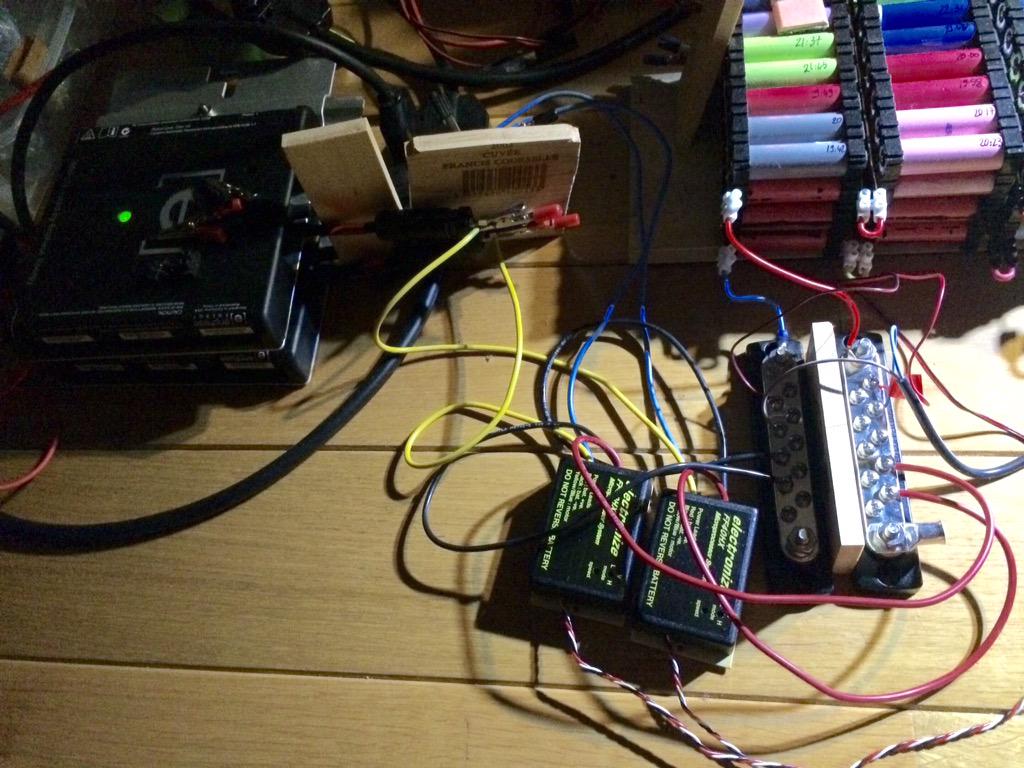
Also I am in the process of building and testing a second version of this DIY ESS, called DIY ESS V2 with Enphase, because it will use the famous Enphase Micro Inverters - M215 or M250 - for more efficiency
It's design & build should be simpler, but it is not ready yet ...


With the new Tesla PowerWall, Enphase AC Battery coming, it really shows everyone that Energy Storage is a serious business and a perfect complement to solar and/or wind installs, at the residential level !


To Celebrate this 2 years milestone, I decided tho slash the DIY ESS Kit price and remove 100 EUR from it, dropping from 249 to 149 EUR ! (Kit #2 is also reduced by the same amount of course)


Also the Kit Building Documentations are now available to anyone FOR FREE on the DIY ESS Kit website ! "All our Patents are belong to you" ;)
http://www.diyesskit.com/p/documentation.html   (look for the "=> Get the PDF File" links)


To have more info about the Kit and why not build your own, go to:

http://www.diyesskit.com
or
http://www.storeyourenergy.com


Now, you can start building your own DIY Energy Storage System for your Home !


Saturday, May 31, 2014

Norcal Veteran Coder Built his Dream Off-Grid House


Loren Amelang once helped code for Silicon Valley companies, but he'd always been sensitive to environment so when his employer installed fluorescent lighting and wouldn't let employees use their own lights, he decided to move to the country and craft his off-grid dream home.

Today he lives with "clean air, a great view, free hot water and free power, and a decent chunk of free heat". The entire south side of his home is covered in solar capture devices: 1600 watts of photovoltaic power, solar hot water panels, a sunroom/greenhouse and a solar hot air collector. The sunroom/greenhouse provides most of the free heat via the 'solar flue' that moderates it in warmer weather or circulates some of it into the house when needed, and the concrete walls that stabilize the temperature over time.

Putting his technical skills to use (he's a pioneer in C++ programming), Amelang wrote over 10,000 lines of code so that his home's water and electric systems could be operated remotely, by even just an iPhone.

Since he built most of the home himself (the person he hired to do it decades ago, spent all the money and built half the house), Amelang has made it very custom. He avoided using aluminum and plastic (except for the insulation on the wiring) and he wired it for pure DC lighting (which makes sense with solar, but Amelang also likes how "peaceful" DC lighting feels).

Building on his own terms means that Amelang created a home that doesn't look or feel like anyone else's, but it works well and makes sense. For instance, he designed an audio system where you can "walk around in the sound space and feel where you are" and a central locking system for all exterior doors so that when he leaves the house he doesn't have to lock 12 different doors, but just turns one key and they all lock.

* This is a follow-up story with Loren. The original stories from 2011: -- C++ programming pioneer hacks off-grid, DIY, smart home
http://faircompanies.com/videos/view/...
-- 96-square-foot tiny home handbuilt inside century-old barn
http://faircompanies.com/videos/view/...

** Note: Loren has always seen the world differently, in a literal sense and he is hoping to hear from anyone who might experience the same phenomenon. He explains they are "issues are with brain-level perception and my expectations of how the visual world should work". He writes about it more in detail in his blog post "Consumed by the light": http://psychoros.org/lightFrame.html

Saturday, November 23, 2013

DIY ESS - Powering the Electric Train !

Winter is here and it is the perfect time to take the Electric Train out of the closet and play with the kids in a warm home


My daughter is actually discovering since I did not use it for years, since she was to young; She seems to like it :-)


Helped by a little bit of solar, our home DIY ESS is providing power to the whole home, for heating, cooking, lighting, ... and even for the Electric Train !


Just starting with a small circuit


Yes, I put a solar panel on the train station roof, back 7 years ago - used for lighting -


A bit dusty, but still fine


Many rails in there, we did some big circuits years ago with up to 4 trains, including a TGV Est, the very first version of the famous French high speed train of the 80s 


Stay tuned ...

Please Share this Post if you Liked it !

Please Share this Post if you Liked it ! Thanks !
Related Posts Plugin for WordPress, Blogger...