Showing posts with label quick charger. Show all posts

Tuesday, October 8, 2013

Look how Tesla Model S owners will be able to use CHAdeMO 50kW Charging Stations

Tesla Model S owners will be able to use CHAdeMO 50kW Charging Stations, very soon ...

Check out this New Adaptor:

 No, this is NOT a gas nozzle  :-)


Take advantage of CHAdeMO’s network of 50 kW charging stations by enabling onboard hardware and purchasing an external adapter. CHAdeMO stations charge at the rate of approximately 150 miles of range per hour of charge with locations primarily in the Pacific Northwest.

This adapter is specifically for North American Model S. A separate adapter is required for European and Asian Model S. For Model S without Supercharging enabled, onboard hardware must be activated to use the CHAdeMO adapter. Every 85 kWh Model S is already Supercharging enabled.

Adapter
For Model S with Supercharging enabled
Available online this winter
$1,000

Adapter + Onboard Hardware Activation
For Model S without Supercharging enabled
To order before your Model S delivery, email buildmymodels@teslamotors.com.
$2,400

After Model S delivery
Available online this winter
$2,900


*Note: Option not available on 40 kWh Model 

Sunday, August 25, 2013

IKEA stores now offer CHAdeMO Fast Charging

Going to IKEA's website, I just realized that, after Autolib charging stations, they now have CHAdeMO DC Fast Charging stations

These charging stations are actually the twin DC & AC models from DBT CEV, the French manufacturer, and will provide charging capability to Renault ZOE or any EV using Type 2 / Mennekes standard, which now includes the Tesla Model S in Europe

I will have to go test that Fast Charger with my LEAF when I go there :-)


IKEA website (France)

at the bottom is this picture of an Autolib and a LEAF charging from theses 2 different charging stations


It says in the fine prints that all IKEA stores around Paris have a CHAdeMO Fast Charging station and stores in Avignon, Bordeaux, Montpellier, Reims, Rouen and Tours


The number of CHAdeMO stations installed is growing steadily ...

Closeup on Paris and surrounding cities

Friday, March 1, 2013

Estonia is first country to operate a nationwide EV charging network of 165 DC fast chargers

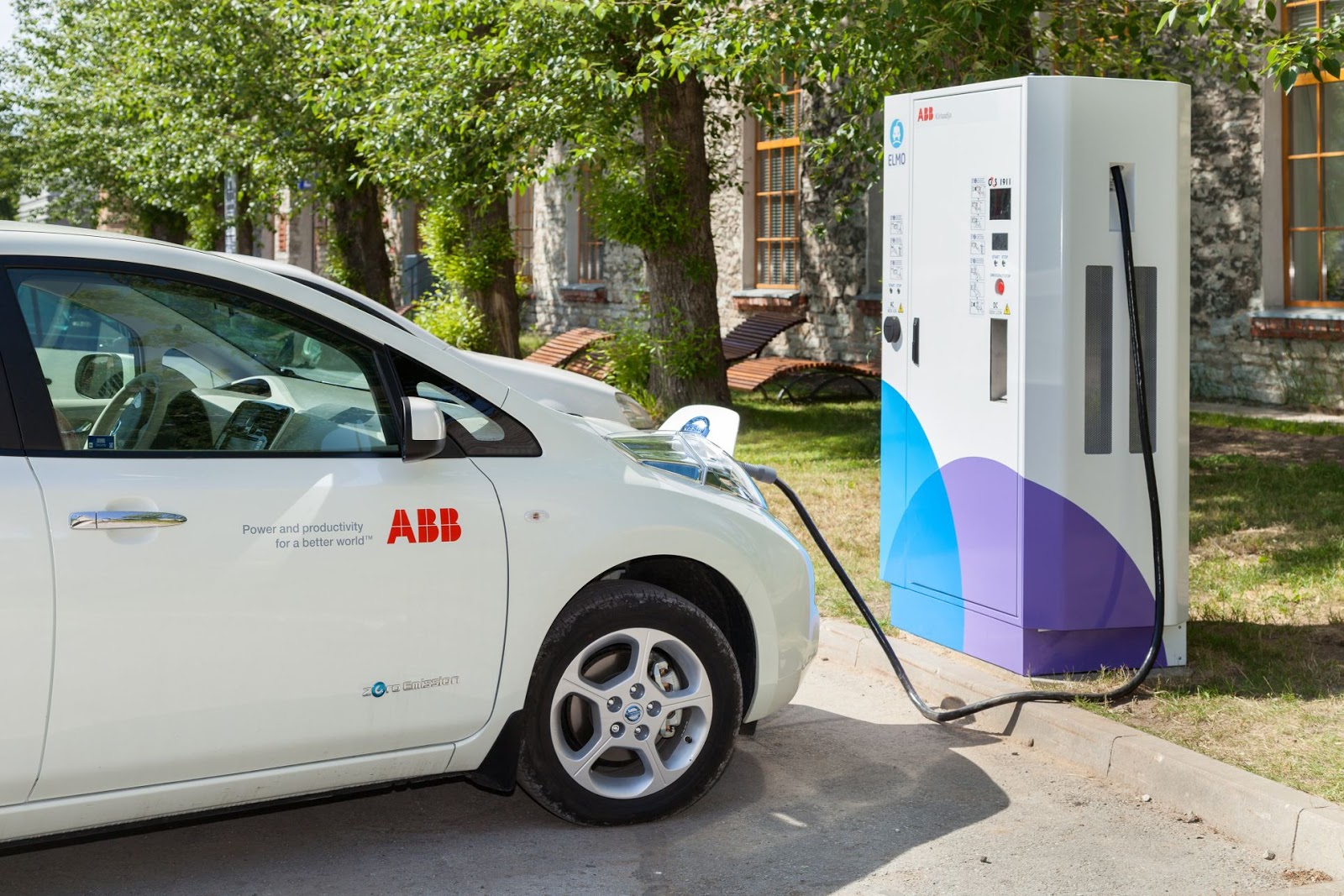
World’s first nationwide EV charging network starts – based on ABB fast charger technology


Zurich, Switzerland, Feb. 20, 2013 – Estonia has become the world’s first country to launch a nationwide fast-charging network for electric vehicles, using technology provided by ABB, the leading power and automation technology group.

The network of 165 web-connected direct current (DC) fast chargers, supplied and built by ABB, was officially opened on Wednesday. The chargers are installed in urban areas with more than 5,000 inhabitants, and on major roads throughout the country, creating the highest concentration of DC chargers in Europe. On highways, the chargers are never more than 60km apart, making it possible for electric vehicles to travel anywhere within the Baltic state without running out of power.


“ABB is delighted to have built the world’s first nationwide electric fast-charging network in Estonia,” said Ulrich Spiesshofer, head of ABB’s Discrete Automation and Motion division. “Having a nationwide fast-charging network will encourage motorists to switch to electric vehicles and it will motivate other countries to invest in their own charging infrastructure.”

Unlike conventional residential power outlets, which take up to eight hours to charge an electric vehicle, ABB’s Terra 51 DC fast chargers need only 15-30 minutes to do the job. The fast-charging stations comply with the CHAdeMO charging standard and can be used for charging vehicles with DC of up to 50 kilowatts (kW) as well as with alternating current (AC) of up to 22kW. The methods can be used simultaneously, if necessary.


“The fact that recharging is so easy is one of the main reasons more and more Estonians will decide in favor of electric cars in future,” said Estonia’s Minister of the Environment, Keit Pentus-Rosimannus. “Our entire transport policy should be based on the notion that environmentally friendly travel is the cheapest and simplest option there is.”

ABB won the contract in 2011 and completed the network in just six months. The contract includes a five-year agreement to provide technical network operating support services for the chargers, which are connected to the central system via an Internet connection, as well as backbone IT architecture. The commercial operation to serve the Estonian EV drivers is handled by local third parties, and is based on a payment platform from parking industry.

Alongside the comprehensive charging infrastructure, Estonia offers subsidies of up to 50 percent of the purchase price of electric vehicles to encourage their adoption.


Source: ABB

Friday, February 1, 2013

Nissan to triple number of EV fast-chargers in the U.S.

Nissan is looking to make it easier for U.S. owners of its LEAF and other electric vehicles to charge their batteries when out and about. Over the next 18 months the automaker plans to add at least 500 quick-charging stations across the country, with the roll out to include the first fast-charge network for the greater Washington D.C. area.


Nissan estimates there are currently only around 160 fast chargers available for public use across the U.S., a number that is sure to exacerbate many an EV owner’s range anxiety and keep many of them tethered fairly close to home. A tripling of the existing fast-charger count will provide additional charging options and, Nissan no doubt is hoping, improve sales of EVs.

In partnership with NRG Energy, whose eVgo Network currently operates in Houston and Dallas/Fort Worth, Nissan says it will work with its dealers and local municipalities to provide extra charging options through its dealer network, workplace campus locations and within local neighborhoods where drivers spend the bulk of their time.

A major part of the charging infrastructure expansion will be a network of 40 eVgo Freedom sites across the greater Washington D.C. area that will each have a Nissan fast charger that can provide an 80 percent charge in less than 30 minutes. NRG has also announced similar networks for the San Francisco, Los Angeles, San Diego and San Joaquin Valley areas.

As well as the 500 public fast-chargers it plans to install in the next 18 months, Nissan says it is looking to increase on the roughly 1,500 charging stations currently available in workplaces by getting companies who already offer such technology to share their experiences with companies interested in getting on board.


Source: Gizmag & Nissan

Friday, January 25, 2013

Carlos Ghosn at Detroit NAIAS about the LEAF

Nissan's CEO Carlos Ghosn talks about the LEAF price drop and the production facilities opening in the US and Europe along with customers expectations being taken into account - 2013 Detroit NAIAS


デトロイトで開催された2013年北米国際自動車ショーでゴーン社長はEV販売から経済状況まで、幅広く今年の展望について語りました。

Wednesday, November 14, 2012

Fuji's low cost 25kw CHAdeMO fast charging station gets first deployment in U.S.


The first publicly available electric car fast charging station on the ChargePoint network has been installed near Los Angeles in the first of what is slated to be a string of fast charging stations in the Los Angeles and San Diego area.


Edison, N.J., and Campbell, Calif., November 8, 2012 – Electric car charging station network operator, EVOasis, has become the first company to install the first publicly available DC Quick Charging station on the ChargePoint network. The new electric car fast charging station was manufactured by Fuji Electric and supports the CHAdeMO protocol used by the Nissan Leaf or Mitsubishi i-MiEV, and was installed at the Residence Inn by Marriott in San Juan Capistrano, California. The 25 kilowatt charging station is open to the public and is convenient to the I-5 corridor just south of Los Angeles.

The Fuji Electric charging station used for this installation will provide a full charge in approximately 60 minutes. Fuji's charging stations have been installed around the world in hundreds of locations, but this is the first time for one to be integrated into the ChargePoint network.

Typically the Nissan Leaf is said to charge, on the fast charge port, to 80% in 30 minutes. The charging time with this station is a bit longer but also provides a full charge. The difference is that the Fuji station runs at 25 kilowatts versus the 50 kilowatt rate of other CHAdeMO charging stations. Fuji says this adds 11 minutes to the recharge time for charging from 23% to 80%, or adds 7 minutes for the time to charge from 40% to 77%. While this adds to the charging time, there are benefits to charging station network providers that should make for wider deployment of this charging station over higher powered units.


The Fuji 25 kilowatt CHAdeMO charging station costs about half as much to purchase, and installation costs are a fraction of that required for the larger more powerful charging stations. Why? It has to do with the sheer bulk of the larger stations, plus the lesser requirements for electrical circuits. The Fuji station weighs 436 lbs versus 2000 lbs for larger stations, it requires only a 208 volt three phase circuit versus the 480 volt three phase circuit for larger stations, and most importantly this charging station will result in smaller demand charges from the electrical utility. DC Fast Charging stations have an external AC-DC conversion unit to charge the battery pack directly from DC electrical current.

Fuji notes that while the SAE DC Fast Charging system has been approved, the market for CHAdeMO fast charging stations is still quite large. There are maybe 30,000 Nissan Leaf's, and other CHAdeMO based electric cars, existent world-wide currently with more being sold every day. On the other hand, sales of electric cars supporting the SAE DC Fast Charging system will not even begin until 2013-14. The long-runningcontroversy between proponents of the CHAdeMO and SAE DC Fast Charge systems was settled when the SAE system was approved, but it's expected to take several years for the SAE system to supplant CHAdeMO. In the meantime the market for electric car fast charging is rapidly changing with other fast charging standards entering the field.

EVoasis offers a charging stations that include full service, with driver comforts including food and beverage service, wireless Internet access, and a drivers lounge, along with solar canopies and on-site electrical energy storage.

The EVoasis website implies the station in San Juan Capistrano is the first of a series planned for the areas between Santa Barbara, Los Angeles and San Diego.

“Fuji Electric is thrilled to be partnering with Residence Inn San Juan Capistrano and Evoasis to offer electric vehicle owners a fast and convenient charging method,” says Phil Charatz, president and CEO of Fuji Electric Corp. of America. “The integration of ChargePoint in our DC Quick Charger enhances the user experience, and we are proud to be the first publicly available DC Quick Charger on their network. We are committed to the EV industry, and will continue to take every opportunity available to further the development of the EV infrastructure in the United States.”


Source: Torque News

More info about the charger : Fuji Americas

More info about this charging location: Marriott Hotel - San Juan Capistrano 

Friday, October 19, 2012

Tahoe to LA - A 530 miles Trip using Tesla's Supercharger Network !


The 530-mile trip using Tesla's superchargers started at Lake Tahoe, near the California-Nevada border.

One week ago at this time, I was speeding down California’s Interstate in a Tesla Model S, on a 530-mile one-day trip from Lake Tahoe to Los Angeles. I told the tale of using Tesla’s supercharger network, and reviewed the vehicle, in yesterday’s New York Times. But that was intended for a general audience. I figured the EV crowd on PluginCars.com would want more of the geeky details about Tesla’s superchargers.

It seems obvious that charging an EV, even at a rapid 90-kW rate, is a different experience than pumping gas into a petrol car. We have become accustomed to rolling up to rest stop on the highway in our gas car, and in a matter of about 10 minutes, pumping gasoline until the nozzle clicks and the tank is full. That’s not what you want to do with a big-battery EV like the 85-kWh Model S.

As I stated in the NYT piece, the rate of charging is about twice as fast when the battery pack is nearly empty as when it gets full. Check out this data, pulled by Tesla engineers right from the Model S I was driving. For two of my three stops, the state-of-charge (SOC) was less than 10 percent, when I arrived to a supercharger.


Timeline of the Model S's state of charger for the 11.5-hour trip.

This might be perceived as a weakness—as if the car was running on fumes (I mean final electrons) as I pulled up for a charge. But it’s actually just one example of how Tesla is using the intrinsic technical and logistical dimensions of EV fast charging to leap ahead of competing models for quick charging.

You can see that during those two stops, at Harris Ranch and Tejon, the batteries were only restored to about 65 percent and 55 percent SOC respectively. Those recharging sessions were completed in 38 minutes and 25 minutes, and added 153 miles and 117 miles. I could have added more without a problem, except for two things: I didn’t need more juice than that to get to the next supercharger, and the reduced pace of recharging to get to full would have slowed down the trip.

I spent more time at the first stop in Folsom, and charged to about 95 percent SOC—or 250 miles of range—because the leg from Folsom to Harris Ranch, near Coalinga, was a bit more than 200 miles. This graph shows the remaining range at all points along the way.


Timeline of the Model S's remaining range for the 11.5-hour trip.

That Folsom-to-Coalinga stretch is not a true indication of what Tesla has in mind, because the company’s strategy is to place superchargers only about 150 miles apart. Last week, we were trying to test the limits of the network—on the company’s inaugural run—but very few, if any, Model S owners will want to drive from Lake Tahoe to L.A.

The supercharger network was created to enable the most likely trips—like Tahoe to San Francisco; SF to LA; or LA to Vegas. So, the only reason we topped up in Folsom, and kept our speed to around 70 miles per hour, was because we were breaking the boundaries of how the system was designed to work.

J.B. Straubel—Tesla’s chief technology officer and the driving force behind the supercharger strategy—told me, “When you start to look at how many you need to enable all the frequent destinations, it’s in the tens if you’re in one state, to the hundreds nationwide. You don’t need 10,000 of them.”


Top: The locations for Tesla superchargers opening to Model S drivers by the end of October, 2012.
Bottom: A nationwide network of superchargers, based on this map from Tesla, can serve the entire country with around 100 locations.


Good Economics

Now, consider relatively low hardware costs for the superchargers, because they are primarily comprised of a dozen of exactly the same on-board 10-kW chargers found in the vehicle—made from the same components and manufactured on the same production line. Straubel told me that each supercharger costs “less than half” of what competing quick chargers (like CHAdeMo) are running. And they are faster.


The refrigerator-looking object is the actual Tesla supercharger. Inside, a dozen of the 10-kW chargers used in the vehicle are stacked up, and supported by computers and liquid cooling. One 120-kW supercharger can serve two vehicles at a time. The pedestal by the car merely supports the charging cord.

It makes good technical and economic sense to Straubel for the same company making the cars to make the off board fast chargers.

“For the cost of one hydrogen fueling station, we can put in a sizable part of a network,” Straubel said. “It’s pretty cool. We’re linking east and west coast, north and south. You can go from Tijuana to New York for free and back. In an EV, in about the same time you can do it in a gasoline car.”

Cheap electricity means that Tesla can make the chargers available at no extra cost to its customers. The network is primarily designed to sell more cars—the first business model for public charging that makes sense to me.


The Tesla supercharger location in Tejon, Calif., is the first that uses solar power. Others will follow. Solar energy will ensure that Tesla vehicles using the network will run on renewable energy, and it will reduce ongoing operation costs.

High-price demand charges from the utility company are mitigated by using solar and stationary batteries, as is planned for many of the Tesla charging locations. While the most built-out Tesla charging locations with full solar and enough connectors to serve eight vehicles at the same time could cost a quarter-million dollars, the stations I visited are more likely to be a third of that cost.


Leading Edge

Tesla is being criticized for the fact that the superchargers are only available to their vehicles. But the company doesn’t want to wait for the entire industry to make up its mind about standards, or to catch on to its approach. Can you blame them? First of all, you need big battery EVs, like the 85 kWh Model S, for the idea to work as intended. And the battery systems in those vehicles must have the capacity to take 90-kW charging.

Once a few thousand Model S drivers start using the system for all-electric road trips, perhaps other automakers will start knocking on Tesla’s door, to see how their EVs can be equipped to use the network. Toyota and Daimler, as existing Tesla partners, are possible candidates.

What I like most about the Tesla supercharger network is how the company looked at long-distance electric vehicle driving and charging with the mindset of experienced EV guys—not like internal combustion carmakers thinking about electric cars for the first time. This EV-centric approach—electricity runs in Tesla's blood—has allowed them to devise a cost-effective solution to a problem that hasn’t crossed the mind of other carmakers. And even if it did, they wouldn’t dare to try to solve it.


Source: PluginCars

Wednesday, September 12, 2012

Energy Storage at Nissan's in Japan using LEAF Battery Packs

Hidetoshi Nakata, a famous retired football player in Japan, is taking a look at the LEAF Battery based Energy Storage System at Nissan's


A nice solar array on the roof at Nissan's


Question: What is in this big cabinet ?

Answer: Several LEAF battery packs hooked together !

And with this stored energy you can charge your LEAF whenever you want to, and fast charge it here using CHAdeMO ! :-) 


More about this visit on Nakata's website

中田英寿がみた、日産リーフ。#05 横浜「日産グローバル本社エコツアー」

中田英寿の第3の旅が始まった。これまで世界を巡り、日本を巡ってきた。そんな彼が新しく始める旅、それは「日産自動車を巡る旅」だ。特に今回、彼が興味を持っているのは­­­、世界初の量産型電気自動車、日産リーフ。従来とは違う発想、構造、乗り心地・・・。中田英寿は、そこに日本そして自動車の新しい可能性を感じているようだ。


Thursday, August 30, 2012

Forget Smart Cards: This Electric Car Charging Station Is Coin-Operated


Ask any electric car owner to tell you about public charging stations, and they’ll likely show you the wallet full of smart cards and RFID tags.

That’s because most electric car charging stations, with a few exceptions, only give access to pre-registered members.

But what if you could pay for your charge in the same way you pay for parking, with cold, hard cash?

It might sound like a simple idea, but we’ve just learned that it wasn’t until earlier this year that the world’s first mass-produced coin-operated payment machine specifically designed for high-power electric car charging stations finally went on sale.

According to Japan For Sustainability, Fuji Electric Co. of Japan, producer of many products including a range of rapid, direct-current charging stations, began to offer the optional coin-operated accessory to retail customers back in April.


Fast Charging 2011 Nissan LEAF

Designed to fit on any of Fuji’s existing charging stations, the unit allows electric car owners without a smart card to pay with coins instead of a credit card.

Just like a coin-operated washing machine at a Laundromat, a vending machine, or a parking meter, the charging station owner can set their own pricing scheme, while customers pay on a per-kilowatt-hour basis for the electricity they use.

The result is a readily-accessible charging station that can be used 24-hours a day, requires no smart card, or giving your credit card details out over the telephone.

Sadly however, the coin-operated addition isn’t cheap.


Electric-car charging network cards, photo by Patrick Connor, Portland

Japan For Sustainability reports that the optional extra costs an additional $7,317 on top of the price of one of its charging stations.

With so much of modern society moving away from cash, do you think charging stations that take dollar bills and loose change in payment for charging your car are a good idea? Do you prefer the wallet of smart cards, or think there's another solution?

Or do you find that, like us, you never carry any spare change around?


Source: GreenCarReports


Tuesday, August 21, 2012

2,400 km Trip with a LEAF throughout Europe

When it comes to going on vacation with an Electric Car, people think it is impossible ... because of the limited range of course

A family of 4, Mark Nitters, his wife and their two kids, from Grasse (South of France) decided to go for a 2,400 km trip throughout Europe with their Nissan LEAF this summer !


Leaving from the French Riviera in july, they went to Paris, Belgium, the Netherlands, then to Scotland, Ireland, and eventually they will go back home


They are of course using CHAdeMO DC fast chargers along the way as much as they can but also use regular wall socket charge in hotels or at friends & family


Check out their travelling experiences on their great blog : Grasse Glasgow Electric 2012


They are sponsored by the electric components maker Walther  and are using some of their products, especially the Type 2 to Type 1 (or J1772) cord used everywhere in Europe


My Favorites:

The best DC Fast Charger spot so far is in the Netherland :-)

A 25 meters extension cord in the trunk can be usefull from time to time ;-)

Check out the gas prices in Belgium ! Electricity is defenitely cheaper :-)

Monday, July 23, 2012

Thursday, July 5, 2012

CHAdeMO Connector Interface Technical Diagram

Found this by accident, interesting technical diagram of the CHAdeMO connector interface


The CHAdeMO quick charger design has a controller that receives EV commands via a CAN bus, and the quick charger sets the current to meet the EV’s command value. Via this mechanism, optimal and fast charging becomes possible in response to battery performance and the usage environment.

 - Maximum current: 200A
 - UL/CE certified.
 - Getting feedback from field use, the design is improving.
 - Detail dimension of interface geometry is open to public, then any
  maker can fabricate compatible connector.

 The CHAdeMO quick charger uses an analog signal transmission and a digital
 communicationvia CAN.
 This diverse and redundant design ensures its safe operation.

 In the design of the DC connector, in addition to having enough safety
 margin such as an insulation distance, between the power pins, four analog signal pins,
 two CAN digital signal pins and one ground pin which are implemented so that
 the control signals can be transferred properly between the vehicle and the charger.

CHAdeMO connector - YAZAKI Corporation


Thursday, June 28, 2012

REFUEL 2012 - Clean Power Motorsports Event @ Laguna Seca

What are you doing on Sunday ?

REFUEL 2012 is the 4th annual Clean Power Motorsports Event at Mazda Raceway Laguna Seca for all Electric Cars and Motorcycles. Several members of SF BayLEAFs will be there, driving their LEAFs on the track, and while it is too late to sign-up for track time, it should be a great spectator event with all sorts of 2 and 4 wheel performance, prototype, experimental, and production EVs trying their skill on one of the world's most challenging racetracks.


The Tony Williams BC2BC car will be there on its return trip from Canada, and SF BayLEAFs has worked with Nissan to provide one of their mobile DC QC units for free quick charges at the track. A special guest for the event will be one of the Nissan LEAF Durability Engineers from their Arizona Testing Facility. He is entered to race that day, and would enjoy talking to SF BayLEAF members about how their cars are doing, and EVs in general.

Wednesday, June 13, 2012

Renault to install 1000 Quick Chargers in France

Renault wants to install 1000 Quick Chargers in France


ZOE and its cameleon charger should be able to handle this kind of charger and is coming out soon here


Renault is also providing an iPhone App called "Renault Z.E. Plug Quest" where you can vote for future Quick Chargers locations !
 

Please Share this Post if you Liked it !

Please Share this Post if you Liked it ! Thanks !
Related Posts Plugin for WordPress, Blogger...