Showing posts with label Demand shifter. Show all posts

Sunday, November 17, 2013

DIY ESS - LiFePO4 CALB CA180FI Voltage Check

As I was moving my ESS upstairs one month ago,  and split the CALB CA180FI battery pack in pairs, I shot another small video doing a cell voltage check, and as usual, they are all in balance ...


The ESS battery pack is now charged and discharged fully in winter, using the low cost electricity provided by our energy provider TOU - Time Of Use - to charge, and discharging into our home grid during peak hours, mostly for heating, cooking and lighting


Wednesday, August 28, 2013

GE Energy Storage - Energy Management for the Modern Age

General Electric's vision of Energy Storage:


"Access to cost-effective and reliable power is essential in today‘s world. For some users, access to highly reliable power that is available 24 hours a day, seven days a week, is critical. Durathon Batteries are a safer, reliable and low maintenance technology that provide effective back-up power for users while saving them money on their energy bill.


In contrast to other backup applications, the Durathon Battery Energy Storage System can reduce a users’ energy bill while waiting for the grid to fail. Utilizing Durathon Battery’s superior cycle performance, the system reduces a user’s daily peak demand load by peak shaving, or smoothing out their energy consumption. For many users, demand response charges can be a significant component of their electricity costs and leveling energy loads across a day provides real savings. When the grid falters, Durathon Batteries are ready to provide hours of backup power supply.


For owners looking to integrate renewable sources into their building’s power supply or roll out electric vehicle charges, the Durathon Battery Energy Storage System is the ideal choice. Durathon Batteries have an extremely small footprint and require minimal maintenance, ensuring that the system is cost effective to install and operate. With the capability to be fully integrated into an existing building energy management system, Durathon Battery technology’s superior storage capability helps ensure renewable power supply is balanced with building loads, and congestion and peak demands caused by excess EV charging are decreased.


Micro-Grids
Micro-grids, whether located on a true geographical island or simply isolated within a building complex, present unique energy challenges such as high diesel costs, renewable integration or the need for black-start capability. For such applications, Durathon Batteries provide smart energy management options to maximize efficiency and lower costs.

Due to the lack of alternate energy sources, micro-grid operators often rely heavily on diesel generators, despite expensive operating costs and slow response times. Most generators are not run at maximum efficiency, which leads to cost and maintenance issues. By using Durathon Battery’s superior cycling capacity in hybrid mode, it is possible to increase the fuel efficiency of the micro-grid by up to 40%, reducing costs and resource usage through better management of fuel deliveries. Durathon Battery technology also provides backup power and black-start capability to get the micro-grid back up and running if the generator fails.

Durathon Batteries’ scalable design means more modules can be added to the micro-grid for renewable integration. Its high-energy capacity also ensures that renewable power is used effectively and efficiently."


Source: GE Energy Storage

Thursday, March 7, 2013

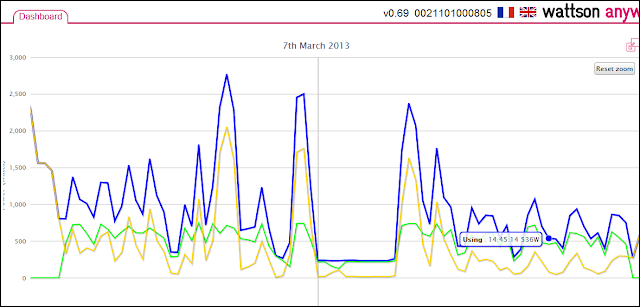
LiFePO4 DIY ESS - Full Day Test Today

After fully discharging and fully charging my ESS, I started it this morning and let it run in automatic mode to see how it behaves ...

Around 2:30 PM, 2.88kWH pushed back into our home grid

Overview in Wattson Anywhere (click)


Power graph (click)


Energy graph


At 3:30 PM, still ON


and 3.38kWh (click)


and it is over around 4 PM


with a total of 3.38kWh pushed back into our home grid after 7 hours of inverter mode


Friday, August 24, 2012

3 Tri-City utilities to start pilot project on storing electricity


Three Tri-City-area utilities plan to start a pilot project in September to show how utilities might be able to store electricity when it's cheap and then release it back to the grid when it's in demand.


The project will help guide research that could make day-to-day storage of electricity by utilities practical, saving customers money and making better use of wind and solar power sources.

Benton PUD is an original participant in the Pacific Northwest Smart Grid Demonstration Project led by Battelle and paid for in part by the Department of Energy.

Franklin PUD and the city of Richland also have been added to the demonstration project through their involvement with the Tri-City Development Council's Mid-Columbia Energy Initiative.

"Demand shifter" devices have been installed by all three utilities.

Each utility has a large metal cabinet, about 6 feet tall and 6 feet wide, filled with batteries to store electricity at times it is not needed.

Battelle, which operates DOE's Pacific Northwest National Laboratory in Richland, will transmit information showing when the price of electricity increases and decreases to a computerized system controlling the demand shifters for the three utilities.

The demand shifters then can store electricity at off-peak hours when electricity is most abundant and least expensive for the utilities. It then can release the electricity back to the grid when demand is high, such as evenings when people are home and using more electricity.

The pilot project is being done on a small scale over two years, with each utility able to store 10 kilowatts for four hours. The average house uses about 1,400 kilowatt hours a month, according to Benton PUD.

"The project should provide some really good background," said Karen Miller, spokeswoman for the Benton PUD. "We're going to learn a lot in the next two years about how energy storage can be incorporated into the utility system."

Battelle researchers plan to quantify the costs and benefits of the demand shifter. For the study, a product called Grid.Balancer, manufactured by Demand Energy in Liberty Lake, is being used.


Anytime utilities can use energy more efficiently, it saves money for the customer, Miller said.

It also could help utilities make better use of renewable resources.

"This has the potential to help offset the intermittency of wind and solar, making them a more reliable source of energy," said Jim Sanders, general manager of Benton PUD, in a statement.

Wind only blows a third of the time.

But, should research prove successful, eventually large-scale demand shifter projects could allow electricity produced when the wind is blowing to be saved for some of the times when it is not.

In addition to the Tri-City-area project, 10 other utilities in Washington, Oregon, Montana, Idaho and Wyoming are participating in the Battelle project with different smart grid programs tailored to its customers.

Smart grids enhance power delivery through two-way communication between suppliers and consumers.

DOE provided $89 million in Recovery Act money for the project, with that money matched by BPA, utilities and five technology companies that make up the demonstration project team.


Source: Tri-City Herald

Please Share this Post if you Liked it !

Please Share this Post if you Liked it ! Thanks !
Related Posts Plugin for WordPress, Blogger...