Showing posts with label frequency regulation. Show all posts

Sunday, December 21, 2014

Reposit Power : Store Solar Energy & Trade it with Grid

A Canberra-based company is to introduce new technology that it says could help turn electricity markets on their head – by allowing households to buy and sell electricity on the market.

The buying and selling of electricity has hitherto been the province of large or specialised companies such as electricity retailers. But Reposit Power says that homes and businesses can and should be able to trade electricity with the help of battery storage, and production facilities such as solar panels.


Reposit Power plans to install battery storage in six homes around Canberra to run a six-month pilot of its technology, known as GridCredits. The Australian Renewable Energy Agency is contributing $445,000 to the $900,000 project.

Reposit Power says GridCredits is a world-first energy storage program that will put consumers in the driving seat and will "transform the grid forever."

Spokesman Luke Osborne says the technology will allow households to "buy low and sell high" – adding a new layer of possibilities to homes that have solar and storage. He says this will enable some households to virtually eradicate their bills and still remain connected to the grid by doing what the retailers do – maximising their earnings on the market.


"A lot of what retailers do is buying services from peaking power stations. Consumer with storage and solar panels can provide the same services themselves," Osborne told RenewEconomy in an interview.

"What we are doing is when it makes sense – households can be a seller, and then buy electricity at a low price."

Reposit Power is interested in using similar technology for wind farms and solar farms and for large businesses. "This is the alternative to going off-grid – households can be energy independent, at the same time as making the whole grid cleaner," Osborne says.

"Networks should be a platform for trading and exchange of electricity, so tariffs should be structured to encourage this, not to prevent it, or that will accelerate the death spiral of the grids.

"This is about households being able to go head to head with the major companies."


Reposit Power hopes to be able to broaden its rollout by mid next year, when this initial program is complete, and when it has convinced the Australian Energy Market Operator that households or businesses can be a "reliable source of power", as AEMO requires.

ARENA CEO Ivor Frischknecht said the new technology would allow consumers to gain more value from their rooftop solar PV installations. He said that one in five houses now use solar power.

"This substantial rise has made it vital to find solutions to better manage how residential solar systems operate in our electricity grids," Frischknecht said.


"Reposit's GridCredits system can control and store solar energy. This gives consumers access to their own power overnight and at peak times, reducing their demand on the grid.

"It also allows energy to be sold back into the grid by placing bids into the market, turning residential properties into micro power plants."

Frischknecht said that storage would help network operators manage demand more effectively by delivering stored power into the grid at peak times, and Reposit's technology will also help smooth out the variable delivery of solar energy.

This in turn would allow more renewables to be connected to the grid.

Reposit Power was co-founded by energy industry veteran Dean Spaccavento and scientist Lachlan Blackhall. The company says the two "shared a vision for allowing consumers to trade their electricity while contributing to a safe and cost-effective grid."


Source: Renew Economy

Saturday, November 29, 2014

When batteries beat traditional power


Battery storage is usually seen as being a handy adjunct to help renewable energy square up to traditional power plants. But on frequency regulation, at least, it seems batteries may actually be better than the generation sources they are helping to supplant.

That, at least, is the consensus emerging from early operating experience at Europe’s largest commercial battery power plant, the 5MWh lithium-ion facility that WEMAG has commissioned from Younicos in Schwerin, Germany.


“Whereas coal-fired and other thermal plants typically take up to 30 seconds to adjust production up or down, and then just hit the neighbourhood of where they are supposed to be, batteries react within milliseconds,” explains Philip Hiersemenzel of Younicos.

The fact that batteries might beat traditional power plants for frequency regulation has long been touted as a big selling point for battery storage and has already helped sell projects in the US.


Now the performance of WEMAG’s installation is strengthening that business case.

As well as being able to respond to frequency shifts more quickly and accurately, says Hiersemenzel: “The second reason batteries are better suited is that they don’t require CO2 emissions to adjust the frequency.”


No must-run capacity

Furthermore, he says, batteries do not create any ‘must-run’ capacity. In other words, they don’t need to remain operational when not being used for frequency regulation, reducing overall power generation.

This can have a significant impact on carbon emissions. Younicos says most thermal power plants need to run at around 70% of total capacity just in order to provide decent frequency regulation, and in German coal-fired plants the level is about 90%.


“This creates an overall must-run capacity of 25GW in Germany alone,” Hiersemenzel states; “25GW of coal and nuclear power must be fed into the grid at all times.”

Natural gas plants are more flexible and can provide frequency response while running at as little as 40% of capacity. “But they’re also more expensive than coal,” says Hiersemenzel.

“Since we’re already competitive against the marginal cost of a completely written-down coal plant, imagine how competitive we are against a new gas plant.”

At the WEMAG plant’s grid-connecting ceremony a fortnight ago, Younicos’s chief technology officer Clemens Triebel pointed out that the facility was essentially providing the same level of frequency control as a 50MW conventional turbine.

Avoiding economic impact

“Coal-fired power plants can only use a fraction of their output for control power,” he said. “This blocks space in the grid, increasingly forcing wind and solar generation to be taken offline. Our battery park avoids this economic impact.”

The WEMAG battery plant features Samsung SDI lithium-ion cells and serves a grid area where 80% of power already comes from wind and solar generation.

It was backed by EUR€1.3m from the German Environment Ministry’s innovation programme and will compete on the primary frequency regulation market, Younicos says.

Younicos expects this capability alone will provide a positive return on investment for the plant. But the facility is also due to earn its keep in other ways. One is by replacing WEMAG’s current ‘black-start’ generators.

“Like all regional grid operators, WEMAG keeps diesel gensets solely for the purpose of black-starting the grid after a power cut,” says Hiersemenzel.

“Such cuts typically happen not so much because of electrical problems in the grid, or even renewable generation, but for much more profane reasons: a car hitting a power line, say.”


Using batteries instead of gensets

When this happens, the grid operator has to coax its power stations back online using smaller genset units. Only WEMAG should now be able to rely on its battery plant instead, and save the expense of maintaining gensets.

The facility, which has been praised by the German Vice-Chancellor and Energy Minister Sigmar Gabriel, and Mecklenburg-Western Pomerania’s Minister-President Erwin Sellering, could also be used for other auxiliary services, such as voltage control.

In fact, for another Younicos project, the 6MW, 10MWh Smarter Network Storage plant being built for UK Power Networks in Leighton Buzzard, UK, batteries will be used for at least six different functions, including peak shaving, and possibly all at once.

Trying to squeeze that much functionality out of a single battery plant will probably cut the lifetime of the batteries, Hiersemenzel points out.

But it is the operator’s choice whether to try to stretch the lifespan of their investment or get the most value possible out of it over a shorter period.

For now, what the WEMAG plant and other early grid-connected battery facilities are showing is that energy storage is no longer about making renewable-laden grids as good as traditional ones; it is about making them better.


Written by Jason Deign

Source: Energy Storage Report

Sunday, April 20, 2014

California to Utilities: Connect Battery-Solar Systems to the Grid

California regulators have just issued a rebuke to utilities, and a thumbs-up to customers and companies that want to connect hundreds of now-stalled battery-backed solar PV projects across the state.
On Tuesday, the California Public Utilities Commission issued a proposed decision that would exempt most storage-solar projects from extra utility fees and interconnection studies (PDF). Instead, it would require utilities to treat them as regular old net-metered solar systems, as long as they meet certain requirements.


For the past twelve months or so, California's big three investor-owned utilities -- Southern California Edison, Pacific Gas & Electric and San Diego Gas & Electric -- have been demanding these systems undergo extensive reviews that come with between $1,400 and $3,700 in extra fees. Utilities have said they need to do this for safety reasons, as well as to make sure that batteries don't store grid power, then feed it back under the guise of green, net-metered power.

Solar and storage system installers say these unnecessary fees and studies have brought new battery-solar projects to a screeching halt, and slowed to a crawl grid interconnections for those that have been approved. SolarCity, for example, says that of the more than 500 customers that have signed up for its solar battery systems, only twelve have been connected to the grid.

Tuesday's proposed decision makes it clear that CPUC agrees with SolarCity and its customers, not the utilities. "We disagree with IOUs' conclusions and would have preferred that the IOUs had taken a more proactive and collaborative approach to avoid creating barriers," it states. In an October assigned commissioners ruling, CPUC President Michael Peevey noted that more than 10 megawatts of solar-storage projects have been put on hold in the state because of the utilities' stance.

Indeed, storage and solar advocates have been anticipating a ruling that supports a more streamlined, no-cost solution. This proposed decision doesn't give them everything they want, but it would certainly remove the main obstacles.

"I think it's going to streamline it quite a bit. There were customers who weren't able to pay these interconnection fees who we can now move forward," Peter Rive, SolarCity co-founder and CTO, said in a Tuesday interview.


UDPATE: Bloomberg reported Wednesday that SolarCity has resumed submitting applications for projects in light of the proposed decision.

SolarCity has been installing batteries from Tesla Motors in homes since 2010 as part of the California Solar Initiative program. In December it announced it was entering the commercial building market as well, competing with companies such as Stem, Green Charge Networks and Coda Energy to provide low-cost battery systems to mitigate demand charges.

But SolarCity CEO Lyndon Rive and his cousin, Tesla CEO Elon Musk, complained during a February CPUC workshop that the utilities' blockade has pushed the average wait time for interconnections to eight months. Last month, SolarCity announced it would stop filing applications with these utilities until the impasse was broken -- a stance that could be re-examined if CPUC commissioners approve this proposed decision at their next meeting.

Peter Rive noted in Tuesday's interview that opening the grid to solar-storage systems should also give utilities, grid operators, individual customers and aggregators like SolarCity a chance to optimize their interactions with the grid at large.

"The idea of solar plus storage being something that removes a customer from the grid is counterproductive to us seeing those benefits," he said. "I think a lot of utilities don't know which way to go. They see these benefits, but they say, 'How do I aggregate these customers, when it adds up to tens of megawatts, not just hundreds of kilowatts?' […] We can aggregate customers in large numbers and use them like a virtual power plant."

CPUC's proposed decision lays out certain limits for systems that are exempt from all fees, interconnection studies and distribution system upgrade cost triggers. First, the energy storage component would have to be smaller than the net metering-eligible generator it's attached to -- usually solar panels, but potentially wind or other qualifying resources – when the system is larger than 10 kilowatts. For systems under that scale, no sizing limits are proposed.


That size threshold also applies for two different ways to meter the output of solar-storage systems. Under Tuesday's proposal, systems larger than 10 kilowatts will require a separate meter for measuring the interplay of battery-charging and solar generation, although the CPUC does take SolarCity's suggestion to cap that extra meter's cost to no more than $500.

For systems less than 10 kilowatts in size, the proposal takes up a system suggested by solar-storage startup Sunverge, to use the local data acquisition system to measure energy drawn into the storage unit, then use that to "de-rate" the annual net metering credit for on-site generation. In other words, it calls for trusting the solar-storage system to measure its own give-and-take status against the grid.


Also, "Because storage systems continually consume some power to maintain system services, these systems should not be penalized for de minimis consumption. Therefore, customers shall receive 100% of annual NEM credits where the annual de-rate factor is 95% or higher," the proposed decision states. That's important to avoid degrading the value of net metering, which makes up a significant payback stream for rooftop solar in California.

"We're very encouraged by the proposed decision having no application fees, and having the costs of the meters capped," Rive said. Given that SolarCity already monitors each individual installation at the meter and at the inverter, "I don't think a meter is necessary at all -- but we're moving things forward," he said.

Other companies, such as Sunverge and Outback Power, have also been filing briefs in support of the CPUC's proposal to exempt simple solar-battery projects from high fees and complicated studies. California is already pushing forward with rules for integrating 1.3 gigawatts of energy storage into the state's grid by 2020, and calls for customer-sited storage to make up a significant portion of that total.
Besides the storage mandate, California is also undergoing a rewriting of its net metering policies, which could open up possibilities for storage-backed solar systems to interact with grid needs in new ways. Rive noted that SolarCity has just launched a Grid Engineering Solutions department that is working on ways to share its aggregated solar-storage capabilities with utilities or grid operators like California ISO.


Source: GreenTech Media

Thursday, October 24, 2013

Winter: Charging during the night, using the Stored Energy from the ESSand Solar during the day

Winter: Charging during the night - off peak rate TOU -, and using the Stored Energy from the ESS and Solar during the day to shave peaks and compensate home usage as much as possible 


The US DOE publishes a website to track Energy Storage Projects


"The DOE International Energy Storage Database provides free, up-to-date information on grid-connected energy storage projects and relevant state and federal policies. All information is vetted through a third-party verification process."


You can refine your search with Technology Type, Location, etc 


For example: with Battery, in France I found two Porjetcs:
- One in Brittany, based on Sodium Sulfur Batteries, providing 1GW for 7:12 :

and a Second One in French Riviera, Nice, based on Lithium-ion (what exact technology of li-ion ?), providing 1GW also, but for 30mn only

Maybe I should try and add my DIY ESS
It is small, BUT, if 500 families install this kind of system at home, they would provide also 1GW of power for several hours, captured from solar or/and wind, produced locally ...


Saturday, August 31, 2013

DIY ESS - Follow its activity with 3 Wattson units

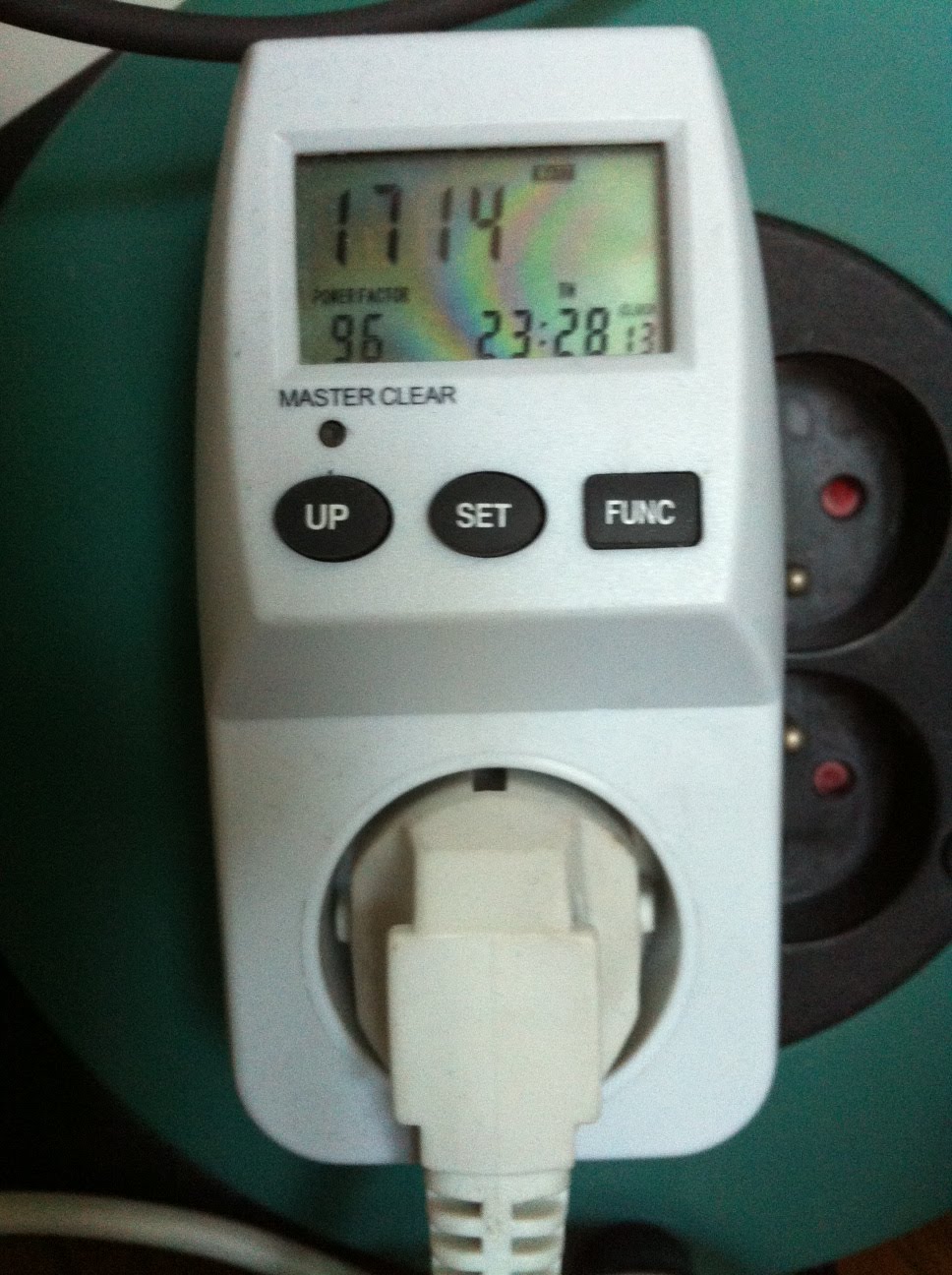
See my ESS in action at home with 3 Wattson units, displaying Home Usage, Generation (from Solar + ESS) and Net Usage

Mostly shot during the evening diner cooking with a rice cooker on (400W),  a stove (1500W on and off), some lights, etc

A good example of peak shaving & smoothing, done at home :-)


and the Power graph shows this activity in the evening (peak)

and the Energy graph

Close up / Focus on this period: The Usage is almost completely covered by the Generation (Solar & ESS mostly), and Energy required from the Grid pretty small 


Wednesday, August 28, 2013

Japan contracts two massive Battery Storage Systems to balance Wind, Solar PV load

Japan's Ministry of Economy, Trade and Industry (METI) has chosen three companies to install two large-scale battery systems in the northern part of the nation to support the expansion of wind and solar on Japan's electric grid.


Sumitomo's redox-flow battery will occupy 
a new 5,000 square meter facility in Hokkaido


Through the Large-scale Storage Battery System Demonstration Project, Hokkaido Electric Power Inc. (Sapporo, Japan) and Sumitomo Electric Industries Ltd. (Osaka, Japan) will jointly install a 60 MWh redox-flow battery on the island of Hokkaido. Additionally, Tohoku Electric Power Co. Ltd. (Sendai, Japan) will install a 20 MWh lithium-ion battery in the Tōhoku region.

“This project is Japan’s first effort to introduce large-scale storage batteries in electricity grids, and METI aims to rapidly acquire the necessary technology and know-how so as to utilize such batteries in electricity grids in a specific manner,” declares METI in a press statement.


Projects to study frequency variation, supply/demand balance

The two projects were chosen via a public solicitation held in April 2013. Tohoku Electric Power's lithium ion project was chosen to address the issue of frequency variation, and Sumitomo's redox flow battery has been chosen to look at the technology's ability to balance supply and demand at times when demand falls.

The Tōhoku project will coordinate the lithium ion batteries to operate with conventional power generation while utilizing the batteries as much as possible to adjust frequency, suppressing the impact on battery life.

In the Hokkaido project, the companies will not only look at how well the batteries address varying electricity output from wind and PV, but also at developing technology to control and manage the battery system. METI notes that redox-flow batteries can be used to deal with supply/demand balance over a long period of time.

METI aims for the projects to increase the capacity of the supply-demand adjustment function by 10% in each region.


Sumitomo to develop battery based on results of tests

Sumitomo and Hokkaido Electric plan to complete installation of the redox flow battery by the end of 2014, and carry out verification tests over the next three years. The massive battery system will occupy two floors of new building roughly 5,000 square meters in size, with the electrolyte tank on the first floor, and the cell stack and heat exchanger on the second floor.

The battery system will have a storage capacity of 60 MWh, and a rated output of 15 MWh.

The company notes that redox flow batteries can be used for a wide range of applications, including addressing frequency variation. Based on the results of the tests, Sumitomo plans to offer a redox flow battery with improved performance.


Source: Solar Server

2013-08-09 | Courtesy: METI; Image: Sumitomo | solarserver.com © Heindl Server GmbH

Friday, May 31, 2013

How to manage risk in energy storage


Understanding the uncertainty associated with operating variable generation systems helps manage the level of risk associated with delivering services.


Moreover, appropriate selection of the rating and charge/ discharge characteristics of an energy storage device, coupled with appropriate operational management, can improve the ability of a variable generation system to participate in certain markets.

This article explores the use of simulation and optimisation techniques for investigating the characteristics that a variable generation system with energy storage should have for given operational profiles. Two examples are considered in this article.

In the first, optimisation techniques are used to determine the rating and charge/discharge characteristics of a variable generation system to maximise revenue on the spot market.

A study of this type is based on historical data of power output and market price, and does not require detailed consideration of technology selection.

In the second example, simulations are used to explore controlling the operational characteristics of a system that combines variable generation with energy storage, and to evaluate the affect that different energy storage interface configurations will have on grid response. Initially, a high level representation of the energy storage device is used in this type of study.

As the study progresses, more detailed representations of different technologies are included in the simulation framework.
Variable energy producer

Historical data of power output and market prices may be used to determine whether an energy storage device would improve the ability of a variable energy producer to participate in certain markets. In this article, spot market participation is considered, although the techniques discussed are applicable to ancillary markets.


Figure 1 shows a schematic of energy flow considered in the optimisation framework


The optimisation problem is then to determine not only the charge/discharge profile of the energy storage device over a period of time, but also to determine the most appropriate energy mix at any given time for charging the energy storage device and supplying energy to the grid.

The optimisation aims to maximise revenue while ensuring that physical constraints associated with operating the energy storage device are not violated.


Figure 2 shows an example of results from an optimisation for a two day period.


In line with expectation, these results show that the energy storage device is charged during periods of lower market price and discharged during periods of higher market price.

Note that compared to a real-world scenario, this example is relatively simplistic for illustrative purposes.


Figure 3 shows the operation of the energy storage device.


In this example, storage capacity was limited to 1200 kWhr and the charge/discharge rate was limited to 200 kW.

As the amount of historic data used in the optimisation formulation increases, the risk associated with the optimisation outcome decreases. The optimisation may be formulated using linear programming, which is beneficial for reducing the computational time of larger-scale problems.

Once the rating of the energy storage device has been determined, a simulation study may be conducted to inform technology selection and the development of appropriate feedback control and supervisory control subsystems for the combined energy storage / variable energy system.

Development of the feedback control and supervisory control systems may proceed on a lower fidelity model of the energy storage device. Lower fidelity models execute faster because they omit detailed representations of power electronic devices, enabling faster simulations and faster iterations during design.

This approach works well because the bandwidth of the feedback control and supervisory control systems will be sufficiently lower than that of the power-electronic switching algorithms, meaning that inclusion of power electronics will have little effect on the RMS operation in the system simulation.


Figure 4 shows the response of a system designed to provide firm power at the grid point-of-connection (POC).


If the energy stored is greater than 10% of capacity, then the feedback control system regulates active power at the grid POC to 0.6 per-unit.

Once the energy stored drops below 10% of capacity, then the energy storage system is charged to capacity at a fixed rate, before the POC regulation is re-engaged.


Figure 5 shows active and reactive power output for a simulation study that compares a standard 6-device insulated-gate bipolar transistor (IGBT) bridge with a 6-cell and 24-cell (per-phase) IGBT modal multilevel converter (MMC) as an interface to an energy storage system.


The system is commanded to move from 0.3 per-unit active power to 1.0 per-unit active power at 0.4 seconds, while regulating reactive power to zero.

The reference tracking capability of the feedback system is not impaired by the inclusion of different power-electronic architectures.


Figure 6 shows the THD of the voltage waveform.


As expected, the THD decreases as the number of power electronic devices in the bridge architecture increases.

Detailed studies help determine the power-electronic architecture, filtering architecture, or combination of the two that is required to meet harmonic distortion requirements.


Graham Dudgeon, Energy Industry Manager, MathWorks


Source : Pace / IICA

Friday, June 22, 2012

The Cash-Back Car: Monetizing Electric Vehicles (Forbes)

While the market for electric vehicles is heating up, with waiting lists for both the Nissan Leaf and the Chevy Volt and startup companies like Tesla, Arcimoto, and Coda Automotive upping their games, some industry watchers still wonder whether electric vehicles will ever become a significant part of the auto market.

But what if you could earn $1,000 a year with your electric vehicle, netting $440 after your fill-up costs? Would that be enough of an incentive to compensate for higher upfront costs and range anxiety?


For years, EV boosters have mulled the possibility of all those car batteries being used to store energy. In addition to drawing electricity, plugged-in cars would also be able to send electricity stored in their batteries back into the grid as needed, acting like tiny power plants.

The grid needs short-, medium-, and longer-term storage to run smoothly, and car batteries could most easily meet the short-term need, a process called frequency regulation. And as we ramp up our percentage of renewable energy from variable sources like wind and solar, the need for this service is growing. But why would car owners allow their cars to be used in this way? Enter the cash-back car.

The so-called vehicle-to-grid model, or V2G, has been a pet project of Dr. Willett Kempton’s since 1997. In an article published that year by Kempton and colleague Steven Letendre, they laid out the economics, the electric engineering, and how to calculate earnings.

Kempton then contacted his regional transmission organization (RTO), PJM Interconnection, which manages wholesale electricity in 13 states and the District of Columbia, and convinced it to make it possible to pay customers for providing this service.


For the last three years, Kempton has operated a pilot project at the University of Delaware, partnering with PJM and a couple of utilities, in which seven electric cars interact with the grid and receive monthly payments.

The service they provide is actually higher quality frequency regulation than the way grid operators have provided that service traditionally: by ramping extra “peaker” power plants up and down, which wastes electricity. It also takes the plants several minutes to ramp up or down. By contrast, batteries in the cars can deliver that service within seconds, making it a more valuable tool. “We’re providing a more valuable and responsive service,” said Kempton.

Federal Energy Regulatory Commission (FERC) Chairman Jon Wellinghoff agrees and believes that value should be compensated with higher payments than the peaker plants receive. He proposed a rule to that effect in February and expects it to become official within months.

The rule would apply anywhere that RTOs or independent system operators (ISOs) have a tariff for regulation services — nearly the entire country, except for the Southwest Power Pool service area: Kansas, Oklahoma, Nebraska and parts of Missouri, Arkansas, and Louisiana.


Cars batteries are a good match with wind power because they mostly charge at night, when people are sleeping, and wind tends to peak at night. Right now, because demand plunges at night, wind generated at night is lower value or sometimes even dumped. Of course, if a lot of cars came online and charged during the day, generators would need to produce more daytime energy. That’s why it’s important to line up “the proper incentives to encourage the car owner to charge at night when the price is best,” said Ray Dotter, a spokesman for PJM.

However, you can’t put your Leaf or Volt to work for you just yet.
To be able to offer frequency regulation service to the grid, cars need a bidirectional power system, so energy can flow both from the grid and to the grid, and software to allow the car to communicate with the grid. Most cars on the market today don’t have those features, although cars from Tesla and AC Propulsion have bidirectional power. “Daimler has announced the Smart fortwo will have this capability in 2012,” said Willett. These cars can also charge faster, at about a mile a minute, he said.

Willet expects that market signals, such as the FERC’s rule change and related RTO and ISO changes, will encourage automakers to make these features the norm in future models.

“If we get the rule out in six months and wholesale providers reset their payments to pay higher amounts for these kinds of services, that will drive car manufacturers to quickly integrate this technology into their cars to allow consumers to participate in these markets,” said Chairman Wellinghoff. “I think it could have an impact in as little as three years.”
Drivers decide when they will need the car and when it will be free for grid use. However, it does require a bit of planning. If you stray from your regular schedule, “You tell the car ahead of time,” said Kempton. “That’s why you get paid money. It’s a slight hassle for the driver. Although ‘telling’ likely means reserving it on your iPhone or on a browser at your home office.”

Another wrinkle: RTOs and ISOs aren’t equipped to manage power from individual cars. The energy generators and frequency regulators they work with must be of a certain size. So for cars to play, they have to aggregate.

PJM requires 500 kilowatts to be registered as a generator, although it may revise that down to 100 kilowatts by the end of the year. Still, that means vehicles have to be grouped together to be able to earn payment.

“One hundred kilowatts would require about 15 cars, some offline and some driving,” said Kempton. “The University of Delaware’s current fleet of seven cars is aggregated with a giant battery to meet the current 500 kilowatt requirement.

For this reason, fleets will likely be the first adopters.

The Department of Defense is intrigued and is studying the matter intently. Last week it put out an RFI to EV manufacturers, EV battery manufacturers, financing firms, and energy management companies for strategies to integrate EVs into DOD’s nontactical ground fleet on a large scale. The goal is to achieve cost parity between EVs and internal combustion vehicles, and one strategy for doing that is frequency regulation.

“Worldwide, the DOD has about 200,000 vehicles in its fleet so there’s a whole lot of opportunity there for us to look at creative ways to advance emerging technologies,” said Camron Gorguinpour, a special assistant to the United States Air Force for Installations, Environment & Logistics.

EVs are attractive to DOD for a range of reasons, including reduction of greenhouse gas emissions, enhanced energy security, and the ability to retain power during a crisis by pairing EVs with microgrids, said Gorguinpour. “And from an asset management point of view, it makes a lot of sense. We’d be putting money into something that sits 99 percent of the time. It would be great to have some value out of that.”

Gorguinpour expects it will take “months, not years” for the DOD to identify the best course of action. It is looking to deploy grid-integrated vehicles by summer 2012.

“DOD is taking this very seriously,” he said.

While still “purely on an exploratory level,” Blue Bird Corporation, a school bus manufacturer in Fort Valley, Georgia, is looking at building this technology into its buses,” said John Kwapis, its chief operating officer.

It seems like a natural fit. “When energy demand is at its peak during the summer months, school buses are at the school yard or bus depot,” he said. “And the amount of battery power needed for a school bus offers the grid a lot of capacity. It takes fewer school buses than cars to get to megawatt,“ he said.

But individual car owners may not be left out of the game for long. The University of Delaware is selling licenses to its proprietary aggregator technology to companies to interface between individuals and RTOs or ISOs.

“We have licensed the technology to one company and have an offer out to a second,” said Kempton. “Nuvve, with offices in San Diego and Copenhagen, has the right to act as an aggregator in all countries except the United States. They’re already making deals.”

Gregory Poilasne, Nuvve’s CEO, said Nuvve could pay one-quarter of an individual’s car loan up front in exchange for the owner plugging in the car at least 14 hours a day for eight years, “which means about 2 hours of charge and 12 hours for the market.”

In the next six months, Nuvve plans to roll out the program in Denmark, Hong Kong, and Taiwan because of their positive regulatory climates. Soon after it plans to move into Germany the Netherlands, Spain and the United Kingdom, said Poilasne, “… places where wind energy is taking a more important role because more wind energy means a high need for regulation.”

It’s a big — and rapidly growing — market. “The regulation market today worldwide is $6 billion, with $1.5 billion in the United States,” said Poilasne. “By 2020, it’s projected to be $12 billion worldwide, with $9.5 billion outside of the United States.”

Stateside, two companies are vying for the license to provide aggregation service to the U.S. market, said Kempton. “They are both very large companies in the power sector. They’d be prepared to move very quickly.” Kempton said the company that wins the U.S. license will be announced next week.

Source: Forbes

Please Share this Post if you Liked it !

Please Share this Post if you Liked it ! Thanks !
Related Posts Plugin for WordPress, Blogger...