Showing posts with label demande response. Show all posts

Wednesday, August 28, 2013

Japan contracts two massive Battery Storage Systems to balance Wind, Solar PV load

Japan's Ministry of Economy, Trade and Industry (METI) has chosen three companies to install two large-scale battery systems in the northern part of the nation to support the expansion of wind and solar on Japan's electric grid.


Sumitomo's redox-flow battery will occupy 
a new 5,000 square meter facility in Hokkaido


Through the Large-scale Storage Battery System Demonstration Project, Hokkaido Electric Power Inc. (Sapporo, Japan) and Sumitomo Electric Industries Ltd. (Osaka, Japan) will jointly install a 60 MWh redox-flow battery on the island of Hokkaido. Additionally, Tohoku Electric Power Co. Ltd. (Sendai, Japan) will install a 20 MWh lithium-ion battery in the Tōhoku region.

“This project is Japan’s first effort to introduce large-scale storage batteries in electricity grids, and METI aims to rapidly acquire the necessary technology and know-how so as to utilize such batteries in electricity grids in a specific manner,” declares METI in a press statement.


Projects to study frequency variation, supply/demand balance

The two projects were chosen via a public solicitation held in April 2013. Tohoku Electric Power's lithium ion project was chosen to address the issue of frequency variation, and Sumitomo's redox flow battery has been chosen to look at the technology's ability to balance supply and demand at times when demand falls.

The Tōhoku project will coordinate the lithium ion batteries to operate with conventional power generation while utilizing the batteries as much as possible to adjust frequency, suppressing the impact on battery life.

In the Hokkaido project, the companies will not only look at how well the batteries address varying electricity output from wind and PV, but also at developing technology to control and manage the battery system. METI notes that redox-flow batteries can be used to deal with supply/demand balance over a long period of time.

METI aims for the projects to increase the capacity of the supply-demand adjustment function by 10% in each region.


Sumitomo to develop battery based on results of tests

Sumitomo and Hokkaido Electric plan to complete installation of the redox flow battery by the end of 2014, and carry out verification tests over the next three years. The massive battery system will occupy two floors of new building roughly 5,000 square meters in size, with the electrolyte tank on the first floor, and the cell stack and heat exchanger on the second floor.

The battery system will have a storage capacity of 60 MWh, and a rated output of 15 MWh.

The company notes that redox flow batteries can be used for a wide range of applications, including addressing frequency variation. Based on the results of the tests, Sumitomo plans to offer a redox flow battery with improved performance.


Source: Solar Server

2013-08-09 | Courtesy: METI; Image: Sumitomo | solarserver.com © Heindl Server GmbH

Monday, June 3, 2013

Lessons Learned From SolarCity’s First Home Energy Storage Installs

SolarCity has reservations for at least 65 energy storage systems in California, according to the latest SGIP summary. (SGIP is California's Self Generation Incentive Program, which provides a subsidy for fuel cells, biogas digesters, energy storage, etc.) In 2009, SGIP started offering credits of $2 per watt for energy storage systems that can store power from an eligible on-site generation system and discharge it at rated capacity for a four-hour period.

SolarCity promotes its system as a way for homeowners to have backup power in case of utility outages. According to the company, there are more than 100 pilot projects under contract. Most of the SolarCity projects in the SGIP spreadsheet are 5 kilowatts in size, using batteries from cousin company Tesla Motors.

Eric Carlson, Lead Architect of Energy Systems at SolarCity, spoke at last week's Energy Storage Association and shared some of the firm's experience in its first 100 energy storage installs.

Carlson said, "We think storage will be absolutely necessary to enable the deployment of solar across the grid at extremely high penetrations," adding, "When you combine solar and storage, you have a dispatchable asset at the load."

SolarCity has built two community deployments using a 9-kilowatt, 18-kilowatt-hour lithium-ion battery, but Carlson notes, "There is no magic formula for proportions -- it depends on usage at the site." Earlier installations used lead acid batteries.


SolarCity's Energy Systems Architect noted some lessons from the field:- The storage system typically gets installed inside a garage. It turns out that people are not happy in turning over precious garage space to a battery and a protective bollard. Carlson said, "Customers hated the space being used in their garage." The new Tesla-labeled 10 kilowatt-hour lithium-ion battery bolts on the wall and mitigates some of the space issues.
- A new acronym, NIMG, stands for "Not in my garage."
- "Interconnection costs and requirements need to reflect the true cost of of the interconnect. Requirements need to be consistent, codified and predictable across multiple regions." The process needs to be streamlined and over-the-counter.
- "We need harmonized tariffs for combining PV and storage."
- "We need outdoor-hardened devices that are low- or no-maintenance."
- Installing solar jointly with energy storage, either where storage was retrofitted or installed with solar, reduces costs and brings the net cost of storage down.


As Jeff St. John reported, "Battery backup could really help solve some of the larger-scale problems associated with connecting lots of intermittent solar power to the grid. Energy storage could help mitigate the distribution grid voltage sags and surges that can occur when clouds pass over neighborhoods with lots of rooftop solar, for example. It could also help shift stored solar power to cover peak loads that may occur slightly later in the afternoon than solar’s peak production times."

Calculations by Sam Jaffe, now of Navigant, found SolarCity offering the systems at a cost of $2,000 per kilowatt-hour, which would add up to $40,000 for a 5-kilowatt system. Adding the ITC benefits to the SGIP incentives cuts the cost of the system to $800 per kilowatt-hour, Jaffe estimated. With time-of-use benefits added to that, “The homeowner is paying about $6,000 for the benefit of having reserve power during short-term blackouts, which is roughly equivalent to what an advanced hard-wired generator would cost,” he said.

Tesla and SolarCity aren’t the first to try out batteries to backup solar power. Japan’s Panasonic and Hitachi are installing home-based, solar-backed energy storage in pilot projects. In the United States, battery startup Xtreme Power is eyeing smaller-scale solar-backed applications to match their big, substation-sized grid batteries, and utility AEP is working with S&C Electric Co. on “community energy storage” systems that back up grids at the neighborhood level. General Electric just inked a partnership to integrate its nickel-salt Durathon batteries with Arista Power’s power-balancing system to back up solar and wind power.

One interesting note on the Tesla-SolarCity effort is that the two are offering the systems for lease in California, according to SolarCity’s website. That could open the door to SolarCity managing the batteries en masse, to maximize the value of the energy they’re storing.

There is always a policy piece with energy storage. SolarCity's Carlson emphasized, "We need to harvest multiple income streams with energy storage. We need policy to align customer benefits with grid operation and wholesale market value."


SolarCity's SGIP reservations

SolarCity PV Storage Reservations


Source : GreenTech Media

Wednesday, May 15, 2013

Fighting Blackouts: Japan Residential PV and Energy Storage Market Flourishing

San Diego, CA -- In the past, a PV system with battery storage was associated with the off-grid system — not connected to the utility grid. The battery stores the energy produced by the PV system and when the sun goes down, electricity is drawn from the battery. In Japan, the battery became attractive to store electricity from "the grid," to reduce electricity bills.

After the devastation of the Tsunami and nuclear meltdown in Mach 2011, Japan became painfully aware of the importance of both safety and maintaining a steady supply of electricity. The combination of a PV system and battery storage gives consumers the ability to produce, store and supply electricity throughout the day at their own home for power outages and emergencies. However, the system can bring economic benefits — electricity bill reduction — during normal days.

Like California, utilities in Japan offer Time-of Use (TOU) rates. How homeowners can reduce electricity bills can be illustrated by using Tokyo Electric Power Company’s (TEPCO) current (non-summer) TOU rates for all-electric homes with a PV system.

- Purchase and store electricity from the grid at off-peak hour (11 pm – 7 am) at ¥11.82/kWh [US $0.12]

- Sell PV-generated electricity to the utility at the FIT premium rate of ¥38.0/kWh [US $0.38]

- Use PV-generated electricity during day time, otherwise paying at ¥30.77 (10 am – 5 pm) [US $0.31] and use stored electricity between 7 and 10 am and between 5 and 11 pm, otherwise paying ¥25.2/kWh [US $0.25]


With the battery storage, PV homeowners can ultimately buy electricity at the lowest rate (¥11.82/kWh or $0.12/kWh) and sell at the highest price (¥38/kWh or $0.38/kWh).

The key domestic PV makers, Panasonic, Kyocera and Sharp, all now offer lithium-ion battery storage along with a PV home system to meet consumers’ demand. Their goal is to move beyond PV and expand into a total Home Energy Management System (HEMS3) arena.

Kyocera started offering PV plus lithium-ion battery storage to homeowners in early 2012 with a target of selling 10,000 units from April 2012 to March 2013. Panasonic also released home battery storage systems that can be connected to Sanyo’s (now Panasonic) HIT PV system. The battery has a capacity of 4.65 kWh and is priced at ¥1.218 million MSRP [US $11,984].

In April, Kyocera released the largest residential lithium-ion battery in Japan. The battery has the capacity of 14.4 kWh, which is priced at an MSRP of ¥4.45million [US $43,784]. This large capacity allows it to power a home refrigerator, TV, computers, lights and cell phone chargers for up to 24 hours.

Kyocera has teamed up with Rakuten, Inc., which operates the nation’s largest internet shopping site, to offer a PV system (poly-Si) and a lithium battery (7.2 kWh) set for homeowners at an affordable price. Rakuten provides options with different sizes of PV systems with the battery, and installed system price (after tax) varies from ¥2.94 million ($29,730) with a-2.28 kW system to ¥4.168 million ($42,153) with a 6.27-kW system. These systems are installed by one of the nation’s largest installers, Nippon Ecosystem, which is part of Itochu Corp.

Residential battery systems remain expensive to average homeowners. To solve this issue,One Energy Corp. has just begun the nation’s first residential energy storage leasing service. Like SolarCity or SunRun’s PV leasing service in the U.S., this requires zero upfront payment to homeowners. The company is a joint venture between Orix, NEC and Epco. NEC provides lithium batteries, whose technology is used for Nissan Leaf electric vehicles.

Besides the energy storage leasing service, One Energy also offers “Yanekari (PV rooftop space leasing)” service. A homeowner can lease a storage system with 5.53 kWh of capacity at between ¥3,045 ($31) to ¥5,145 ($52) a month from One Energy while offering the roof-space to One Energy, making a monthly revenue of ¥2,500 ($25). The image below illustrates how a customer could use an energy storage system to offset the high cost of purchasing energy during peak times.


One Energy currently offers this leasing service in the TEPCO region only and is planning to expand to the Kansai region by the second half of this fiscal year and eventually expand nationwide.

NEC started mass production of residential storage systems in February. Besides partnering with One Energy, the company sells home batteries directly to homebuilders and building material distributors with the goal of selling 15,000 units during this fiscal year.

The company stated that PV homeowners will start storing PV electricity in batteries even more as the FIT rate gets lower in the future, creating a more self-sufficient and less grid-dependent environment.

It is declining, but the national government provides upfront, capacity-based rebates (¥15-20/kW) and a net FIT of ¥38/kWh on excess electricity generation for 10 years) for PV home systems. The government also currently provides a subsidy for lithium-ion battery storage for homeowners. The subsidy is one third of the installed system cost or up to ¥1 million ($10,823).

The hot and humid summer is approaching in Japan. Some of the nation’s utilities have just raised electricity rates and many of them will request that consumers limit and/or shift electricity consumption from peak to off-peak to control raising fossil fuel cost caused by the shutdown of nuclear power plants. With PV + battery systems, homeowners are moving to take energy matters into their own hands in defense against rolling blackouts and rising electricity bills.

Friday, April 26, 2013

LiFePO4 DIY ESS - Cutting Usage Peaks in Half

Last wednesday, for testing purposes and after charging the day before, I switched my ESS ON before leaving to work and this is what it did ... It shaved high consumption peaks in half (more than half actually if you look at the Energy Graph below this one) 


Power Graph


Energy Graph


Friday, March 8, 2013

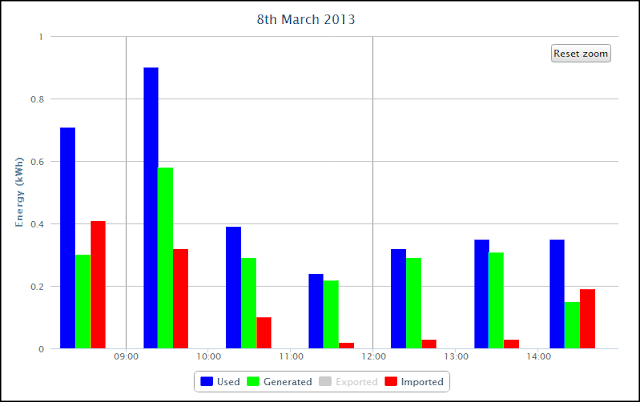
LiFePO4 DIY ESS - Today Micro Generation Sticks to the Usage

It is interesting to see how close the generation from my DIY ESS is to our home usage today


Look how the generated Energy bars (Green) are close to the usage bars (Blue) and how small are the Imported bars (Red) 


Thursday, March 7, 2013

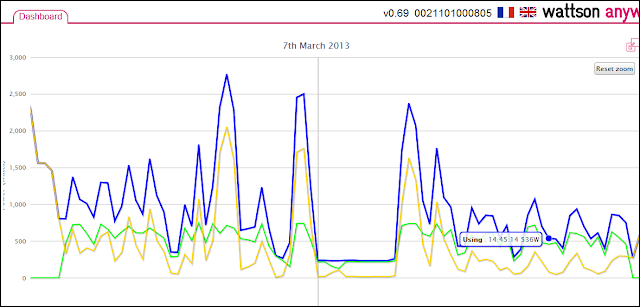
LiFePO4 DIY ESS - Full Day Test Today

After fully discharging and fully charging my ESS, I started it this morning and let it run in automatic mode to see how it behaves ...

Around 2:30 PM, 2.88kWH pushed back into our home grid

Overview in Wattson Anywhere (click)


Power graph (click)


Energy graph


At 3:30 PM, still ON


and 3.38kWh (click)


and it is over around 4 PM


with a total of 3.38kWh pushed back into our home grid after 7 hours of inverter mode


Monday, February 4, 2013

Copper Lugs found in Boat Store in Boulogne - New Lugs & More Crimping

Sometimes, you do not need to go very far to find what you need; This saturday moring, I went to a first boat equipment store in Boulogne, found some nice BlueSea bus bars (made of copper) but no lugs ...

In the afternoon, I tried another boat equipment store, next to La Seine, with boats for sale, and it was a huge store ! I eventually found what I was looking for: some copper lugs for 25mm² and 35mm² cables, and also 25mm², 35mm² and 50mm² copper cables by the meter 

For a start, I got two packs of 4 lugs, 25mm² with 8mm hole and 35mm² with 8mm hole too for 1 EUR and 1.5 each, which is not bad ... I can always come back anytime ...


So on sunday, I got rid of these huge aluminum cables and replaced them by shorter twin 16mm² cables, crimped togeter in one lug

Negative cable screwed onto the Battery Bank terminal

and onto the Grid Tie Inverter negative terminal

Same for positive cable

screwed on the Tyco Kilovac contactor

and on the Grid Tie Inverters

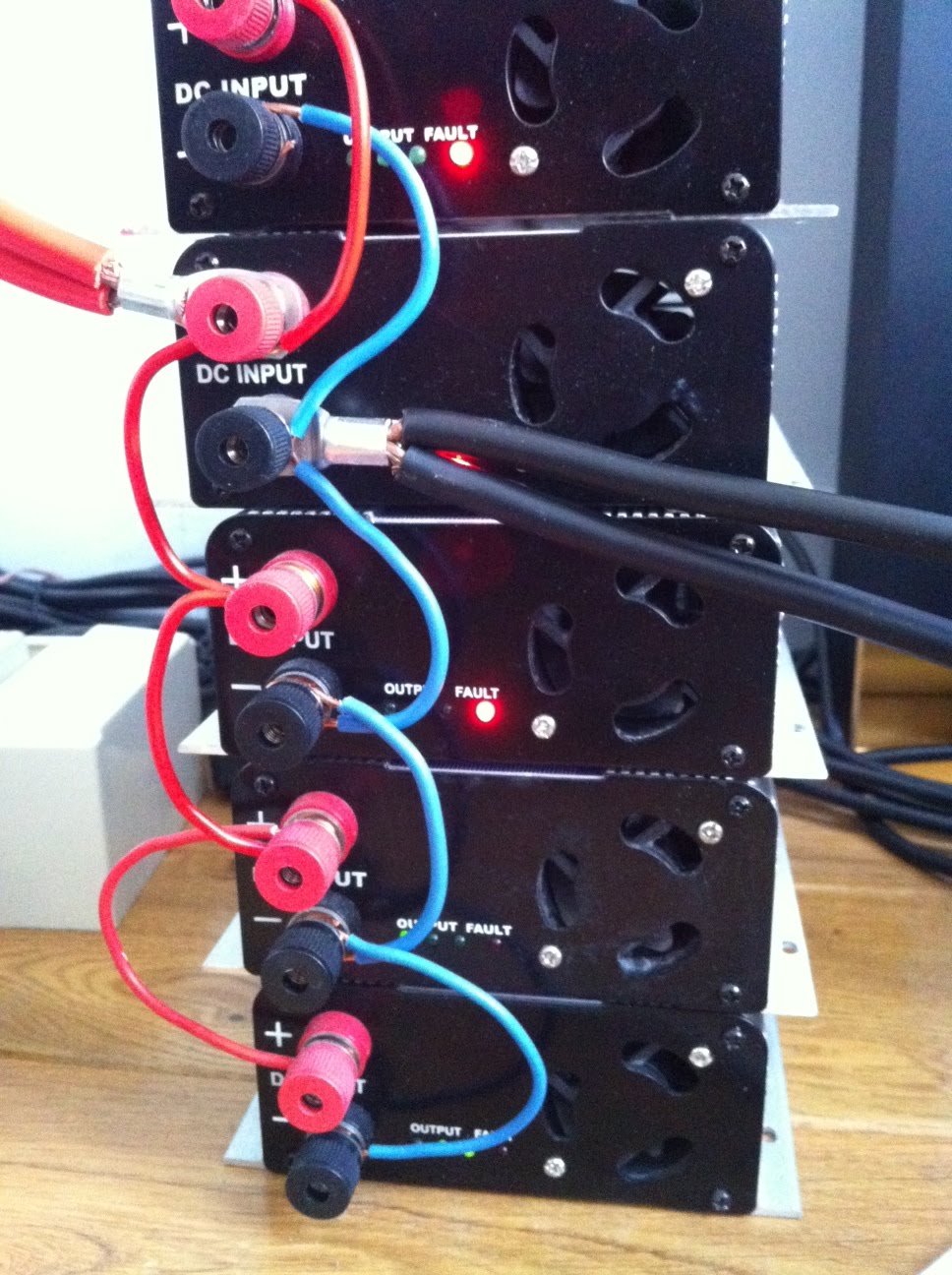
Grid Tie Inverters stack (the ESS is ON)


Et voilà !

Friday, October 26, 2012

The Numbers Behind Tesla and SolarCity’s Home Energy Storage Play


IDC Energy Insights breaks out how Tesla and SolarCity’s play for residential solar battery backup systems may play out in California and other states.


Have electric carmaker Tesla and solar power installer and financier SolarCity cracked the financial code for backing up residential rooftop solar panels with household batteries?

Over the past year or so, the two companies have been quietly installing Tesla’s lithium-ion batteries to back up SolarCity’s solar panels. That’s no secret -- SolarCity advertises its home energy storage system on its company website.


But battery backup for solar panels has been too expensive to justify for all but the wealthiest of homeowners. Simply put, batteries are too expensive, and the price of power too cheap, to justify the expense.

That’s too bad, because battery backup could really help solve some of the larger-scale problems associated with connecting lots of intermittent, on-again, off-again solar power to the grid. Energy storage could help mitigate the distribution grid voltage sags and surgesthat can occur when clouds pass over neighborhoods with lots of rooftop solar, for example. It could also help shift stored solar power to cover peak loads that may occur slightly later in the afternoon than solar’s peak production times.

Enter the Tesla-SolarCity technology combo. So far, the two companies have submitted about 70 applications to Pacific Gas & Electric under California’s Self-Generation Incentive Program (SGIP). That program offers credits for on-site generation sources like solar power, biogas digesters and fuel cells. Starting in 2009, SGIP started offering credits of $2 per watt for energy storage systems that can store power from an eligible on-site generation system and discharge it at rated capacity for a four-hour period.

IDC Energy Insights analyst Sam Jaffe has reviewed Tesla and SolarCity’s SGIP applications with PG&E, most of which fall in the 5-kilowatt size range, and estimates that the two companies have applied for a combined 500 kilowatts of storage systems. In a Friday blog post, he extrapolates from the SGIP rule requiring four hours of discharge at rated capacity, and projects that the two companies’ applications add up to about 2 megawatt-hours of storage capacity.

That’s a lot of storage, and Jaffe predicts it’s just the beginning of Tesla and SolarCity’s plans. California’s other two big utilities, Southern California Edison and San Diego Gas & Electric, haven’t published their lists of SGIP applicants yet, and even PG&E has yet to announce the next wave to come later this year, he noted in his blog post. Given those variables, he estimates that the two may be eyeing as much as 10 megawatt-hours of home battery-solar backup systems in California in 2012.

Jaffe also states that SolarCity is offering the systems at a cost of $2,000 per kilowatt-hour, which would add up to $40,000 for a 5-kilowatt system. SolarCity bills the system as a way for homeowners to back up their homes in case of power outage, but it’s likely the bigger financial benefit would be to put power back on the grid to manage peak grid power, which could get the utility involved in further subsidies.

If SolarCity sets up the batteries to go beyond backing up solar power -- say, by charging with cheap nighttime grid power and combining it with rooftop solar power in the afternoon to make the home energy-neutral or even a net producer of energy -- that could yield additional payoffs under PG&E’s residential time-of-use tariff, Jaffe noted. That could shave about $500 more off the price of the system, he estimated.

But the big question for Tesla and SolarCity is whether or not they’ll be able to bundle the battery costs into the overall solar system costs that are eligible for the federal government’s 30-percent investment tax credits. Jaffe predicts that the two may be the first to try to do so, which would instantly pay for one-third of the price of the system.

Adding the ITC benefits to the SGIP incentives cuts the cost of the system to a mere $800 per kilowatt-hour, Jaffe estimates. With time-of-use benefits added to that, “the homeowner is paying about $6,000 for the benefit of having reserve power during short-term blackouts, which is roughly equivalent to what an advanced hard-wired generator would cost,” he said.

All in all, it’s still an expensive proposition for most homeowners. Jaffe notes that the two will have to figure out how to cut the price further to create a truly disruptive play in the home energy storage space. Still, if battery prices continue to fall as IDC predicts (down to $600 per kilowatt-hour in 2012), that could cut the overall system cost further.

Tesla and SolarCity aren’t the first to try out batteries to back solar power. Japan’sPanasonic and Hitachi are installing home-based, solar-backed energy storage in pilot projects. In the United States, battery startup Xtreme Power is eyeing smaller-scale solar-backed applications to match their big, substation-sized grid batteries, and utility AEP is working with S&C Electric Co. on “community energy storage” systems that back up grids at the neighborhood level. General Electric just inked a partnership to integrate its nickel-saltDurathon batteries with Arista Power’s power balancing system to back up solar and wind power.

One interesting note on the Tesla-SolarCity effort is that the two are offering the systems for lease in California, according to SolarCity’s website. That could open the door to SolarCity managing the batteries en masse, to maximize the value of the energy they’re storing. That sounds a bit like the plan from Stem, the startup formerly known as Powergetics, which has shifted from a straightforward home energy storage play to a cloud-managed, energy optimization technology play that manages home batteries without the customer getting involved. Of course, SolarCity and Tesla haven’t publicly disclosed any such plans. But it may be one way to squeeze more value out of what could end up being a common good.


Source: GreenTechMedia

Please Share this Post if you Liked it !

Please Share this Post if you Liked it ! Thanks !
Related Posts Plugin for WordPress, Blogger...