Showing posts with label arizona. Show all posts

Friday, October 19, 2012

Nissan : Leaf Battery Capacity Loss Due To High Miles

It's been a few months now since reports of losses in battery capacity in Nissan LEAF electric cars began to filter out of Arizona.


Owners have complained to Nissan's Consumer Affairs group and written hundreds of posts on owner forums. In July, Nissan Americas took seven different Leafs in for a complete assessment by the technical unit at its Arizona Testing Center.

Now Nissan is starting to reveal the conclusions it's drawn from examining those seven Leafs and their battery packs.


Mark Perry, Nissan North America’s product planning and advanced technology director,discussed the company's findings exclusively with Green Car Reports.


19,000 miles or more

The common thread among the seven Leafs from Arizona, Perry said, was that all of them had covered much higher mileage than the 12,500 miles Nissan used to estimate the rate of battery capacity loss over time.

All of them had covered at least 50 percent more than that--or roughly 19,000 miles a year--and a few were "significantly higher" than that.

[UPDATE: After this article was published, Nissan used the actual mileage of the seven cars in the test to provide additional data. "The average mileage for the cars investigated was 19,600 miles, and the average in-service time was 14.7 months," wrote the company's Katherine Zachary. "Average annual mileage [of those cars] is about 16,000 per year, more than double the average Phoenix customer mileage of 7,500 miles per year."]

As a sprawling suburban city, Phoenix also requires a higher proportion of travel at freeway speeds, with relatively less time spent in low-speed urban stop-and-go traffic.

Based on those factors, Perry said, "The cars and the battery packs are behaving as we expected" given the use they've logged to date.


2011 Nissan LEAF prototype

Starting in 2009, Nissan executives have consistently said the Leaf battery pack would retain 70 to 80 percent of its charge capacity after five years--and average roughly 70 percent capacity after 10 years.

In other words, capacity loss is not linear, but quicker during the first few years than in subsequent years, assuming equivalent mileage in every year.


Assuming averages

Those projections, based on battery testing during development of the Leaf, assume the car covers 12,500 miles a year, in climates largely similar to those of Los Angeles (50 to 90 degrees F, with an average temperature of 68 or 70 degrees).

Phoenix has also just had one of its hottest summers ever, he noted.

Looking at 450 Nissan Leafs now in Arizona, Perry said, using data each car transmits to a Nissan control center, it appears that Leafs in Arizona are "on a glide path" to average battery capacity of 76 percent after five years rather than 80 percent.

The seven cars the company inspected in depth are likely to have less capacity than that after the same time.

Perry said he couldn't comment on what the company's data showed regarding frequency of charging and frequency of quick-charging for the Leafs it inspected.


Reaching out to owners

Starting on Thursday, Perry said, Nissan began reaching out to the owners of the seven cars it tested, to arrange face-to-face meetings with each of them.

The company's goal, he said, is to discuss how to satisfy those owners. "We want to make sure they're satisfied with their vehicles," Perry stressed.

He declined to suggest any remedies or compensations the company might offer, stressing that Nissan wanted to satisfy each owner individually.

Nissan has also heard from "a handful" of other Leaf owners on battery-capacity issues, he said, both those who have lost one or more bars and those who are concerned that this may happen in the future.

The company isn't now planning face-to-face talks with that larger group of owners, he said.


Leaf specialists

Instead, they should continue to discuss these issues with the Leaf electric-car specialists at the Nissan Consumer Affairs Center.

The toll-free number to reach that center is 800 877-NO-GAS-EV, or 800-664-2738.

Perry declined to go beyond "a handful" in specifying how many Leaf owners had contacted the company about the issue, although after continued questioning, he indicated it was far fewer than 100.

Perry also declined to comment on independent tests conducted by electric-car advocate and Leaf owner Tony Williams, which took place in Phoenixrecently and appeared to show range loss comparable to the indicated capacity loss in 12 Leafs tested.

"I understand what he was trying to do," Perry told Green Car Reports, "but it's hard to comment because we weren't there."


Pessimistic meter

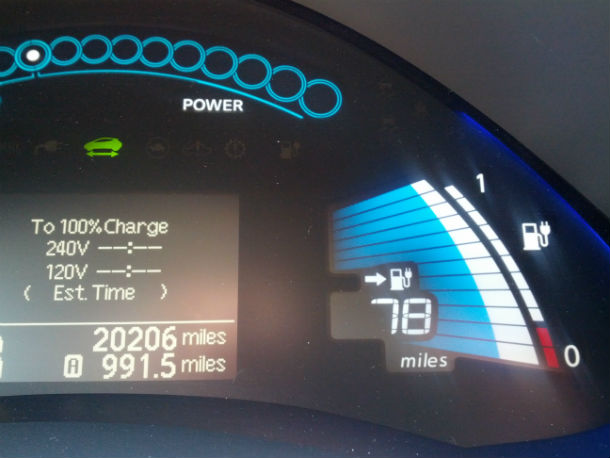
A further issue, Perry said, the battery capacity meter in the Leaf dashboard errs on the conservative side.

Thus, he said, a loss of three of the 12 capacity bars doesn't translate to exactly a 25-percent loss of capacity. In fact, not all the bars represent equal fractions of capacity.

This had previously been discussed by Andy Palmer, Nissan's executive vice president, who alluded to capacity-loss reports as stemming from a faulty battery level display.

Perry wouldn't specify what proportion of pack loss those three bars did represent, saying it could vary with each car's use.

The company would have to dig into its data on each individual pack to get those individual figures for each Leaf, he said.


Communicating with owners

While the Leaf batteries are behaving as the company expected, Perry admitted the challenge may be that the battery capacity losses may not have been what the owners of those electric cars expected.

Our analogy for battery capacity might be something like tire wear: The more miles you put on your tires, the more they wear.

Nissan Americas requires each buyer of a new Nissan Leaf electric car to sign a disclosure form in which the new owner acknowledges that battery capacity will decline over time.

The form also suggests ways the owner can maximize battery life.


Goodwill at risk

And that may be the real issue here.

"This ceased to be a technical issue a while ago, and has long been a goodwill issue," said electric-car advocate Chelsea Sexton, "based in what the drivers perceive as a lack of adequate communication."

And, she continued, if Nissan takes a position that 'there's still nothing wrong with your cars," that message is "unlikely to go over any better than it did the last time they said it."

On the other hand, electric-car advocate Mark Larsen takes a more nuanced view, decrying the angry tone adopted by some of the Leaf owners.


Your mileage may vary?

After analyzing the 12-car independent test data published by the owners, Larsen suggests that, in essence, "your mileage may vary."

His conclusion is that the Arizona heat affects "what data the capacity gauges are gleaning from the pack, but not the capacities themselves, according to miles driven."

This all indicates that there's likely to be much more to come on this story. Stay tuned.


Source: GreenCarReports


My notes:

It seems that Mark Larsen comes to the same conclusion as Jack Rickard: It looks like it is an instrumentation problem, degraded by the heat probably, because, out of all the LEAF tested by Tony Williams in Arizona last month, the pack voltages when the turtle shows up are very different from LEAF to LEAF, some showing a much higher voltage than others .... So the capacity is there, but it can not be used, blocked by the faulty energy meter on board ... 

Tuesday, October 9, 2012

Andy Palmer and Chelsea Sexton Discuss the Nissan LEAF

Chelsea Sexton, Founder of the Lightning Rod Foundation, Consulting Producer of "Revenge of the Electric Car", and a Co-Founder of Plug In America, sits down with Andy Palmer, Executive Vice President of Nissan Motor Co., Ltd., to discuss the Nissan LEAF battery capacity loss problem encountered by some Arizona drivers.


Wednesday, September 26, 2012

Andy Palmer will talk to Nissan LEAF owners from the Paris Motor Show


Just a quick update from Nissan's Facebook page about the LEAF battery capacity loss in Arizona: Executive Vice President, Andy Palmer, will be answering LEAF owners' questions live from the 2012 Paris Motor Show


Nissan’s Open Letter To The LEAF Community, Starts Independent Advisory Board On Battery Capacity Loss

At this point most readers are aware that many Nissan LEAFs in very hot southern climates, like that of Phoenix, Arizona, have experienced some battery capacity loss, which has been translate by Nissan’s on board instrumention as “bars lost.” The debate has been how much loss has there been, is Nissan’s instrumentation over exaggerating that loss, and what is an acceptable amount to lose?

Understandably, Nissan has been more than a little guarded on the subject, and several theories have been floated(instrument failure, heat, mileage, driving style of those with loss) by the company ahead of results from actual testing of consumers cars done by Nissan at their testing facility in Casa Grande, Arizona.

Just recently Mark Perry, Nissan’s Director of Product Planning and Advanced Tech, said that LEAFs, on the average, are still on a “glide path” to 76% capacity after 5 years/60,000 miles, very close to the expected national average of 80% .

Nissan has also decided to convene an independent global advisory board, which is to headed up by Chelsea Sexton, noted EV advocate. This board will also examine the issues and recommend a course of action for the company to follow, as well as aid Nissan in communicating better with their customers.

Nissan Exec Carla Bailo has issued an official letter to the LEAF community via Facebook and MyNissanLEAF.com announcing the test results and the formation of this advisory committee:

Carla Bailo, Senior Vice President, 
Research & Development – Nissan Americas

Happy eve of National Plug In Day. We’re excited that Nissan LEAF owners are gathering nationally tomorrow to celebrate zero-emission motoring, and appreciate that so many of you are sharing your enthusiasm with others. You are truly our best ambassadors to the next generation of passionate EV drivers.

We also want to update you, the LEAF community, on our findings regarding battery capacity loss concerns expressed by a number of owners in the Phoenix market. Nissan takes customer concerns seriously, and we know many of you have been interested to hear what we’ve learned in our thorough investigation, and what it all means.

We identified seven LEAF owners in the Phoenix area who had reported concerns with their vehicles. With their agreement we brought the cars to Nissan’s Arizona test facility, where we removed the batteries for evaluation, measured capacity, and conducted voltage testing on individual battery cells. These tests were diagnostic only; no modifications were performed to the battery packs themselves.

After returning cars to their owners, we analyzed the results of our tests, with specific emphasis on the rate of actual capacity loss for each vehicle. Our goals were simple: to determine 1) if there were any defects in materials or workmanship in the individual batteries or vehicle systems; 2) if the batteries were performing to specification; and 3)their performance relative to the global LEAF population.

This week, we will meet with these LEAF owners to share our findings on their individual vehicles. In the mean time, we can report the following overall findings:
The Nissan LEAFs inspected in Arizona are operating to specification and their battery capacity loss over time is consistent with their usage and operating environment. No battery defects were found.
A small number of Nissan LEAF owners in Arizona are experiencing a greater than average battery capacity loss due to their unique usage cycle, which includes operating mileages that are higher than average in a high-temperature environment over a short period of time.

While we understand that some LEAF owners are concerned about battery capacity loss, we want all owners to remember that all battery-electric vehicles – and all lithium-ion batteries – demonstrate capacity loss over time. So while your LEAF may have been able to travel a certain distance or more on a charge when new, its range will decrease as the battery ages, miles accumulate and gradual capacity loss occurs. This loss in capacity will occur most rapidly in the early part of your battery’s life, but the rate should decrease over time. Information on gradual battery capacity loss is available in the paperwork that was delivered with your vehicle, in the owner’s manual and on the many vehicle resources available athttp://www.nissanusa.com/leaf-electric-car/.

It is also important to put the scope of these concerns in perspective. Globally, there are more than 38,000 Nissan LEAFs on the road that have travelled more than 100 million zero-emission miles, and we expect these vehicles, in normal operating conditions, to retain 80 percent of battery capacity after five years. As each user’s operating characteristics are unique and many factors impact battery capacity, we can expect some vehicles to have greater than 80 percent capacity at five years, and some vehicles to have less. In Arizona, we have approximately 450 LEAFs on the road. Based on actual vehicle data, we project the average vehicle in that market to have battery capacity of 76 percent after five years – or a few percentage points lower than the global estimate. Some vehicles in Arizona will be above this average, and some below. Factors that may account for this differential include extreme heat, high speed, high annual mileage and charging method and frequency of the Nissan LEAFs in the Phoenix market.

We at Nissan stand by our product, and we also stand by our customers. Recently, we’ve asked Chelsea Sexton, a passionate advanced technology advocate, to convene an independent global advisory board. Members would be selected by Chelsea, not Nissan, and they would recommend their own mandate, but our hope is that they would hold up a mirror to us and help us to be more open and approachable in our communication and to advise us on our strategy. We should have more information on the advisory board in a few weeks.

As we work with individual owners to ensure their satisfaction, we are appreciative of your continued support of both the Nissan LEAF and the electric vehicle movement, overall. We look forward to continuing our dialogue here in the MyNissanLEAF forum and within the Nissan LEAF community.

Best Regards,
Carla Bailo
Senior Vice President, Research & Development – Nissan Americas


Source: InsideEVs & Nissan

Tuesday, September 25, 2012

EVTV Friday Show - September 21, 2012

This week:

- EVCCON 2012 T-Shirt !
CALB CA60FI Cells & matching braided straps in the Store
- Electric Cadillac Escalade range testing
- Phoenix Leaf Testing


EVCCON 2012 T-Shirt ready for the event next week end : "Kickin' Gas, one car at a time ! "

CALB CA60FI Cells arrived in numbers, and the specific length matching braided straps too 

Always clean the cell terminals with light sandpaper to remove oxydation before screwing the M6 bolts


Jack's theory about the Nissan LEAF range test conducted by Tony Williams in Arizona


Jack has something very interesting to say about this problem, and the outcome could be that it is really an instrumentation / BMS (Battery Management System) problem: "LEAF people are talking in terms of Bars and Turtles" (referring to the LEAF battery gage showing 12 bars fully charged and the Turtle sign coming on when the battery is completely depleted) ...


Jack takes the Cadillac EL Escalade for range test drive on the freeway: 12 miles at 50 mph, then at 60, and 70; At one point the motor(s) temperature gage goes up to more than half and he has to stop and check under the hood, but nothing significant and carries on his test 

Happy Cruising Jack is really enjoying his ride and tells us about the benefits of Camel cigarettes :-)


Where is Brian L. Noto .... ? (probably busy preparing EVCCON)


Thursday, September 20, 2012

LEAF Battery Loss in Arizona - Indepedent Test Follow up


All The Results From Independent Test Of Nissan LEAFs With Lost Capacity. Not Instrument Failure

Nissan LEAF Range Autonomy Demonstration


Nissan LEAF 'Fleet' At Dawn, Ready To Start Test
The Nissan LEAF electric car was introduced to the world as a mass production vehicle during December 2010. Almost 40,000 have been sold around the world in the short time since then, with well over 10,000 sold in the USA. Unfortunately, a percentage of those USA cars that are operated in hot climates, such as Phoenix, Arizona, and the state of Texas, have experienced accelerated losses of the vehicle’s range autonomy, when compared to its performance when new. The phenomenon is not relegated solely to areas of extreme heat; many LEAFs now in moderate temperature areas of California have also experienced significant range autonomy reduction, however not yet to the extent of those cars exposed to Arizona and Texas heat.

When customers have complained, thus far Nissan has claimed that any reduction in range is “normal”, regardless of how much that capacity loss is. Battery issues that are covered under the warranty include “power” to accelerate, or a specific battery failure or abrupt change in the battery performance. Nissan specifically claims that they do not warranty capacity. Nonetheless, in late 2011, Nissan did exchange at least one battery of an Arizona LEAF when its owner complained of reduced capacity. That replacement battery also began degrading recently, and the owner subsequently relinquished the car as a result.


Staging The Cars The Night Before The Test
In July 2012, with increasing numbers of LEAFs reporting battery capacity problems, Nissan took approximately one half dozen Phoenix area LEAFs whose owners had complained of reduced range and lowered battery capacity (as indicated by the vehicle’s dash mounted instrument) to its corporate testing facility in Casa Grande, Arizona.

All of those cars have since been returned to their owners, however none of those returned cars had reported any positive change in actual performance by their owners. One car’s battery capacity instrument was reset by Nissan to a “like new” battery indication of 12 of 12 instrument segments, from its previous 10 or 12 segments (10 segments indicates 72.5% – 78.74% battery capacity per Nissan documents). This same car once again lost the 12th capacity segment (with 11 of 12 remaining) on Sunday, September 16, 2012. Of the cars sent to Casa Grande, none have been reported to have been driven by Nissan more than a few dozen miles while at the testing facility.

One prominent Nissan executive is frequently quoted saying that the LEAF should have 80% capacity in 5 years, and 70% capacity in 10 years, and in fact, he specifically states during a Nissan produced YouTube video that those figures are considered “gradual” loss of capacity. Earlier this month, an Australian news agency reported that a Nissan Executive Vice President with specific experience with the LEAF, Mr. Andy Palmer, said that there is “no problem” with the LEAF battery, and that the any customer complaints were merely the result of instrument problems.

In response to this revelation, a group of twelve Nissan LEAFs were independently gathered on Saturday, September 15, 2012 in Phoenix to put this statement to an actual range test; driving a fully charged LEAF in controlled conditions to measure how far they could actually go. Any battery test (or allegation of good batteries) is meaningless if the car can’t actually do the job it was designed to do. In the USA, that job is advertised as traveling “100 miles” (161km), and even further, 200 kilometers (124 miles) in Japan. Clearly, if Nissan truly felt that the batteries were performing as designed for the customer cars they tested at Casa Grande in July, they could have simply verified that at the private, purpose built test track at their disposal there. The actual driving portion of the test would have taken about 90 minutes per car, but they chose not to. Four of the twelve cars in Saturday’s Phoenix area test were previously at the Casa Grande test facility in July.

2:44am, just 25 minutes before I launched my car, "Black782", on the test course. Five of us stayed up all night, and one of those pictured doesn't even own a LEAF anymore!

A staging area was selected at 7755 South Research Drive, Tempe, Arizona, which has one DC Chademo fast charger, and two J1772-2009 EVSE charging stations. Equipment was used to split the latter two stations into four total EVSE’s. This staging site was conveniently located within 0.3 miles (0.5 km) from the main highway. The route traveled was highway 101 north for 5.2 miles (8.3 km), then highway 202 west which becomes highway 10 west. Each car continued west until a predetermined course reversal point, and then returned to near the starting point. This route is largely level and with dry asphalt or concrete roadbed in excellent condition.

Turn around points were determined based on predicted range of each car after considering each car’s battery capacity meter and viewing the car’s report of stored watt-hours with additional equipment. The following round trip distances apply at these course reversal exits on highway 10. The total distance measured is from the staging area and ending on the 101 highway southbound at the East Elliot Road overpass at highway 101. The percentages are the battery’s stored available energy:
62% – 52.3 miles (83.7 km) – Exit 136, 75th Avenue
64% – 54.3 miles (87.4 km) – Exit 135, 83rd Avenue
67% – 56.3 miles (90.6 km) – Exit 134, 91st Avenue
69% – 58.3 miles (93.8 km) – Exit 133a, 99th Avenue
74% – 62.3 miles (100.3km) – Exit 131, 115th Ave / Avondale Boulevard
79% – 66.3 miles (106.7km) – Exit 129, Dysart Road
81% – 68.3 miles (109.9km) – Exit 128, Litchfield Road
85% – 72.3 miles (116.4km) – Exit 126, Pebble Beach Parkway / Estrella Parkway
91% – 76.3 miles (122.8km) – Exit 124, Cotton Lane / highway 303
98% – 82.3 miles (132.5km) – Exit 121, 195th Avenue / Jackrabbit Trail
101%- 85.1 miles (136.9km) – Exit 120, Airport Road / Verrado Way
109%- 91.5 miles (153.0km) – Exit 117, Watson Road

The dash display of Battery Capacities per Nissan documents are as follows:
53.75% – 59.99% – 7 segments of 12 illuminated
60.00% – 66.24% – 8 segments of 12 illuminated
66.25% – 72.49% – 9 segments of 12 illuminated
72.50% – 78.74% – 10 segments of 12 illuminated
78.75% – 84.99% – 11 segments of 12 illuminated
85.00% – 100.0% – 12 segments of 12 illuminated

The backup routes, in case of highway closures, crashes, etc., were either a 40.4 mile (64.6 km) “RIGHT LOOP” consisting of highway 101 North, 60 East, 202 South and then West, then 101 North again, or a 21.8 mile (34.9 km) “LEFT LOOP” via 101 North, 60 West, 10 South, 202 East and returning to 101 North. None of the cars took either of these latter routes. The only highway closure was Cotton Lane exit on highway 10.

The course was driven at 100 km/h as measured by the LEAF’s onboard GPS (62 mph ground speed, 64 mph indicated speed as displayed on the LEAF’s speedometer) with the cruise control engaged. It was estimated that this speed would yield a target energy usage rate of 4 miles (6.437 km) per kWh without climate control. Based on Nissan’s published official range data below (from Nissan Technical Bulletin NTB11-076a), it was determined that a new car would travel 84 miles (135 km) until “turtle” mode (a reduced power mode to safely get the vehicle off the road before the battery disengages power altogether). This data is consistent with extensive publically available independent testing.
The following is the official U.S. government weather reports, during the period of active vehicle testing, from nearby KPHX airport from 2:51am (0951Z) until 9:51am (1651Z):
Time (UTC – GMT – Zulu)Barometric Pressure (mbar)Temperature (degrees F/C)Dewpoint (degrees F)Relative Humidity (%)Wind direction (degrees magnetic) @ Wind speed (knots/meters per second)
0951Z1018.2978.8 / 2646.431080 @ 6/3
1151Z1018.2978.8 / 2644.629070 @ 8/4
1251Z1018.2978.8 / 2644.629060 @ 12/6
1351Z1018.6378.8 / 2642.827070 @ 15/8
1451Z1019.9678.8 / 2644.629070 @ 12/6
1551Z1019.3080.6 / 2742.826080 @ 13/7
1651Z1019.9882.4 / 2842.824070 @ 10/5
1751Z1019.9884.2 / 2942.823070 @ 10/5

Air Density Calculation
Elevation: 1135 feet (346 meters)
Air Temperature: 80F (26.6C)
Altimeter Setting: 30.09 inches Hg (1018.5 hPa)
Dew Point: 43F (6C)
Density Altitude: 2685 feet (819 meters)
Absolute Pressure: 28.864 inches Hg (977.46 hPa)
Air Density: 0.0706 lb/ft3 (1.132 kg/m3)
Relative Density: 92.38%

Some LEAFs (shrinks) Took Some Damage Over The Course Of The Test
All LEAFs in this test had the front bumper tow hook installed. All trip odometers, miles/kWh, average speed, timers, etc., were reset. Headlights were on, climate control off and tires set to 36 pounds per square inch (2.48 bars) pressure. All assigned routes were programmed into each navigation display.

Each car had a stored energy display meter (Gidmeter) installed. A new LEAF in optimum condition will show 281 units reported by the LEAF’s automation, for a total of 281 x 80 watt hours per unit = 22.48 kWh stored in the battery. This value, referred to in the LEAF community as “Gids”, is alternately displayed as a percentage of 281 (281 would equal 100%). The LEAF battery has an advertised capacity of 24 kWh.

To help keep track of each of the cars, the last three digits of the LEAF’s serial number were affixed on the right top front of the windshield and left rear top of the rear window. Stickers were added to the dash to remind the drivers not to use climate control (or even turn the fan on, as that powers the climate control) and for other safety related functions. Lighter weight driver’s cars had ballast added to match heaviest drivers. The front windows could be either closed, or up to 2 inches open. Rear windows were no to be opened. Most drivers were not the owner of the car they drove, but instead drove another car. Every car was charged the night before, and left outside to be exposed to ambient air for a minimum of 4 hours (most cars well exceeded this). A secondary goal to this was to allow time for the LEAF’s automation to properly balance the 96 cell pairs.


Keeping "Controls" On The Test
At the start of each car’s test, the driver recorded the starting position GPS coordinates, time from the GPS clock, battery pack voltage (typically 393.5), the “Gid” percentage, Fuel segments observed (in every case, 12), battery capacity segments (varied from 8 to 12, depending on which car) and battery temperature segments displayed (6 in every case, indicating temperatures between approximately 50F (10C) to 100F (38C) per Nissan documents).

Each car had a nine page comprehensive checklist and information package. Finally, the “Distance to Empty” meter readout was recorded. This is largely for entertainment value, as the meters are known to provide such wide variations from actual expected performance that it is affectionately known as the “Guess… Oh… meter”, or “GOM” amongst LEAF owners.

At the conclusion of each run, after the car was safely off the road, and awaiting one of five recovery vehicles used (four rental car dollies attached to gasoline tow vehicles, and one flatbed truck), GPS coordinates were once again recorded, the time from the GPS clock, battery pack voltage, Gid percent, fuel bar segments illuminated, battery capacity segments illuminated and temperature segments illuminated. Finally, the trip odometer mileage and the dash readout of miles/kWh were recorded.

Following is the performance of each car:

Conclusions and Opinions

My Car Is Loaded, Then Off To Brunch Off to Brunch And An Almost 400 Mile Drive Home
The Nissan LEAF has only been on the world stage for about 21 months. Many in the automotive battery world expressed concern over Nissan deploying this chemistry in hot climates without a means to regulate battery temperature long before a single LEAF was built. Only LEAFs in very stable and mostly cool places like the England, the San Francisco peninsula, Seattle, Portland (which this summer had unseasonably cooler temperatures, while the rest of the USA baked) have been largely immune from degradation. Even San Diego, where I live, has reported cases of battery degradation.

Both of the 2012 cars (my car was one of them) in the test were replacements for previous LEAFs that suffered battery degradation. Nissan offered no assistance or consideration for the previous cars shortcomings for these new leases. Battery reports issued by the dealers were consistently “5 of 5” stars.

One of the many challenges in this endeavor was finding a “control” car that could actually test out at 100% battery capacity. LEAFs sitting on dealer’s lots in Phoenix, and other hot places, usually with very high states of charge, are in a very difficult situation for the long life of the battery. None of the cars in our group could even come close to 100%, and that includes a car with both of the 2012 model cars, both built in April 2012; one with 2500 and the other 7000 miles.

I planned, and completed a promotional trip from Mexico to Canada, “BC2BC”, in June 2012 with my Nissan LEAF. However, my first car could not complete the trip as planned, due to its reduced range capability, so I leased my current LEAF, built in April 2012 and took delivery at the end of May. Now, with 7000 miles (11000 km), and only 3 months of actual use, this car could not complete the trip that it did in June. During the BC2BC trip, several times I arrived with 4%-5% capacity remaining, which means today, just a few months later, I would come up 4%-5% short. This car has never been exposed to the heat of Phoenix, although it was 104F (40C) in San Jose, California the one day that I was there.

My car, Black782 and the BC2BC car, tested at about 89% of available battery capacity, and drove to 91% of available capacity. That’s within 2% between the two figures and a reasonable error. Other cars had HUGE differences between the instruments and the actual range performance. So, Andy Palmer was right… they have poor instruments. But, he was wrong about the batteries. It was sheer stupidity to tell this group of owners that the batteries are ok. A California study showed that about half the owners have post-graduate degrees, and many of those are in technical fields. A significant percentage have owned electric vehicles prior to the LEAF, and many, if not most of those who have traded their faulty LEAF have gotten another electric powered car, like the GM Volt, and like me, another LEAF.

Nissan – Renault chairman Carlos Ghosn announced Friday that 2013 LEAFs would have a new battery design. One has to wonder if this is merely public relations move to deflect from the current battery woes, or if a real new battery will emerge. Then, we have to wonder if they employed the same testing that the current batteries were exposed to. Nissan really needed to get the LEAF right the first time, and they did an absolutely incredible job overall. I tell everybody know that it’s a fantastic car with one fatal flaw.

I would like to thank everybody who helped make this test a reality, and a fun experience. There are literally dozens who participated. Four of the cars were damaged during loading on the Uhaul rental tow dollies, and many folks have expressed interest in donating money to offset costs and damages from this event. You’re welcome to email me at DriveGreen@QuickChargePower.com and I will let you know how to send a donation. All monies will first reimburse the owners of damaged cars (I’m not going to fix mine, however, so I don’t need reimbursement), and then any donations above that will go into the non-profit company that I founded to provide electric vehicle charging in California. I won’t personally take any donations.

Source: InsideEVs

Please Share this Post if you Liked it !

Please Share this Post if you Liked it ! Thanks !
Related Posts Plugin for WordPress, Blogger...