Announced 2 weeks ago, I finally purchase 2 SunPower flexible solar panels of 100W each, from the UK for 100 GBP only
After watching their prices for the last 2.5 years I finally found a good deal and got them right away
The panels arrived few days later, with again a low shipping cost of 20 GBP for both with DHL (very reasonable)
So these panels are made with the famous SunPower high efficiency cells, made in the USA
36 cells : 9 x 4, with standard MC4 solar connectors
and the idea is to install them right behind the wall, outside, between my windows, vertically to catch the reflection coming from the south oriented wall of the building in front of us
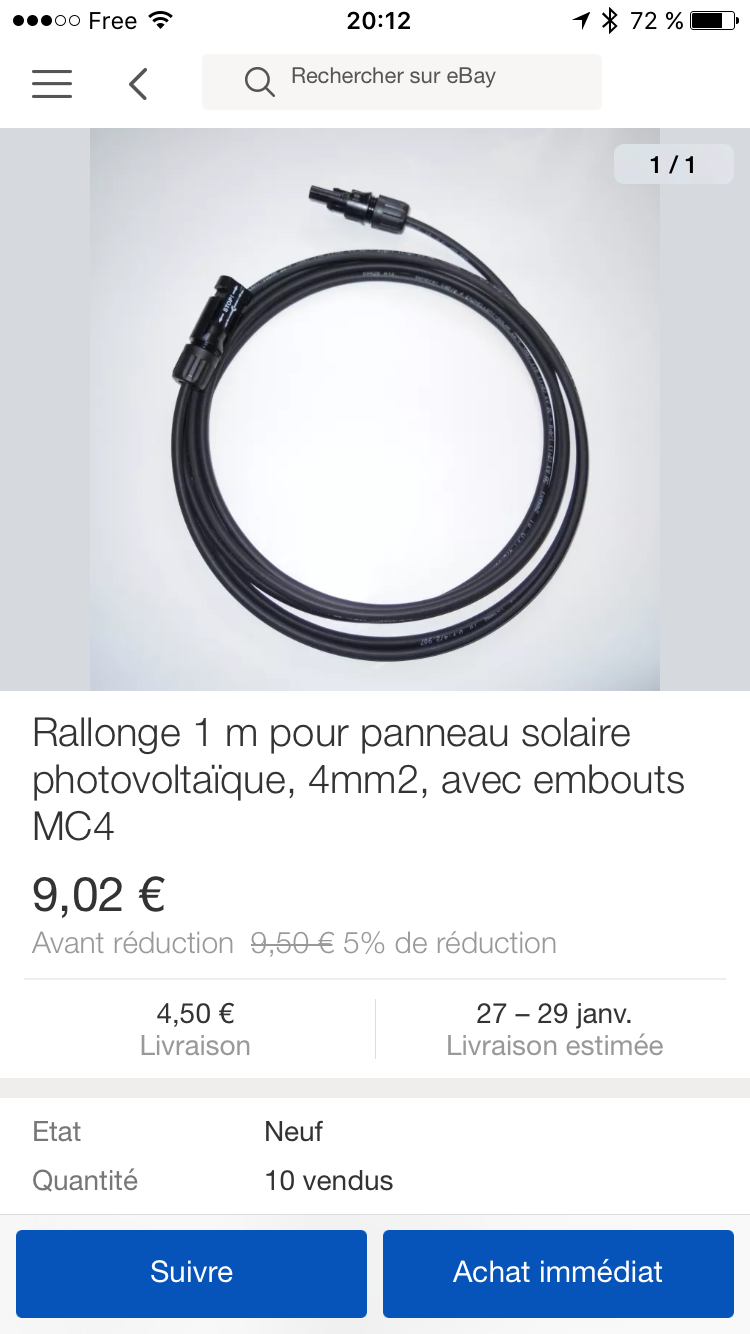
Ordered also a 1m long MC4 extension cable on eBay
I also got some chain and rapid connectors form the local hardware store
Extension cable arrived, just before last week end, now I have everything to install them
So I did that last sunday morning, and it didn't take long, because I already had big screws and chains installed by my windows back in 2010, when I installed my very first solar panels (13W each, but 3 of them), which have been charging AGM batteries, used to charge iPhones, iPad, and power a battery charger for radio, Wii, or other home devices ... This has been working well by the way and they are staying in place
I just had to attach the new connectors to the existing chains (holding 20kg each, way more than enough)
Of course these panels need a micro inverter and I got several used ones for my DIY ESS V2 experiments last year, so I used one of them
I is screwed to a piece of chain using a bolts, washers, and all this is tighten very well
I had to drill a through hole in the lower corner of the window and that was not too difficult ...
The Enphase Engage cable can now go directly inside my apartment
All the cables are fitted so that they don't block the light coming onto the panels
Now, after everything has been connected and installed, there was absolutely no sun, and it has been like during the whole week almost, very frustrating ... :(
I was watching closely on wednesday from work using my DIY ESS Live Cam, and saw clearly that the overall solar generation was more than usual: maybe 60-70W more (we are still in winter and my max generation when the ESS is empty, is 250W or so, maybe 280 now that the sun is a bit higher, still low compared to the 1100W I see in summer)
This morning (saturday), I am home for the week end and as soon as I saw a little sun (half sunny/cloudy, I looked at the wattmeter installed on this specific new line, and it only showed 15W (!! that's not possible, the Enphase M215 can not produce this little power)
BTW the ESS is empty by
So I siwtch off the main solar array DC input on the solar electric panel and there I saw that the 2 SunPower + Enphase M215 were producing 80W :) that's better
DC breakers OFF on Uni-Solar Array on the roof
Enphase M215 is blinking Orange, so it is producing and Orange is normal since there is no Envoy Gateway
This is the reflection light I got when read the generation figure
This small meter gives me wrong figures I guess ...
Finally, 2.5 years after its discovery on EVtv in October 2013, I just purchased 2 100W SunPower Flexible Solar Panels :) for 100 GBP each, plus 20 GBP of shipping (a bargain I think compared to all the ones I have seen over this period)
They will replace my very first lower power panels installed in 2009 but won't charge AGM batteries, they will be wired in series and plugged into an Enphase M215 micro inverter to directly feed Power into my home grid, improving low solar generation in winter hanging vertically by my windows
The 100W one is the smallest on the picture, 32 cells 4 x 8, ultra light, flexible, with holes already there to hang it ... You will understand better when I receive and install them ....
I started working on Energy Storage 4 years ago ...
As most of you probably already know, I started looking into Energy Storage several years ago, actually back in 2011 if I remember well ... It all started with my will to install Solar on the roof of our building to start generating free electricity for our home, I actually had this idea years before; Of course nobody in our condo was interested in this and mentioning it a an owners annual meeting was useless (but I tried once at least), so I decided to do it myself anyways, discretely, and living on the last story would make it easier.
I quickly found out that the only solar panels that I could install without touching/damaging the classic Parisian zinc roof were the Uni-Solar PVLs and ordered some from the US through eBay, in 2 lengths, studying the roof layout using Google Maps ... I eventually found a local contractor who would install them and provide the inverter
Since I did not have the approval, I could not resell the excess electricity to the French utility - what all people were doing at that time -, so any Surplus Power would be wasted during the day... That's when I started thinking about Energy Storage
At the same time, I was selling my used 2004 Prius, which I retrofitted with an Enginer PHEV Battery system in 2009, and removed all this from the trunk of course: I had 4kWh worth of Lithium-ion LiFePO4 cells I could use right there ! and I always thought that Li-ion battery would be perfect for this use
Switching ON a Charger to use the Surplus of Power generated during the day was obvious to me, but the opposite, push Power back into our grid at night (or when need during the day), was not more difficult: problem solved after looking at a Green Power Science video on small low voltage inverters !
Previously, in may 2011, after several months looking for the "best" Energy Monitor, I purchased a DIY Kyoto / Energeno Wattson unit, and installed it: I could now see in real time - for the first time - our home Power Usage, that was a mandatory starting point for the rest
Now that I had all the ingredients to make an energy Storage System, I had to build one, because what you could find on the market at that time was just very expensive and/or huge
I experimented with the Battery cells I had in my bedroom for several weeks, using a LiFePO4 charger, Grid Tie Inverter found on eBay (video)
A big question/problem to solve was "How do I safely Charge my LiFePO4 Battery Pack ?" and I found the answer watching my first ever EVtv weekly video on Youtube
Key info you need is: Usage, Generation, and Net Usage (calculated by subtracting Usage - Generation):
- If Positive, your Solar install does not produce enough Power to cover you home loads, and you are using Power from the Grid => You have to use Energy from your ESS
- If Negative, your Solar install produces more Power than your home is using, you are "wasting" Power flowing back to the Grid => You have to Store it into your ESS to re-use it later on
That's rather simple isn't it ? :)
Click the picture to see the details on this conversion to Enphase Micro Inverter
All these years, I have been following the development of the upcoming main stream Energy Storage Systems, and they are finally coming ! Enphase announced their AC Battery first a year ago already, then Tesla announced their Powerwall - "The Missing Piece" - , a lot in advance for both of them, before anybody could actually order one
Also both companies are targeting specific countries where it makes sense Economically : Australia and Germany will be served first because of factors including the Price of Electricity, Feed In Tarif - FIT - rates, Grid Parity, the development of Solar.
So it will take some time I think to have either one of them installed at my place, but patience, Residential Energy Storage for the Masses is coming for good this time ! :)
Enphase is the leader in Micro Inverters with 4 generations of them since July 2014 and the launch of the M250, producing now up to 250W per solar panel; The advantage is the maximum harvesting of solar power - because it is done at the panel level, whereas a classic solar panel string will be affected by one panel being shaded for example - all inverters produce 240V AC Power which is then routed to the home consumer unit, making their installation is easy. On top of that it comes with great panel level online monitoring solution - called Enlighten - using their Envoy gateway which gathers all the data using PLC and sends it to the cloud.
For Energy Storage, Enphase - now Enphase Energy - continues with this all AC strategy and proposes a small unit called the AC Battery: It contains 1.2kWh of LiFePO4 Battery cells, and a new S275 - S for Storage - bi-directional inverter (or inverter/charger) which is key: Plugged into the same Engage AC cable it will charge and discharge the Battery pack, using AC only, based on the data - communicated by PLC again - of a new gateway called Envoy-S - S for Storage too - which comes with in a metered version: It know how much Power your home is using, and since it already knows the total panel generation, it can easily deduct the amount that should be stored into the AC Battery, or used from it.
The limitation of this is the maximum Power Output: 270W per AC Battery ... But you can add as many as you want to be able to shave home loads properly... But it will cost you 990 USD per unit (wholesale price), so it is scalable, but can become expensive if you need to overcome big Usage peak at home (A/C ON, dryer, EV charging, at the same time for example)
Tesla Motors created Tesla Energy to sell their PowerWall and PowerPack, residential and commercial/utility scale Energy Storage Systems
Tesla had been testing wall mounted residential Backup storage systems in California for the last 2 years at Solar City customers willing to participate in this test program; The pack was already using the Model S battery pack technology and the PowerWall and PowerPack still do. That was interesting but, it was only purely Backup, meaning you store Energy from solar into you system, and release/use it only in case of a Power Outage ...
On April 30th, 2015 Tesla Energy launched the Powerwall (and Powerpack) but I thought Elon Musk did not give much technical information on it, appart from the price of 3500 USD which is actually pretty good (I will focus on the 7kWh Daily Cycling version of the Powerwall because I am not interested in the Backup only version)
Elon Musk said (during the Q1 2015 Earnings Call at 9:15) that "the response has been overwhelming / crazy", and that they are basically "Sold out until mid 2016 when the GigaFactory will be able to take over" with 38,000 Powerwall pre-ordered in the first week !
Since this event, I have been trying to find answers to my questions and some elements came from this video few days after the event (Video Q1 2015 Earnings Call et 35:40 JB Straubel goes into details on the PowerWall (for the first time), on Tesla Motor Club forums or in Inverters manufacturers videos and websites:
Fronius
Until I recently got the most important piece of information (the one I missed all the way since the launch): There is of course a communication going on between the Powerwall and the Solar Inverter, and the protocol used is the well known RS-485
As seen above in my DIY ESS past experience, you need to command the inverter and charger to produce Power and Store Energy from and to the Battery Pack of the ESS, in real time
I got this information from studying the websites and videos of both Solar Edge and Fronius, the two only Inverter manufacturers compatible (for now) with the Powerwall
From Tesla Energy website diagram and JB Straubel explanation, we know that the Powerwall is wired in parallel with the Solar array (, and Inverter), so it is getting the Generated Power Directly from it, at something like 400V, and will be using its DC-DC converter to boost it to an Higher Voltage to be able to Charge the Battery Pack if the input voltage (coming from the solar array) is too low
Writing this post, I realize that Tesla Energy recently updated their diagram to give more information about the Inverter and now says that it is a specific one: "The inverter converts direct current electricity from solar panels, the grid and Powerwall into the alternating current used by your home’s lights, appliances and devices. All Powerwall installations require a compatible inverter. To maximize solar consumption, a meter is also installed to measure solar production and home energy use."
With this update, Tesla Energy now clearly says that the inverter is also a charger (like well known energy storage inverter/charger used for years now) which is the only way to Charge the Powerwall with Night Rate (TOU) cheaper Electricity (if you want/decide to do so)
So as I understand it, the Inverter required to be able to use the Powerwall is a specific one, and my/your existing Solar install Inverter will most likely not be compatible and will have to be replaced with one from Fronius or Solar Edge (the only 2 options for now)
Also from this update, they tell a bit more and at last mention that a Specific Meter has to be installed too, obviously, to know the Usage/Generation/Net Usage, and decide from that what the Inverter and Powerwall will do ... Now it all makes sense, because all this information was hidden/not given for months ...
When I learned about the RS-485 protocol being used to communicate (Meter <-> Inverter <-> Powerwall), it reminded me of a interesting discussion 2.5 years ago (on my DIY ESS Kit website):
It was a bit too complex for me (I like to keep it simple), and required a high voltage battery pack to be able to use a regular SMA inverter controlled by RS485 to provide the desired Power Output ...
By the way, SMA recently said it could be Powerwall compatible (they used RS-485 on older solar inverter, Sunny Island and their latest Sunny Boy Smart Energy)
I found this nice preview of the Powerwall Online Portal / Interface
Since the end of September with the visit of India PM Narendra Modi at the Fremont factory we know what the Powerwall looks like from the inside !
How did I choose ?
Max Power Output
What is interesting with the Powerwall is that it can produce 3.3kW with only one unit, which would be perfect for my home, as I rarely use more than that, with few peaks will cooking with stove and oven on at the same time, or maybe when heat pump plus cooking in winter, but it does not last long.
Elon Musk announced 2kW during the Powerwall launch, then said few days later that it could be doubled easily, but now it looks like they settled at 3.3kW (from the website specs)
To match this Power Output with the Enphase AC Battery, you would need 3,300 / 270 = 12 units
Each unit being priced at 990 USD (wholesale), that is going to be at least around 12,000 USD
Efficiency: The less you convert, the less you loose ...
The advantage of the Powerwall is that it is wired directly (in parallel) to the Solar Panels Array and stores Energy without conversion (or a minimal one if boosting up voltage to charge batteries); Eventually to use the Stored Energy there will be a conversion performed by the Solar Inverter to make AC Power
The AC Battery takes AC from the Solar Panels after conversion by the Inverters (1), Charges the Battery Pack using the bi-directional Inverter/Charger S-275 (2) and then releases Power back to AC using the same (3): So we have 3 conversions here, instead of 1; even if Enphase makes very efficient micro inverters, we will have to wait and see what is the overall Energy Loss with these 3 conversions
Design
Well it is a matter of taste, but being able to choose the color of this slim and elegant Powerwall is a plus, I will not be ashamed of hanging it in the main room in my apartment, next to the kitchen/entrance cabinet
On the other side, several AC Battery next to each other will not offer the same visual impact, a bulky look which would be fine in a garage but not inside my apartment ...
On this picture, I would install a Dark Red or White Powerwall to the very right, instead of these two frames, and why not, two units later on, but I think one would be enough for my home as I now know well enough what it needs to run ...