Showing posts with label micro generation. Show all posts

Thursday, May 30, 2013

LiFePO4 ESS - Last night testing with 2 Wattson Monitors


Last night I was testing my LiFePO4 ESS as usual, after a full day of charge, and this time I brought the 2nd Wattson downstairs in my bedroom to display Usage, Generation, or Net Power


Instead of turning the ESS off when the low rate TOU comes in at 22:26 (10:26 PM), I decided to leave it on and see how it bahaves, poushing all it can for a full hour

At the end of this hour, the new 35mm2 longer cables were just luke warm, nothing was over-heating at all

Power graph (iPhone)


Power graph (iPad)

Energy graph

Energy Analysis

Thursday, May 16, 2013

DIY ESS - Still testing & Evening Usage Covered

This is the Energy graph from last night using my DIY ESS in automatic mode: I am covering almost all the energy used during the evening and shut off the system when I went to sleep with still half in the LiFePO4 battery bank

Wattson Anywhere Energy Graph


Wattson Anywhere Energy Analysis Pie Chart

Wednesday, May 15, 2013

Fighting Blackouts: Japan Residential PV and Energy Storage Market Flourishing

San Diego, CA -- In the past, a PV system with battery storage was associated with the off-grid system — not connected to the utility grid. The battery stores the energy produced by the PV system and when the sun goes down, electricity is drawn from the battery. In Japan, the battery became attractive to store electricity from "the grid," to reduce electricity bills.

After the devastation of the Tsunami and nuclear meltdown in Mach 2011, Japan became painfully aware of the importance of both safety and maintaining a steady supply of electricity. The combination of a PV system and battery storage gives consumers the ability to produce, store and supply electricity throughout the day at their own home for power outages and emergencies. However, the system can bring economic benefits — electricity bill reduction — during normal days.

Like California, utilities in Japan offer Time-of Use (TOU) rates. How homeowners can reduce electricity bills can be illustrated by using Tokyo Electric Power Company’s (TEPCO) current (non-summer) TOU rates for all-electric homes with a PV system.

- Purchase and store electricity from the grid at off-peak hour (11 pm – 7 am) at ¥11.82/kWh [US $0.12]

- Sell PV-generated electricity to the utility at the FIT premium rate of ¥38.0/kWh [US $0.38]

- Use PV-generated electricity during day time, otherwise paying at ¥30.77 (10 am – 5 pm) [US $0.31] and use stored electricity between 7 and 10 am and between 5 and 11 pm, otherwise paying ¥25.2/kWh [US $0.25]


With the battery storage, PV homeowners can ultimately buy electricity at the lowest rate (¥11.82/kWh or $0.12/kWh) and sell at the highest price (¥38/kWh or $0.38/kWh).

The key domestic PV makers, Panasonic, Kyocera and Sharp, all now offer lithium-ion battery storage along with a PV home system to meet consumers’ demand. Their goal is to move beyond PV and expand into a total Home Energy Management System (HEMS3) arena.

Kyocera started offering PV plus lithium-ion battery storage to homeowners in early 2012 with a target of selling 10,000 units from April 2012 to March 2013. Panasonic also released home battery storage systems that can be connected to Sanyo’s (now Panasonic) HIT PV system. The battery has a capacity of 4.65 kWh and is priced at ¥1.218 million MSRP [US $11,984].

In April, Kyocera released the largest residential lithium-ion battery in Japan. The battery has the capacity of 14.4 kWh, which is priced at an MSRP of ¥4.45million [US $43,784]. This large capacity allows it to power a home refrigerator, TV, computers, lights and cell phone chargers for up to 24 hours.

Kyocera has teamed up with Rakuten, Inc., which operates the nation’s largest internet shopping site, to offer a PV system (poly-Si) and a lithium battery (7.2 kWh) set for homeowners at an affordable price. Rakuten provides options with different sizes of PV systems with the battery, and installed system price (after tax) varies from ¥2.94 million ($29,730) with a-2.28 kW system to ¥4.168 million ($42,153) with a 6.27-kW system. These systems are installed by one of the nation’s largest installers, Nippon Ecosystem, which is part of Itochu Corp.

Residential battery systems remain expensive to average homeowners. To solve this issue,One Energy Corp. has just begun the nation’s first residential energy storage leasing service. Like SolarCity or SunRun’s PV leasing service in the U.S., this requires zero upfront payment to homeowners. The company is a joint venture between Orix, NEC and Epco. NEC provides lithium batteries, whose technology is used for Nissan Leaf electric vehicles.

Besides the energy storage leasing service, One Energy also offers “Yanekari (PV rooftop space leasing)” service. A homeowner can lease a storage system with 5.53 kWh of capacity at between ¥3,045 ($31) to ¥5,145 ($52) a month from One Energy while offering the roof-space to One Energy, making a monthly revenue of ¥2,500 ($25). The image below illustrates how a customer could use an energy storage system to offset the high cost of purchasing energy during peak times.


One Energy currently offers this leasing service in the TEPCO region only and is planning to expand to the Kansai region by the second half of this fiscal year and eventually expand nationwide.

NEC started mass production of residential storage systems in February. Besides partnering with One Energy, the company sells home batteries directly to homebuilders and building material distributors with the goal of selling 15,000 units during this fiscal year.

The company stated that PV homeowners will start storing PV electricity in batteries even more as the FIT rate gets lower in the future, creating a more self-sufficient and less grid-dependent environment.

It is declining, but the national government provides upfront, capacity-based rebates (¥15-20/kW) and a net FIT of ¥38/kWh on excess electricity generation for 10 years) for PV home systems. The government also currently provides a subsidy for lithium-ion battery storage for homeowners. The subsidy is one third of the installed system cost or up to ¥1 million ($10,823).

The hot and humid summer is approaching in Japan. Some of the nation’s utilities have just raised electricity rates and many of them will request that consumers limit and/or shift electricity consumption from peak to off-peak to control raising fossil fuel cost caused by the shutdown of nuclear power plants. With PV + battery systems, homeowners are moving to take energy matters into their own hands in defense against rolling blackouts and rising electricity bills.

Friday, March 8, 2013

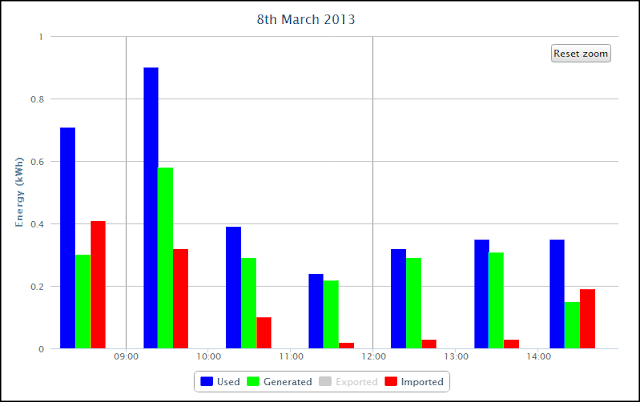
LiFePO4 DIY ESS - Today Micro Generation Sticks to the Usage

It is interesting to see how close the generation from my DIY ESS is to our home usage today


Look how the generated Energy bars (Green) are close to the usage bars (Blue) and how small are the Imported bars (Red) 


Wednesday, January 30, 2013

A day with the ESS & Wattson Anywhere

This morning I decided to show a typical day using my Energy Storage System, ESS, along with the - beta version - of Wattson Anywhere

So it starts just after I get up and start my BESPSS by switching it to Inverter Mode; The batteries have been charging all night long, during off peak hours, they are now fully charged.

After this, shower, breakfast, and during these I can see Wattson (I have one downstairs in my bedroom and another one upstairs in the dining room) and also see the usage & generation graph on my iPad using the Wattson Anywhere portal - still in beta version -


Wait until the end of the video to see me refresh the Power graph on the iPad and zoom in during the generation period


These temporary used Lead AGM Batteries do not hold much energy, but they are still usefull to continue testing my BESPSS while waiting to get some CALB CA180FI ...

After brushing my teeth, I switch the ESS back into Charge Mode for the day

After my Vectrix ride to work, I light up a cirgarette and take my iPhone out of my pocket to check mails; This is what the Wattson Anywhere portal shows
In case you are wondering, the big 2kW+ usage at night until a bit more than 2AM is the water heater, starting automatically at 10:30PM when the rate is lower - night rate is half the price of day rate here -


After a coffee and saying hi to my colleagues, I start working, and soon I check the graph again, on my office Vista plastic HP PC - :-( - with a Chrome browser


After an hour or so


Let's zoom in a little bit on the last two hours


Karotz, facing Wattson, sends me an email with a picture taken few seconds before; I can then see instant Power Usage - before Wattson Profesional and now Wattson Anywhere, this was the only way I could see my home usage -

Let's refresh my PC Wattson Anywhere graph


Now, I am soon taking a lunch break, I check the portal again and zoom in again to see the overall morning graph

After our lunch and a little coffe, here is the situation


Let's see the Energy used & generated so far: Note the Green Generated Energy this morning, which brought down almost by half the Energy Purchased from EDF, my utility company


Karotz just sent me another photo: I see some light at home ...


and the power usage has gone up, which means the heat pump is working harder to get to the desired temperature (we always lower to 16°C when out and put it back to 19°C when at home)


Back home, I switch the LiFePO4 ESS to Inverter Mode


The effect on Wattson Anywhere graph

10 minutes later

Zooming in the 2nd generation period of the day

At the end of the day, this is what it looks like on the online portal


and this is the Energy grpah for the whole day


That's it for today !


Tuesday, January 29, 2013

ESS + Wattson Anywhere = Real Time Follow up of Generated Power at Home

Now with Wattson Anywhere I can keep track of my ESS Generation Anytime & Anywhere on Any device ! For me, this is really cool ...


My LiFePO4 BESPSS = Battery Energy Storage & Power Supply System stores 4kWh of energy and pushes it back into my home grid adjusting its output automatically, thanks to Wattson color codes, to keep the usage (purchased from my utility company EDF) as low as possible

Later on, this will be much improved when my solar panels are connected to my home grid: I will then store free solar energy during the day, and feed it back to my home appliances as soon as the sun is down or when the overall home power usage is high

To seethis Real Time Graph, go to my Public Wattson Anywhere Page


Back in october, when I still had these Mottcells cells (see picture above) on my BESPSS, the generation was pretty close to the usage (see graph below)

Zoom on the two generation periods of this day: Notice how the generation follows closely the usage

The same day, but the Energy graph, showing the amount of "green" energy generated


These are two iPad screenshots taken yesterday, while having breakfast, with my (Lead AGM) BESPSS switched ON


Every 5 minutes, I get an updated graph


The following screenshots show two full days with 2 BESPSS production periods in december and in january; Note that the Wattson Anywhere portal beta release has changed in between

Friday, January 25, 2013

Wattson Energy Monitor is getting a lot better !

Wattson is already a great energy monitor because it shows real time power usage & generation, and this is what people need to see to understand what is going on in their home


Day or Night, you know your usage & generation


But if you wanted to see your energy history, then you had to plug Wattson into your computer, upload the data and launch the Holmes graph software to see your usage & generation figures over the last days, months or years ... Good but a bit tedious and time consuming


Energeno will probably launch soon Wattson Anywhere, a portal where you can see all this online; Their director Mark Elliott mentionned this in his last article and Energeno has a link to one of their team member's Wattson Anywhere Public graph on their Optimmersion product page; Check out the very interesting PDF documentation of this Wattson Family Product here: Optimmersion PDF Documentation


I think that now I can say that I have been beta testing this Wattson Wifi & Wattson Anywhere plateform for the last three months and I love it; You can find my home usage and - BESPSS - micro generation graphs on my public Wattson Anywhere page

This portal is great because it works on an iPhone, iPad, Mac, PC and more ... You do not need to install any app on your device, just a web browser is needed


iPad screenshot


iPhone screenshot


You can click to zoom in and see the details of the selected period


Via a user / password link I can access the History, Analysis on the Energy Generated, Account / Set up; Here are some more screenshots (Chrome on OS X) of the History tab:

History - Power


History - Energy

Please Share this Post if you Liked it !

Please Share this Post if you Liked it ! Thanks !
Related Posts Plugin for WordPress, Blogger...