Announced 2 weeks ago, I finally purchase 2 SunPower flexible solar panels of 100W each, from the UK for 100 GBP only
After watching their prices for the last 2.5 years I finally found a good deal and got them right away

The panels arrived few days later, with again a low shipping cost of 20 GBP for both with DHL (very reasonable)

So these panels are made with the famous SunPower high efficiency cells, made in the USA

36 cells : 9 x 4, with standard MC4 solar connectors

and the idea is to install them right behind the wall, outside, between my windows, vertically to catch the reflection coming from the south oriented wall of the building in front of us

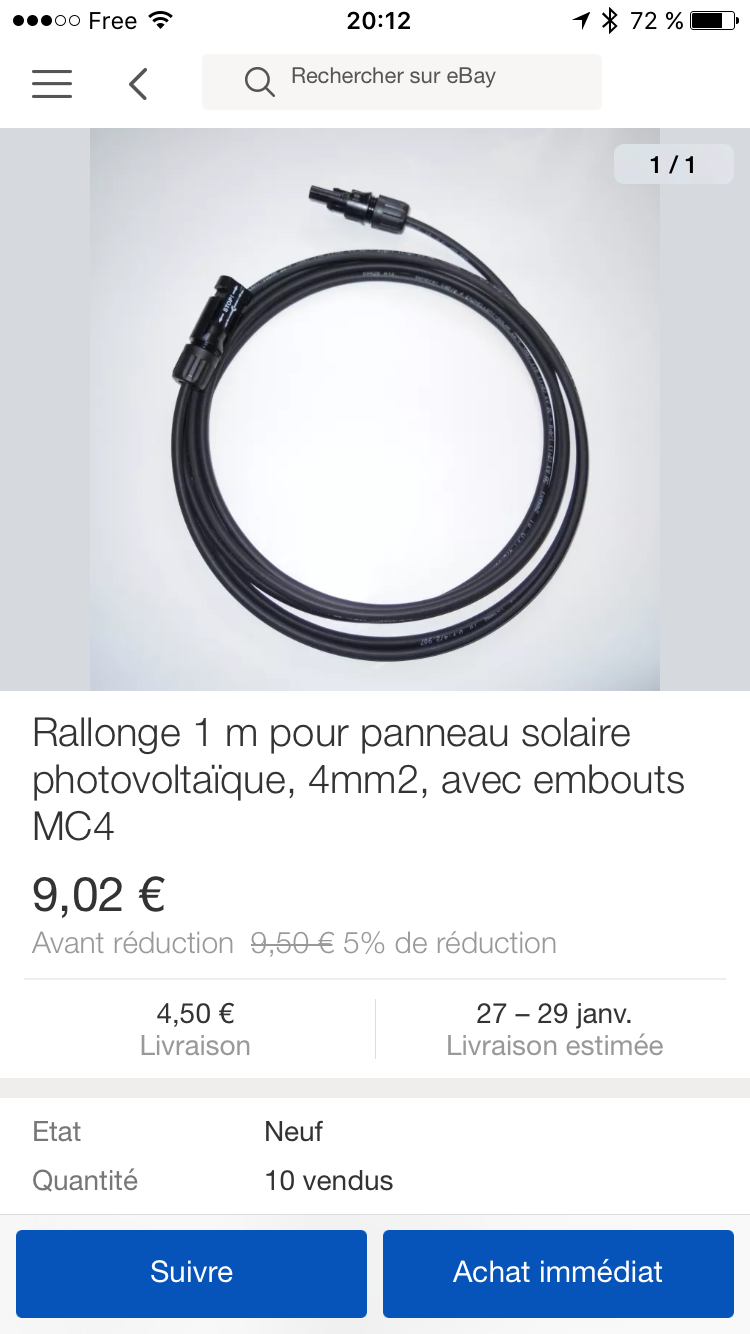
Ordered also a 1m long MC4 extension cable on eBay


I also got some chain and rapid connectors form the local hardware store

Extension cable arrived, just before last week end, now I have everything to install them


So I did that last sunday morning, and it didn't take long, because I already had big screws and chains installed by my windows back in 2010, when I installed my very first solar panels (13W each, but 3 of them), which have been charging AGM batteries, used to charge iPhones, iPad, and power a battery charger for radio, Wii, or other home devices ... This has been working well by the way and they are staying in place
I just had to attach the new connectors to the existing chains (holding 20kg each, way more than enough)


Of course these panels need a micro inverter and I got several used ones for my DIY ESS V2 experiments last year, so I used one of them

I is screwed to a piece of chain using a bolts, washers, and all this is tighten very well


I had to drill a through hole in the lower corner of the window and that was not too difficult ...

The Enphase Engage cable can now go directly inside my apartment

All the cables are fitted so that they don't block the light coming onto the panels

Now, after everything has been connected and installed, there was absolutely no sun, and it has been like during the whole week almost, very frustrating ... :(
I was watching closely on wednesday from work using my DIY ESS Live Cam, and saw clearly that the overall solar generation was more than usual: maybe 60-70W more (we are still in winter and my max generation when the ESS is empty, is 250W or so, maybe 280 now that the sun is a bit higher, still low compared to the 1100W I see in summer)

This morning (saturday), I am home for the week end and as soon as I saw a little sun (half sunny/cloudy, I looked at the wattmeter installed on this specific new line, and it only showed 15W (!! that's not possible, the Enphase M215 can not produce this little power)
BTW the ESS is empty by
So I siwtch off the main solar array DC input on the solar electric panel and there I saw that the 2 SunPower + Enphase M215 were producing 80W :) that's better

DC breakers OFF on Uni-Solar Array on the roof

Enphase M215 is blinking Orange, so it is producing and Orange is normal since there is no Envoy Gateway

This is the reflection light I got when read the generation figure

This small meter gives me wrong figures I guess ...
15W

235V

0.18A

After watching their prices for the last 2.5 years I finally found a good deal and got them right away

The panels arrived few days later, with again a low shipping cost of 20 GBP for both with DHL (very reasonable)

So these panels are made with the famous SunPower high efficiency cells, made in the USA

36 cells : 9 x 4, with standard MC4 solar connectors

and the idea is to install them right behind the wall, outside, between my windows, vertically to catch the reflection coming from the south oriented wall of the building in front of us

Ordered also a 1m long MC4 extension cable on eBay

I also got some chain and rapid connectors form the local hardware store

Extension cable arrived, just before last week end, now I have everything to install them


So I did that last sunday morning, and it didn't take long, because I already had big screws and chains installed by my windows back in 2010, when I installed my very first solar panels (13W each, but 3 of them), which have been charging AGM batteries, used to charge iPhones, iPad, and power a battery charger for radio, Wii, or other home devices ... This has been working well by the way and they are staying in place
I just had to attach the new connectors to the existing chains (holding 20kg each, way more than enough)


Of course these panels need a micro inverter and I got several used ones for my DIY ESS V2 experiments last year, so I used one of them

I is screwed to a piece of chain using a bolts, washers, and all this is tighten very well


I had to drill a through hole in the lower corner of the window and that was not too difficult ...

The Enphase Engage cable can now go directly inside my apartment

All the cables are fitted so that they don't block the light coming onto the panels

Now, after everything has been connected and installed, there was absolutely no sun, and it has been like during the whole week almost, very frustrating ... :(
I was watching closely on wednesday from work using my DIY ESS Live Cam, and saw clearly that the overall solar generation was more than usual: maybe 60-70W more (we are still in winter and my max generation when the ESS is empty, is 250W or so, maybe 280 now that the sun is a bit higher, still low compared to the 1100W I see in summer)

This morning (saturday), I am home for the week end and as soon as I saw a little sun (half sunny/cloudy, I looked at the wattmeter installed on this specific new line, and it only showed 15W (!! that's not possible, the Enphase M215 can not produce this little power)
BTW the ESS is empty by
So I siwtch off the main solar array DC input on the solar electric panel and there I saw that the 2 SunPower + Enphase M215 were producing 80W :) that's better

DC breakers OFF on Uni-Solar Array on the roof

Enphase M215 is blinking Orange, so it is producing and Orange is normal since there is no Envoy Gateway

This is the reflection light I got when read the generation figure

This small meter gives me wrong figures I guess ...
15W

235V

0.18A