Showing posts with label V2H. Show all posts

Tuesday, August 6, 2013

Ten Bucks a Litre - Dick Smith Documentary cherry picks the facts

A recently aired Australian documentary by local eccentric millionaire Dick Smith about alternatives to fossil fuels has stirred quite a hornets nest of feedback, both positive and negative.


While on the whole the Doco was fairly interesting and we here at EV News noted Dick's enthusiasm for electric cars, some facts seem to have been seriously cherry picked.

The EV segment starts @47 mins with Dick enthusing about an EV powered only by renewables and which has Vehicle to Grid Technology (V2G) that can held smooth the intermittency of renewable energy.


The cherry picking starts @50 mins when to close the segment Dick holds up a flask containing 1 litre of fuel stating that it weighs 700 grams and will take an average car approx 10 km. The bad news for EV's, we are told, is that the equivalent battery would weigh 25x as much! End of argument apparently and the story moves onto bio-fuels.

What Dick failed to mention was that the equivalent of that 1 litre of fuel (10 kWh) stored in an EV battery can propel an electric car 10x as far (100 km)... surely a worthy trade-off in energy efficiency Dick?

Of course, battery power may not be a solution for his Helicopter any time soon but Dick was so impressed with EVs he is now the proud owner of a solar powered Nissan Leaf.


Source: Electric Vehicle News

Wednesday, July 4, 2012

Nissan advertising online for LEAF to Home System in Japan

This week end I saw this ad on Yahoo! Japan where my wife usually goes for some news and was surprised to see that Nissan is actually advertising for their new LEAF to Home System
Here are some screen captures: 

LEAF to Home ad


Yahoo! Japan 

Tuesday, July 3, 2012

Osaka's New LEAF - 250 LEAF Available Free in Japan


Some 250 Nissan LEAFs will be available free for public and private use in Osaka - with a population of 8.8 million, supplying power to homes during the day and charging from the grid at night.


Osaka's economic activity is second only to Tokyo and it slowed last year due to changed work schedules and emergency conservation measures taken across Japan in the wake of the March disasters that disrupted national power supply.


With renewed fears of brownouts this summer, the LEAF can also be used as a backup power source, and the Osaka city and prefectural offices are taking 50 units.


"This year's demand for energy in Japan, and particularly in the western region of Kansai, is a very difficult situation," said Seiji Nakamura, general manager at the Osaka prefectural government office.

"The central government has created simulations for national energy demand, and as a result in Kansai we've been told we need to reduce consumption by at least a 15% to cope with the situation. In this, the Osaka prefectural and city governments are asking for citizens' cooperation and working together to achieve this cut target."


Nissan Chief Operating Officer Toshiyuki Shiga met Tuesday with Osaka governmental officials about the "LEAF-to-Home" power plan.

Shiga said that after last year's energy pinch that conservation has become a national issue.

"This year across the country, we are suffering a quite serious power shortage, especially this Kansai area," said COO Shiga.

"So, Nissan has developed the 'LEAF to Home' - we can store electricity in the nighttime, and then from the car, we use it in the daytime, especially during peak demand time."


The involvement of Mayor Toru Hashimoto, the leader of the One Osaka political party, is seen as a potential catalyst for further LEAF utilization.


Osaka is a first step for Nissan, which intends to offer "LEAF-to-Home" in other locations in Japan if further demand emerges.


Published on Jul 3, 2012 by NissanNewsroom

Friday, June 22, 2012

The Cash-Back Car: Monetizing Electric Vehicles (Forbes)

While the market for electric vehicles is heating up, with waiting lists for both the Nissan Leaf and the Chevy Volt and startup companies like Tesla, Arcimoto, and Coda Automotive upping their games, some industry watchers still wonder whether electric vehicles will ever become a significant part of the auto market.

But what if you could earn $1,000 a year with your electric vehicle, netting $440 after your fill-up costs? Would that be enough of an incentive to compensate for higher upfront costs and range anxiety?


For years, EV boosters have mulled the possibility of all those car batteries being used to store energy. In addition to drawing electricity, plugged-in cars would also be able to send electricity stored in their batteries back into the grid as needed, acting like tiny power plants.

The grid needs short-, medium-, and longer-term storage to run smoothly, and car batteries could most easily meet the short-term need, a process called frequency regulation. And as we ramp up our percentage of renewable energy from variable sources like wind and solar, the need for this service is growing. But why would car owners allow their cars to be used in this way? Enter the cash-back car.

The so-called vehicle-to-grid model, or V2G, has been a pet project of Dr. Willett Kempton’s since 1997. In an article published that year by Kempton and colleague Steven Letendre, they laid out the economics, the electric engineering, and how to calculate earnings.

Kempton then contacted his regional transmission organization (RTO), PJM Interconnection, which manages wholesale electricity in 13 states and the District of Columbia, and convinced it to make it possible to pay customers for providing this service.


For the last three years, Kempton has operated a pilot project at the University of Delaware, partnering with PJM and a couple of utilities, in which seven electric cars interact with the grid and receive monthly payments.

The service they provide is actually higher quality frequency regulation than the way grid operators have provided that service traditionally: by ramping extra “peaker” power plants up and down, which wastes electricity. It also takes the plants several minutes to ramp up or down. By contrast, batteries in the cars can deliver that service within seconds, making it a more valuable tool. “We’re providing a more valuable and responsive service,” said Kempton.

Federal Energy Regulatory Commission (FERC) Chairman Jon Wellinghoff agrees and believes that value should be compensated with higher payments than the peaker plants receive. He proposed a rule to that effect in February and expects it to become official within months.

The rule would apply anywhere that RTOs or independent system operators (ISOs) have a tariff for regulation services — nearly the entire country, except for the Southwest Power Pool service area: Kansas, Oklahoma, Nebraska and parts of Missouri, Arkansas, and Louisiana.


Cars batteries are a good match with wind power because they mostly charge at night, when people are sleeping, and wind tends to peak at night. Right now, because demand plunges at night, wind generated at night is lower value or sometimes even dumped. Of course, if a lot of cars came online and charged during the day, generators would need to produce more daytime energy. That’s why it’s important to line up “the proper incentives to encourage the car owner to charge at night when the price is best,” said Ray Dotter, a spokesman for PJM.

However, you can’t put your Leaf or Volt to work for you just yet.
To be able to offer frequency regulation service to the grid, cars need a bidirectional power system, so energy can flow both from the grid and to the grid, and software to allow the car to communicate with the grid. Most cars on the market today don’t have those features, although cars from Tesla and AC Propulsion have bidirectional power. “Daimler has announced the Smart fortwo will have this capability in 2012,” said Willett. These cars can also charge faster, at about a mile a minute, he said.

Willet expects that market signals, such as the FERC’s rule change and related RTO and ISO changes, will encourage automakers to make these features the norm in future models.

“If we get the rule out in six months and wholesale providers reset their payments to pay higher amounts for these kinds of services, that will drive car manufacturers to quickly integrate this technology into their cars to allow consumers to participate in these markets,” said Chairman Wellinghoff. “I think it could have an impact in as little as three years.”
Drivers decide when they will need the car and when it will be free for grid use. However, it does require a bit of planning. If you stray from your regular schedule, “You tell the car ahead of time,” said Kempton. “That’s why you get paid money. It’s a slight hassle for the driver. Although ‘telling’ likely means reserving it on your iPhone or on a browser at your home office.”

Another wrinkle: RTOs and ISOs aren’t equipped to manage power from individual cars. The energy generators and frequency regulators they work with must be of a certain size. So for cars to play, they have to aggregate.

PJM requires 500 kilowatts to be registered as a generator, although it may revise that down to 100 kilowatts by the end of the year. Still, that means vehicles have to be grouped together to be able to earn payment.

“One hundred kilowatts would require about 15 cars, some offline and some driving,” said Kempton. “The University of Delaware’s current fleet of seven cars is aggregated with a giant battery to meet the current 500 kilowatt requirement.

For this reason, fleets will likely be the first adopters.

The Department of Defense is intrigued and is studying the matter intently. Last week it put out an RFI to EV manufacturers, EV battery manufacturers, financing firms, and energy management companies for strategies to integrate EVs into DOD’s nontactical ground fleet on a large scale. The goal is to achieve cost parity between EVs and internal combustion vehicles, and one strategy for doing that is frequency regulation.

“Worldwide, the DOD has about 200,000 vehicles in its fleet so there’s a whole lot of opportunity there for us to look at creative ways to advance emerging technologies,” said Camron Gorguinpour, a special assistant to the United States Air Force for Installations, Environment & Logistics.

EVs are attractive to DOD for a range of reasons, including reduction of greenhouse gas emissions, enhanced energy security, and the ability to retain power during a crisis by pairing EVs with microgrids, said Gorguinpour. “And from an asset management point of view, it makes a lot of sense. We’d be putting money into something that sits 99 percent of the time. It would be great to have some value out of that.”

Gorguinpour expects it will take “months, not years” for the DOD to identify the best course of action. It is looking to deploy grid-integrated vehicles by summer 2012.

“DOD is taking this very seriously,” he said.

While still “purely on an exploratory level,” Blue Bird Corporation, a school bus manufacturer in Fort Valley, Georgia, is looking at building this technology into its buses,” said John Kwapis, its chief operating officer.

It seems like a natural fit. “When energy demand is at its peak during the summer months, school buses are at the school yard or bus depot,” he said. “And the amount of battery power needed for a school bus offers the grid a lot of capacity. It takes fewer school buses than cars to get to megawatt,“ he said.

But individual car owners may not be left out of the game for long. The University of Delaware is selling licenses to its proprietary aggregator technology to companies to interface between individuals and RTOs or ISOs.

“We have licensed the technology to one company and have an offer out to a second,” said Kempton. “Nuvve, with offices in San Diego and Copenhagen, has the right to act as an aggregator in all countries except the United States. They’re already making deals.”

Gregory Poilasne, Nuvve’s CEO, said Nuvve could pay one-quarter of an individual’s car loan up front in exchange for the owner plugging in the car at least 14 hours a day for eight years, “which means about 2 hours of charge and 12 hours for the market.”

In the next six months, Nuvve plans to roll out the program in Denmark, Hong Kong, and Taiwan because of their positive regulatory climates. Soon after it plans to move into Germany the Netherlands, Spain and the United Kingdom, said Poilasne, “… places where wind energy is taking a more important role because more wind energy means a high need for regulation.”

It’s a big — and rapidly growing — market. “The regulation market today worldwide is $6 billion, with $1.5 billion in the United States,” said Poilasne. “By 2020, it’s projected to be $12 billion worldwide, with $9.5 billion outside of the United States.”

Stateside, two companies are vying for the license to provide aggregation service to the U.S. market, said Kempton. “They are both very large companies in the power sector. They’d be prepared to move very quickly.” Kempton said the company that wins the U.S. license will be announced next week.

Source: Forbes

Wednesday, May 30, 2012

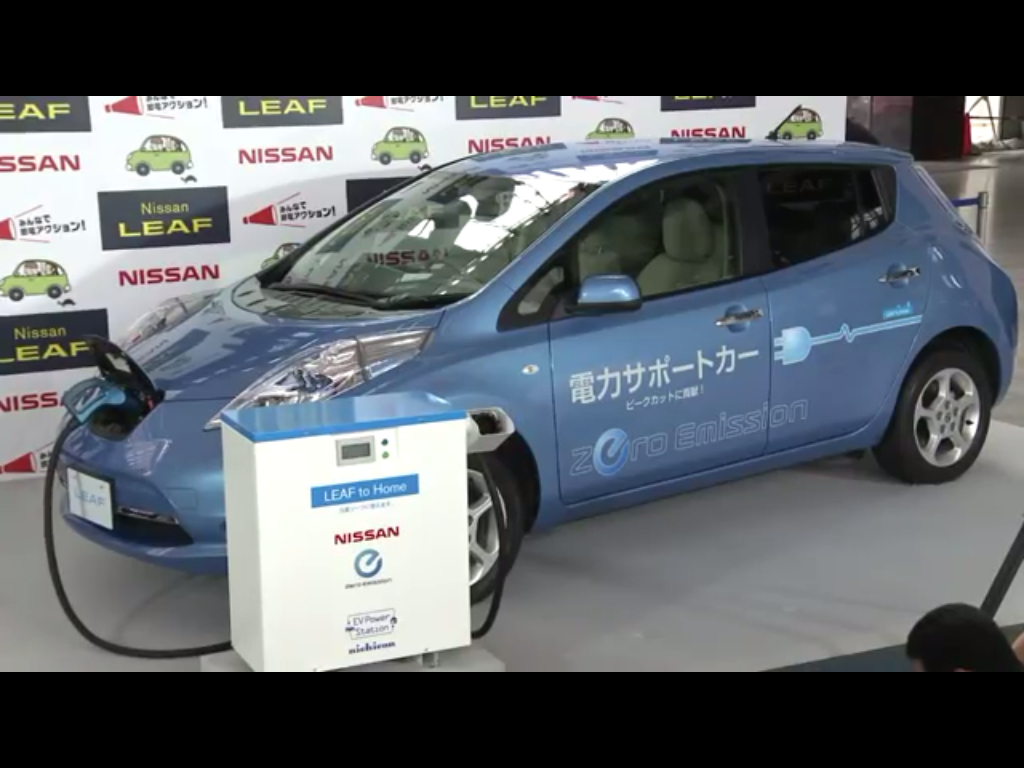
Nissan Launched "LEAF to Home" V2H EV Power Supply System


- Nissan to launch LEAF to Home power system at its dealerships in Japan in mid-June

- Nissan and Nichicon collaborate to achieve the world's first power supply system that provides electricity from the Nissan LEAF's high-capacity batteries to houses

Nissan announced "LEAF to Home" power supply system, which can supply electricity from batteries onboard in Nissan LEAF electric vehicles (EV) to homes when used with the "EV Power Station" unit developed by Nichicon Corporation. "LEAF to Home" is an industry first backup power supply system that can transmit the electricity stored in the large-capacity batteries of Nissan LEAFs to a residential home. Nissan will showcase this system at its Japanese dealership showrooms beginning in June to help promote efficient electricity management and demonstrate the features built into electric vehicles.


This equipement is using the CHAdeMO protocol / standard


Nissan Motor Co., Ltd. will launch the "LEAF to Home" power supply system at its dealerships in Japan in mid-June 2012. The V2H system (Vehicle to Home) can supply electricity from batteries onboard in Nissan LEAF electric vehicles (EV) to homes when used with the "EV Power Station" unit developed by Nichicon Corporation.


"LEAF to Home" is an industry-first backup power supply system that can transmit the electricity stored in the large-capacity batteries of Nissan LEAFs to a residential home. Nissan will showcase this system at its Japanese dealership showrooms beginning in June to help promote efficient electricity management and demonstrate the features built into electric vehicles.

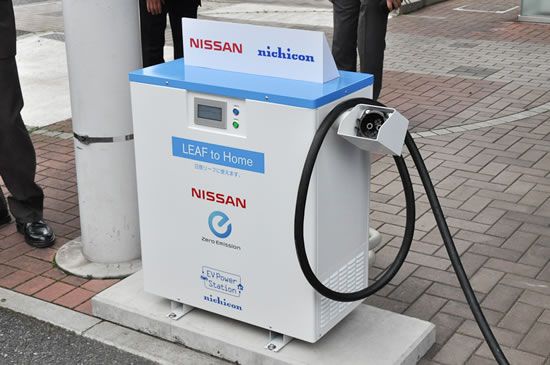
Nichicon, an innovator in power supply systems, will provide the technology to move the electricity from vehicle to home through its "EV Power Station" units. This power transfer system enables electricity stored in high-capacity lithium-ion batteries onboard a Nissan LEAF to be sent to an ordinary home by connecting the car to the home's electricity distribution panel with a connector linked to the LEAF's quick charging port.

The EV Power Station system is similar in size to an external air-conditioning unit, can be installed outdoors, and conforms to the CHAdeMO protocol for EV quick chargers. CHAdeMO is an abbreviation of "Charge de Move" ("charge for moving") and is the trade name for a quick-charging method used to charge the batteries of electric vehicles. The Nichicon system's connector complies with the JEVS G 105 standard defined by the Japan Automotive Research Institute (JARI). This system can run on various operating modes and has a timer function which can be controlled with a liquid crystal display (LCD) touch panel. Electricity is stored or supplied automatically in accordance with a household's electricity capacity and consumption.

The EV Power Station can fully charge a LEAF in as little as four hours, which is approximately half the time required when a normal charger is used. All current Nissan LEAF owners in Japan will be able to use the system, depending on their home's installation requirements. With Japanese government subsidies taken into account, the EV Power Station is estimated to cost 330,000 yen ($4200), which amount includes 10% consumption tax and installation charge.


Detailed specifications of the system:


Official video:


This system helps to balance the electrical supply system, and can even lower a consumer's electricity bill. The LEAF to Home system will help encourage Nissan LEAF owners to charge their cars with electricity generated during the night, when demand is low, or sourced from solar panels. This assist in balancing energy needs by supplying electricity to the grid during daytime, when demand is highest. It can also be used as back-up power source in case of power outages and/or shortages.

The lithium-ion batteries can store up to 24kWh of electricity, which is sufficient to supply an average Japanese household for about two days. This system underscores an additional attribute of EVs: vehicles which can be used as a storage battery whether they are moving or stationary.

Source: http://www.nissan-global.com/EN/NEWS/2012/_STORY/120530-01-e.html?rss

The LEAF 24kWh battery pack could, through the LEAF to Home PCS / EV Power Station, supply all the necessary power used by a  regular house, that is 6 kW.
This supply could come on to fill the power gap between the house solar system and the power usage, or in the evening and at tnight when the sun doesn't shine anymore 


Using the Peak Offset Function, an average home in Japan could save money and releave the grid during power consumption peak at noon, by using the LEAF as a power supply during this period, charging at night at low power demand and low cost :

More info here: http://car.watch.impress.co.jp/docs/news/20120530_536403.html

Nissan did a first demo of this system back in August 2011:
http://www.nissan-global.com/EN/NEWS/2011/_STORY/110802-01-e.html

Here is a video of this event:


[System Overview]

Power Control System (PCS)
- Rating: 6kW
- Control system: Sinusoidal PWM System
- System power: 200V single-phase three-wire system
Operation display panel
- Display for switching electricity charge between supply
- Battery power, output voltage and output current display
Nissan LEAF connection specification
- Quick charge connector (CHAdeMo specification)
Nissan LEAF
- Corresponds to the electricity supply program


Please Share this Post if you Liked it !

Please Share this Post if you Liked it ! Thanks !
Related Posts Plugin for WordPress, Blogger...